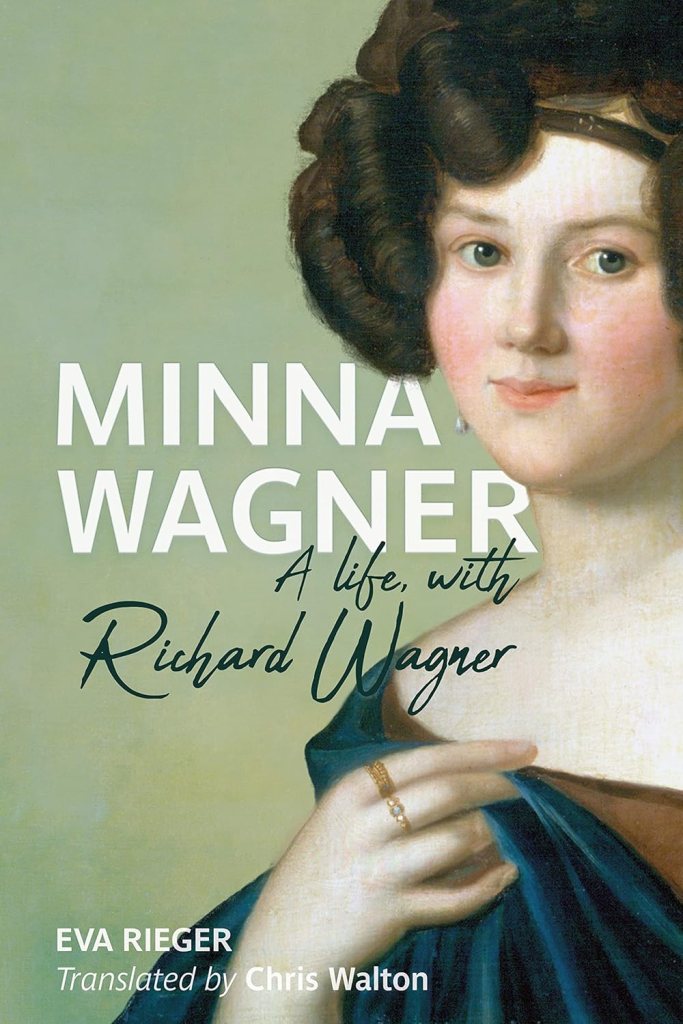
Minna Wagner: A Life, with Richard Wagner by Professor Dr. Eva Rieger, translated by Chris Walton, is a monumental biography that reconfigures our understanding of Richard Wagner’s first wife, Minna Planer. Far from being the peripheral figure often portrayed in traditional Wagnerian scholarship, Minna was a pivotal influence in Wagner’s creative and personal life. This work presents the complexities of their relationship, offering a portrayal of a woman who was not only a steadfast partner but also an accomplished artist in her own right.
Minna Planer, born into a modest family in Oederan, Saxony, navigated the socioeconomic challenges of early 19th-century Germany to become a celebrated actress. Her early life was marked by hardship, including the financial ruin of her family and a traumatic relationship with a Saxon nobleman that resulted in the birth of her daughter Natalie. These experiences forged in Minna a resilience and practicality that would later prove indispensable in her tumultuous marriage to Wagner.
When Minna met the young Richard Wagner in 1834, she was an established actress, and he was an ambitious but obscure conductor. Their courtship was intense and fraught with obstacles, culminating in their marriage in 1836. Rieger paints a vivid picture of their early years together, highlighting how Minna’s earnings and professional stability provided a foundation for Wagner’s burgeoning career. She was not merely a supportive spouse but a critical sounding board for his early compositions, including Tannhäuser and Lohengrin. Wagner often sought her opinions, and she offered practical insights into stagecraft, drawing from her own theatrical experience.
The biography challenges the long-held perception that Minna lacked understanding or appreciation for Wagner’s work. Instead, Rieger presents evidence of Minna’s genuine enthusiasm for his music. She attended performances of his operas with visible emotion, demonstrating a deep connection to his art. However, as Wagner’s musical ambitions grew more avant-garde, especially with works like Tristan und Isolde, tensions emerged. Minna struggled with the personal and ethical implications of his evolving themes, particularly when they mirrored the strains in their own relationship.
Central to the narrative is the exploration of Minna’s role during Wagner’s years of exile following his involvement in the 1849 Dresden uprising. Minna’s pragmatic concerns about financial stability and social respectability clashed with Wagner’s revolutionary zeal and disregard for bourgeois norms. Yet, despite her apprehensions, she joined him in exile, enduring hardships that tested the limits of her endurance. Rieger emphasizes that Minna’s sacrifices during this period were not merely acts of spousal duty but manifestations of her deep commitment to their shared life, even as Wagner’s actions increasingly marginalized her.
The crux of their marital discord is poignantly examined through the lens of Wagner’s infatuation with Mathilde Wesendonck. This relationship not only precipitated their eventual separation but also symbolized the widening chasm between Minna’s desire for a stable, conventional marriage and Wagner’s pursuit of artistic and personal liberation. Rieger does not shy away from critiquing Wagner’s self-centeredness and his tendency to recast personal failings as artistic necessities. She illustrates how Minna’s emotional turmoil was exacerbated by Wagner’s manipulation of their personal lives into his operatic narratives, blurring the lines between reality and art.
Rieger’s scholarship draws from a wealth of primary sources, including personal letters and contemporary accounts. She offers a balanced perspective, acknowledging Minna’s limitations while also highlighting her strengths. Minna is depicted as a woman of great decency and common sense, qualities that were both her greatest assets and, paradoxically, sources of friction in her marriage to Wagner. Her practical nature and commitment to bourgeois values often put her at odds with Wagner’s unconventional lifestyle and financial irresponsibility.
The biography also sheds light on Minna’s own artistic identity, which has been overshadowed by her husband’s towering legacy. Rieger reconstructs Minna’s career as an actress, emphasizing her talent and popularity prior to her marriage. She examines the sacrifices Minna made in abandoning her profession at Wagner’s behest, a decision that had significant repercussions on her sense of self and autonomy. The narrative underscores the gender dynamics of the time, illustrating how societal expectations constrained Minna’s opportunities for personal fulfillment outside of her roles as wife and caretaker.
Throughout the book, Rieger addresses the distortions and biases that have colored previous portrayals of Minna. She critically examines how Wagner’s own writings, particularly his autobiography My Life, contributed to a skewed image of Minna as unsophisticated and obstructive. Rieger juxtaposes Wagner’s subjective accounts with Minna’s perspective, offering a more equitable assessment of their relationship. This approach not only rehabilitates Minna’s reputation but also provides a more comprehensive understanding of Wagner’s personal and artistic development.
The later chapters poignantly recount the final years of their marriage, marked by separation and failed attempts at reconciliation. Despite the irreparable damage to their relationship, they remained legally married until Minna’s death in 1866. Rieger interprets this enduring connection as indicative of a complex bond that defied simple categorization. Minna’s death elicited a profound, albeit complicated, response from Wagner, reflecting the deep, if troubled, ties that bound them.
Minna Wagner: A Life, with Richard Wagner is not merely a biography but also a philosophical exploration of the interplay between personal relationships and artistic creation. Rieger goes into the psychological and emotional dimensions of Minna and Richard’s marriage, considering how their individual aspirations and insecurities influenced their interactions. She explores themes of dependency, sacrifice, and the pursuit of self-realization within the constraints of societal norms.
The book also engages with broader historical and cultural contexts, situating Minna’s experiences within the shifting landscapes of 19th-century Europe. Rieger examines the impact of political upheavals, economic hardships, and evolving gender roles on Minna’s life. This contextualization enriches the narrative, highlighting how personal histories are inextricably linked to larger societal forces.
Chris Walton’s translation deserves special mention for its clarity and elegance. He skillfully conveys the nuances of Rieger’s prose, making the biography accessible to an English-speaking audience without sacrificing the depth of the original text. The inclusion of detailed footnotes and pertinent photographs enhances the reader’s engagement, providing valuable supplementary information that complements the main narrative.
Minna Wagner: A Life, with Richard Wagner is a groundbreaking work that reasserts Minna’s rightful place in the historical and artistic discourse surrounding Richard Wagner. Professor Dr. Eva Rieger’s exhaustive research and insightful analysis offer a compelling reappraisal of a woman whose contributions have been undervalued and misunderstood. This biography is essential reading for anyone interested in Wagnerian studies, feminist scholarship, or the dynamics of marital relationships in the context of artistic genius. It not only rehabilitates Minna’s legacy but also invites readers to reconsider the often romanticized narratives of great men, acknowledging the complex realities of those who stood beside them.
 Simon Gros
Leave a comment