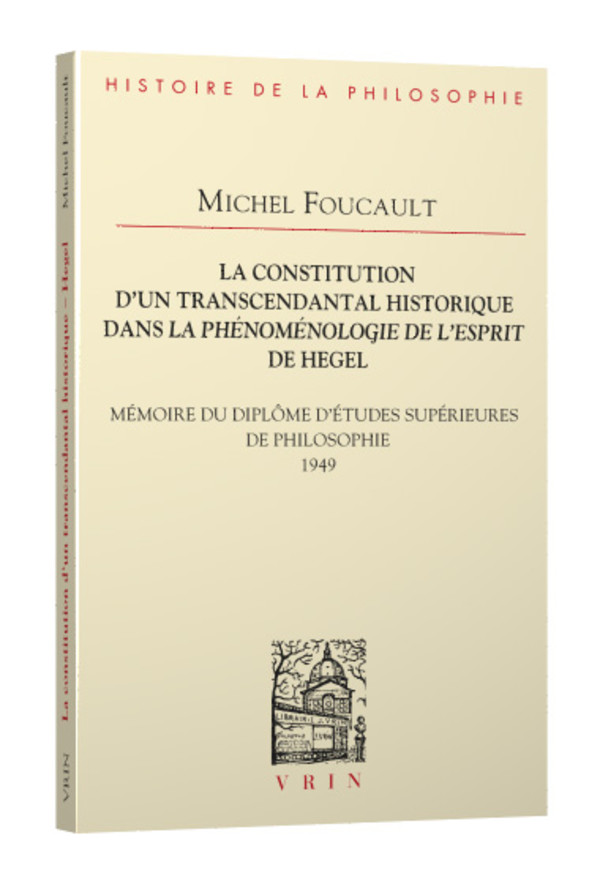
The Constitution of a Historical Transcendental in Hegel’s Phenomenology of Spirit by Michel Foucault is the analysis of Hegelian philosophy through the lens of a young philosopher deeply immersed in the intellectual currents of his time. Defended on June 11, 1949, as his master’s thesis in philosophy at the Sorbonne under the supervision of Jean Hyppolite, Foucault’s work delves into the relationship between time, history, and the transcendental in Hegel’s Phenomenology of Spirit. In this ambitious endeavor, Foucault positions Hegel in contrast to Kant, re-examining the fundamental epistemological question, “What can I know?” and proposing a philosophical program wherein “all philosophy will be the science of history and the reverse side of history.”
The context of Foucault’s thesis is critical to understanding its depth and ambition. At the time, the Diplôme d’études supérieures (DES), which was eventually replaced by the maîtrise in 1966, was a requisite qualification beyond the licence for candidates aspiring to the agrégation. For Foucault, this thesis represented an intermediate milestone in his academic journey at the École Normale Supérieure on rue d’Ulm, bridging his licence in philosophy obtained from the Sorbonne in 1948 and his preparation for the agrégation in philosophy, which he successfully passed in 1951. Concurrently, Foucault also earned his diploma in general psychology from the University of Paris on July 4, 1949, reflecting his interdisciplinary interests and the breadth of his scholarly pursuits.
The choice to focus his thesis on Hegel was influenced by several factors, both personal and intellectual. Hegel was, in many respects, the philosopher “in the air” during that period. Foucault later remarked that the era was dominated by Hegel and phenomenology: “In essence, it was Hegel who prevailed.” For France, Hegel represented a relatively recent discovery, invigorated by the works of thinkers like Jean Wahl and the lectures of Jean Hyppolite. This resurgence of Hegelian thought was deeply infused with phenomenology and existentialism, particularly centered on the theme of the “unhappy consciousness.” It provided what the French university considered the most expansive form of understanding of the contemporary world, one that had just emerged from the tragedies of the Second World War and the seismic shifts that preceded it, such as the Russian Revolution and the rise of Nazism.
At this juncture, the young Foucault was an assiduous reader of Hegel and Marx, laying the groundwork for his later engagements with Husserl, Heidegger, and Nietzsche in the early 1950s. In the chronological progression of his readings, Hegel stood as the first of the “three H’s,” marking a foundational influence on his philosophical development. The prominence of Hegel during this time is further underscored by Louis Althusser’s 1947 review of Alexandre Kojève’s work, in which Althusser declared Hegel to be “the mother-truth of contemporary thought,” describing him as a “decomposed thinker, broken into pieces, trampled, betrayed,” yet one who still inhabited the intellectual landscape.
Foucault’s thesis embarks on a critical examination of Kant’s transcendental philosophy, particularly scrutinizing the concept of time within the Kantian framework. He argues that in Kant’s system, time is effectively “chased out of the transcendental.” By this, Foucault means that the notion of succession, which is associated with the synthetic activity of the subject, is ultimately reduced to a purely formal, causal relationship between different moments of experience. This reduction ensures the necessity and universality of time but at the expense of its inherent flow and dynamism. Consequently, this de-temporalized concept of time precludes any meaningful connection with history, which, in Kant’s philosophy, is relegated to other parts of the system and is treated as a regulative idea rather than a constitutive element of experience.
Foucault contrasts this Kantian subject devoid of history with the Herderian conception of history without a subject. In Johann Gottfried Herder’s thought, Foucault identifies an initial sketch of the theme of historical discontinuity, a theme he would later revisit in his studies of Nietzsche. Herder’s idea of “Fortgang” expresses “the concrete notion of a continuously discontinuous passage from one epoch to another,” deliberately avoiding the establishment of any hierarchy among different historical moments. However, Foucault notes that in Herder’s conception, history remains severed from both time and subjectivity. This is because potential candidates for the unifying function in history—such as God, the human species, or the historian—are incapable of fulfilling this role within Herder’s framework.
Turning to Hegel, Foucault centers his analysis on the concept of time as mobilized in the Phenomenology of Spirit. He acknowledges the complexity of this endeavor, given that references to time in Hegel’s work are sparse and often obscure, yet they are of decisive importance. Foucault focuses particularly on the passage from the chapter on “Absolute Knowledge,” where Hegel asserts: “Time is the concept itself that is there and presents itself to consciousness as empty intuition. Therefore, spirit necessarily appears in time, and it appears in time as long as it does not grasp its pure concept, that is, as long as it does not eliminate [tilgt] time. Time is the pure self external to itself, intuited, but not grasped by the self; it is the concept that is only intuited. When this concept grasps itself, it supersedes [hebt auf] its form of time, conceives the intuition, and is intuition conceived and conceiving.“
Foucault delves into the intricacies of this passage, emphasizing that for Hegel, the “concept” is not merely a concept like any other but a specific form of thought characterized by its dialectical identity with its object. While Hegel adopts Kantian vocabulary, particularly regarding time as a form of intuition, he does so in a fundamentally different sense. In Hegel’s philosophy, the thesis that time is the intuition of the concept signifies that as long as consciousness has not grasped its unity with the object beyond their difference—as long as it has not attained absolute knowledge where the concept grasps itself as concept—it is only aware of itself in the successive form of time. Here, intuition represents a mode of thought marked by immediacy, succession, and the unstable opposition between subject and object. As Foucault elucidates, intuition is the “immediate knowledge of the concept” as opposed to absolute knowledge, which is the “conceptual knowledge of the concept.”
Time, therefore, is the form that consciousness assumes in the succession of its figures preceding its access to absolute knowledge—a movement whose final term is not yet known to consciousness. Foucault articulates this by stating: “The movement of the concept of which one is only conscious as an irreversible and empty succession is nothing other than time; or, to give a definition that is the exact reciprocal of this, time is the consciousness that the concept has of itself before it attains absolute knowledge.” This leads to a pivotal question: what transpires once consciousness has achieved the concept, or absolute knowledge?
The Hegelian text presents an ambiguity in this regard, employing both the verb “tilgen,” meaning “to eliminate” or “to erase,” and “aufheben,” meaning “to suppress and to preserve.” This duality gives rise to two possible interpretations: either absolute knowledge abolishes time, marking a transition to the timeless realms of the Science of Logic, or it transforms time into “conceived history,” which concludes the Phenomenology and resides at the heart of the third part of the system, the philosophy of spirit. Foucault adopts the latter reading, aligning with interpretations by Kojève and especially Koyré, asserting that the Hegelian conception of time as the immediate intuition of the concept establishes a connection between intuitive time and the conceptual thought to which the Phenomenology seeks to lead consciousness. This linkage dismantles the longstanding dichotomy inherited from antiquity between eternal knowledge and the temporal world, thereby integrating the forms of thought and knowledge within the historical process.
However, Foucault probes whether this connection is sufficient to underpin a philosophy of history. He argues that Hegel demonstrates that the historical material is precisely the content that fills the empty intuition of time. This historical material is the successive chain of experiences of consciousness, which, as will be explored further, partially overlaps with world history. The time of the Phenomenology—the succession of consciousness’s figures—is inherently historical, just as the history described within it is intrinsically temporal.
In his analysis Foucault distinguishes between two parts within Hegel’s work: the first five chapters, which are descriptions of figures of consciousness without direct relation to history, and the last three chapters, which introduce the concept of spirit as a concrete totality self-conscious and situated in world history. He observes that while the initial sections lack a direct historical dimension, they gain retrospective historical significance once consciousness reaches absolute knowledge. These earlier figures become necessary moments in the progression toward science, and in this way, they are historical “after the fact,” as they reveal themselves to be conditions of possibility for the history of spirit.
Foucault further explores the role of the philosopher—or the “we”—in the Phenomenology. He posits that there is a doubling within the experience described by Hegel: on one hand, each figure of consciousness exists “for itself,” appearing as it does to itself; on the other hand, it has a truth “in itself” that differs from the knowledge it believes it possesses—a truth pointed out by the philosopher in the mode of “for us.” This philosopher is not merely a disinterested spectator but serves as a discreet guide, mediating between the in-itself truth of consciousness and its next for-itself truth, its certainty. In this role, the philosopher embodies the transcendental activity that constitutes experience.
This leads Foucault to address a potential critique: does equating the transcendental subjectivity with the solitary subjectivity of the philosopher risk collapsing transcendental philosophy into a form of subjectivism? He acknowledges that this question is somewhat rhetorical and proceeds to engage with Marx’s critique of Hegel. In the Economic and Philosophic Manuscripts of 1844, Marx accuses Hegelian philosophy of being ensnared in an idealism incapable of grasping nature and the world in their concrete objectivity. According to Marx, in Hegel’s philosophy, objectivity is conceived only from the standpoint of the subject’s knowledge; what is objective is merely what is known by consciousness. The labor discussed by Hegel is “abstract spiritual labor,” not the concrete labor of workers at their machines. Moreover, the alienation of spirit into nature is, for Marx, a false alienation, a mere illusion, because in reality, spirit never truly departs from itself.
Foucault scrutinizes this critique, recognizing that certain Hegelian texts could be construed to support Marx’s allegations. In passages where Hegel speaks of spirit alienating itself into nature, comparing this movement to a “sacrifice,” it might appear that nature lacks real independence from spirit. However, Foucault points out that at the end of the Science of Logic, Hegel affirms that the idea is the unity of the subjective and the objective. In these texts, objectivity receives its full due. The logical Idea does not “fall” into nature; rather, it “resolves” to become nature according to a logic that Foucault identifies precisely in Hegelian thought: the logic of freedom.
For Foucault there is no need to oppose Marx’s naturalism to Hegel’s idealism, for in this type of text, Hegel “insists on the very real objectivity of this realization of Spirit [in nature].” Far from being a suppression of the objective, it is an apotheosis of it. The absolute knowledge in Hegel’s philosophy does not entail any form of subjectivism; instead, it is defined by the unity of the subjective and the objective. Objectivity of nature (and of history) is affirmed not only at the end of the Phenomenology but also throughout the last two parts of the Encyclopedia, namely, the philosophy of nature and the philosophy of spirit.
In examining these complex arguments, Foucault’s thesis presents the Phenomenology of Spirit as a historicization of the transcendental—a move that reconfigures the transcendental subject not as an ahistorical entity but as one deeply embedded within the temporal and historical process. This reorientation allows Foucault to rethink the foundational epistemological question “What can I know?” by situating knowledge within the unfolding of history itself. The “absolute knowledge” that concludes the Phenomenology is not a static endpoint but a dynamic culmination of the historical dialectic, wherein the concept fully grasps itself and, in doing so, transcends the form of time without negating it.
Foucault’s early engagement with Hegel in this thesis foreshadows many of the themes that would become central in his later work, such as the relationship between knowledge and power, the role of historical discontinuities, and the critique of transcendental subjectivity. By setting Hegel against Kant and engaging with the critiques of Marx, Foucault positions himself within a lineage of thinkers grappling with the implications of history for philosophy. His analysis of the Phenomenology not only demonstrates his mastery of Hegelian thought but also lays the groundwork for his own philosophical trajectory, which would continue to challenge and redefine the boundaries of historical and philosophical inquiry.
Michel Foucault’s The Constitution of a Historical Transcendental in Hegel’s Phenomenology of Spirit is a dense and detailed examination of the ways in which Hegel’s philosophy integrates time and history into the very the transcendental. It presents the intellectual rigor and depth of a young philosopher who, even at the outset of his career, was unafraid to tackle the most challenging and foundational questions of philosophy. Through this work, Foucault not only contributes to the scholarly understanding of Hegel but also initiates a philosophical program that would resonate throughout his subsequent writings: the pursuit of a philosophy that is both a science of history and its reflective counterpart.
 Simon Gros
Leave a comment