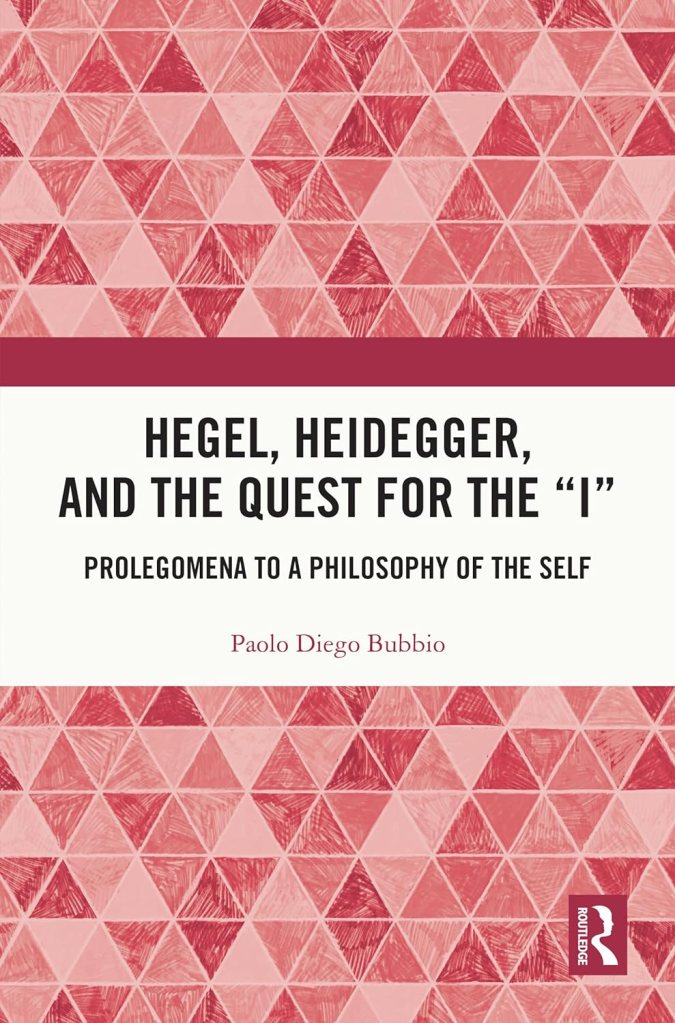
Hegel, Heidegger, and the Quest for the “I”: Prolegomena to a Philosophy of the Self by Paolo Diego Bubbio is a rigorous examination of the elusive nature of the “I” within the philosophical frameworks of G.W.F. Hegel and Martin Heidegger. Bubbio explores the ways both philosophers grapple with the concept of selfhood, moving beyond the traditional subject/object dichotomy that has long dominated Western thought. The book journeys through the philosophical landscapes of Hegel and Heidegger, uncovering the pathways each thinker takes in approaching the question of what it means to be an “I.”
At the heart of Bubbio’s study is the assertion that while the “I” appears fleeting and almost elusive in both Hegel’s and Heidegger’s philosophies, it nonetheless occupies a central position in their respective ontological and metaphysical inquiries. Hegel’s idealism is presented as a philosophical expression of self-conception as an “I,” attempting to articulate the implicit practical knowledge underlying the use of the first-person pronoun. Hegel’s critique of Kant and Fichte serves as a backdrop for his own conception of the “I,” which seeks to transcend the limitations of subjectivism and the subject/object dichotomy inherent in modern philosophy. Bubbio elucidates how Hegel’s notion of the “I” is deeply entwined with intersubjective acts of mutual recognition, emphasizing that the self-conscious “I” arises from a process of recognition that is both historical and social.
In contrast, Heidegger’s existential phenomenology offers a reconfiguration of the relation between the “I” and the world, aiming to overcome metaphysics altogether rather than reconceptualize it as Hegel does. Bubbio navigates through various interpretative approaches to Heidegger’s thought, particularly focusing on the hermeneutic and transcendental readings that highlight the disclosedness of being and the externalist conception of the self. Heidegger’s notion of mineness (Jemeinigkeit) and the process of authentic self-realization are examined as key components in understanding his approach to “I-hood.” Bubbio argues that Heidegger, like Hegel, strives to move beyond the polarizing subject/object opposition by emphasizing the relational and interpretative nature of being and selfhood.
Throughout the book, Bubbio maintains a delicate balance between the distinct philosophical vocabularies of Hegel and Heidegger while facilitating a productive dialogue between them. He acknowledges the inherent challenges in superimposing one philosopher’s terminology onto the other’s thought but succeeds in highlighting the complementary aspects of their approaches to the “I.” By examining the phenomenological and logical development of the “I” in Hegel’s work—from consciousness to self-consciousness through recognition with the other—Bubbio demonstrates how Hegel envisions the “I” not as an immediate given but as a dynamic process actualized through intersubjective relations.
Similarly, in his analysis of Heidegger, Bubbio analyses the experiential dimension of beingness, emphasizing the role of genuine experience and the concept of subjectness (Subjektität) in unfolding the subjective nature of the self. He explores how Heidegger’s ontology extends beyond mere description to unveil the process that shapes our understanding of ourselves and the world. The notion of breakdown (Zusammenbruch) is discussed as a pivotal moment in experience that reveals the structures of care and concern inherent in Dasein’s being.
Bubbio’s work is not merely comparative but constructive; he employs the insights gleaned from Hegel and Heidegger to chart a path toward a novel understanding of “I-hood.” He proposes that both philosophers, despite their divergent methodologies and objectives, offer resources for developing an account of the self that bypasses the traditional dichotomy between subjectivity and objectivity. By emphasizing the relational and intersubjective dimensions of the “I,” Bubbio advances a model of selfhood that is neither purely subjective nor objectivist but is instead mediated through recognition, experience, and myth.
The book also addresses the practical implications of this reconfigured understanding of the “I” in contemporary contexts. Bubbio argues that traditional models of agency rooted in individualism and philosophical subjectivism are ill-equipped to address challenges such as globalization, multiculturalism, and environmental change. He contends that a richer, more flexible model of the “I,” one that acknowledges the collective formation of the self and the intersubjective nature of identity, is essential for navigating the complexities of modern life.
In examining Hegel’s and Heidegger’s treatments of nature and history, Bubbio reveals how both philosophers conceive of the “I” as emerging from a dynamic interplay between these realms. For Hegel, nature and history represent the dimensions in which the “I” operates and through which it is produced. The “I” emerges as a result of the equilibrium between necessity and freedom, a process involving the collective agency of humans within the realm of absolute Geist. Heidegger, on the other hand, grapples with the challenge of avoiding the dichotomy between nature and history by reconfiguring their relation. His later works introduce the process of “dislodging shifting” (verrückende Einrückung) as a means of shaping the normativity of a genuine self.
Bubbio’s exploration extends to the role of experience and myth as fundamental modes through which the “I” is lived and expressed. Both Hegel and Heidegger regard myth as a narrative that encompasses the nexus of nature and history, serving as a collective articulation of the experience of selfhood. By analyzing their conceptions of myth, Bubbio underscores the significance of narrative and storytelling in the formation of identity and the expression of the self’s journey from nature into history.
The book culminates in proposing a model of “I-hood” that synthesizes the non-subjectivist approaches of Hegel and Heidegger. Bubbio suggests that the “I” should be conceived not as an entity but as a perspective emerging from intersubjective relations and the dynamic interplay with the world. This model challenges traditional accounts of personal identity and offers a framework better suited to address contemporary challenges. By moving beyond the limitations of subjectivist conceptions, Bubbio’s work contributes to ongoing dialogues in the philosophy of self, providing valuable insights into the nature of identity and its place in the world.
Hegel, Heidegger, and the Quest for the “I” is an important addition to the literature on both philosophers, offering a stimulating and insightful exploration of a topic that has received relatively little direct philosophical attention. Bubbio’s careful scholarship, clarity of style, and rigorous philosophical imagination make this work a significant and original contribution to contemporary thought. By engaging deeply with the philosophies of Hegel and Heidegger, he not only enhances our understanding of their ideas but also demonstrates how their insights can inform and enrich current debates about the self, identity, and subjectivity.
The book has garnered praise from esteemed scholars who recognize its erudite and historically informed analysis. Michael Baur commends Bubbio’s contribution as philosophically original and insightful, noting how it helps us appreciate Hegel and Heidegger on their own terms while learning from their similarities and differences. Jeff Malpas highlights the book’s significance in going beyond mere exegesis or comparative critique to make a substantial and original contribution to contemporary thought. Paul Redding acknowledges the elusive nature of genuine answers to the question “Who am I?” and appreciates how Bubbio builds on transformations of Kantian ideas by Hegel and Heidegger to point toward a satisfying answer that evades the opposition of “subjective” to “objective.” Dennis Schmidt praises the work for addressing the enigma of the self through innovative readings that open up a new paradigm for understanding the “I.”
Paolo Diego Bubbio’s Hegel, Heidegger, and the Quest for the “I”: Prolegomena to a Philosophy of the Self is a comprehensive examination of the nature of the “I” as explored by two of the most influential philosophers of the modern era. By analyzing and comparing Hegel’s and Heidegger’s respective conceptions of identity, Bubbio offers a rich account that transcends traditional dichotomies and paves the way for new approaches to understanding the self. This work is essential reading for scholars and advanced students working on Hegel, Heidegger, the history of European philosophy, and contemporary theories of subjectivity and personal identity. It not only sheds fresh light on the work of these seminal thinkers but also contributes significantly to the ongoing dialogue on the nature of the self and its place in the world.
 Simon Gros
Leave a comment