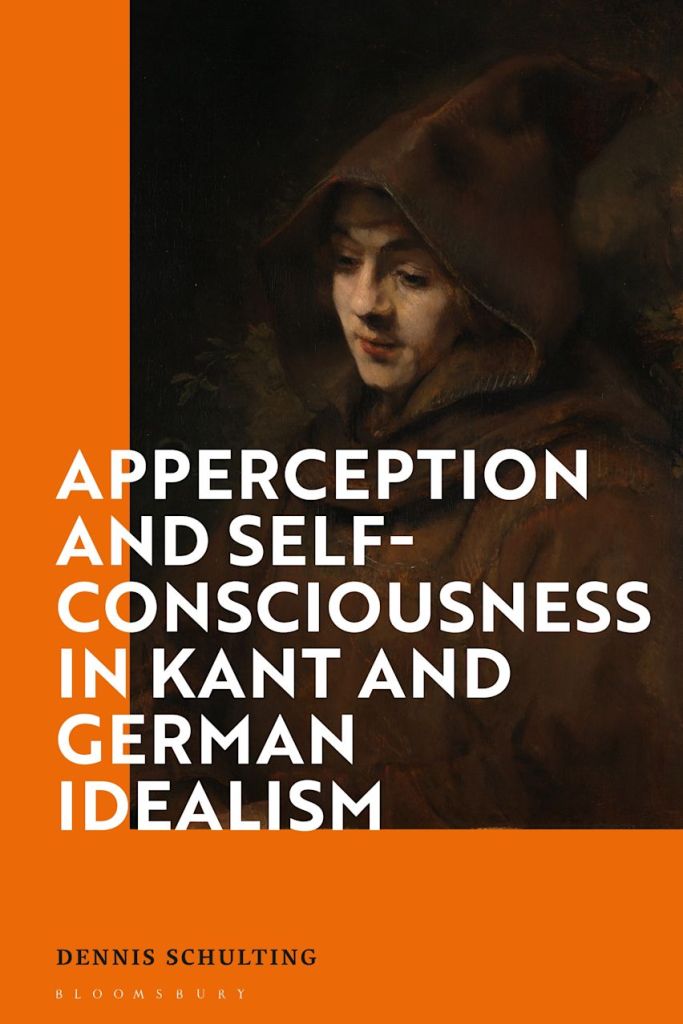
In Apperception and Self-Consciousness in Kant and German Idealism, Dennis Schulting makes an intense analysis of the pivotal concept of self-consciousness as it evolved from Kantian philosophy through the German Idealist tradition, focusing on the notion of apperception, or the reflexive self-awareness that informs and conditions human experience. Schulting traces the intellectual trajectory from Christian Wolff to Kant, and subsequently to Reinhold, Fichte, and Hegel, arguing that apperception serves as a crucial mechanism for understanding not only self-consciousness but also how self-referentiality underpins our entire framework of cognition. This key work demonstrates that, for Kant and the German Idealists, human consciousness is inherently self-reflective, with every act of perception or representation implicitly involving an awareness of the self that perceives. Schulting elucidates how Kantian thought, particularly the concept of transcendental apperception, introduced a paradigm wherein self-consciousness is not merely a byproduct of cognitive processes but rather an integral structure that enables those processes, shaping experience itself.
In his detailed examination, Schulting elucidates how transcendental apperception, introduced in the Critique of Pure Reason, embodies Kant’s Copernican revolution in philosophy: by shifting the basis of knowledge from the external world to the cognitive capacities of the mind itself, Kant reoriented philosophy toward an understanding of the mind’s role in constituting experience. Schulting carefully unpacks Kant’s assertion that the “I think must be able to accompany all my representations“, a phrase indicating that self-consciousness is a necessary condition for organizing diverse representations into a unified, coherent experience. This necessary unity, Schulting argues, provides the structural basis for objectivity, as the self’s capacity to synthesize representations under the unity of apperception enables experience to be more than a chaotic collection of impressions—it becomes a meaningful, objective encounter with the world.
Moreover, Schulting places Kant in context by analyzing his intellectual debts to Wolff and Leibniz. Through Wolff’s concept of consciousness as inherently reflexive, and Leibniz’s early formulation of apperception as a distinct layer of self-awareness, Kant inherited a philosophical framework in which consciousness is not purely a passive receptor but actively engages in synthesizing and organizing perceptions. Schulting emphasizes that for Kant, unlike his predecessors, self-consciousness is not derivative of perception; rather, it is fundamental to it. Apperception becomes a transcendental, or foundational, condition for cognition itself, a concept Kant uniquely expands upon by arguing that this self-reflexive unity of consciousness enables objectivity. This nuanced reinterpretation of Kant’s theory illuminates why self-consciousness is not merely psychological but is instead epistemological, concerned with the very conditions for knowledge and reality as perceived by the human mind.
Schulting extends his analysis beyond Kant by exploring how this concept of transcendental apperception shaped German Idealism’s trajectory, particularly through Reinhold, Fichte, and Hegel, each of whom reinterpreted Kant’s ideas in novel ways. Reinhold closely adhered to Kant’s representational framework, emphasizing that we only represent the appearances of things rather than their intrinsic natures. Schulting argues that Reinhold, by situating representation as a principle unto itself, underscores Kant’s epistemic humility in refraining from metaphysical speculation, while at the same time reinforcing Kant’s insight into the inherently representational nature of human cognition. Reinhold, Schulting suggests, preserves Kant’s boundary between appearance and reality but elevates the principle of representation as an autonomous foundation for knowledge.
Moving to Fichte, Schulting explores the radical shift toward absolute idealism, where Fichte dispenses with Kant’s cautious separation between phenomena and noumena, proposing instead that all reality is a product of the self’s positing activity. Here, the self-conscious activity of the subject no longer encounters an external limit in the form of unknowable “things in themselves.” Rather, the self’s creative, synthetic activity produces both subjective and objective dimensions of experience. Schulting positions Fichte’s interpretation as a crucial advance toward Hegelian idealism, where the unity of the self and its representations culminates in an absolute identity between thought and reality. In Hegel’s framework, Schulting argues, the concept of apperception expands into a vision of the self as identical with the absolute, a vision that erases the Kantian distinction between appearance and reality and posits the self’s awareness of itself as ultimately inseparable from the structure of reality itself.
Schulting’s work also engages extensively with contemporary Kant scholarship, particularly with interpretations that challenge traditional ontological readings of Kant’s transcendental idealism. For Schulting, Kant’s idealism remains inherently formal rather than metaphysical; it does not assert a particular ontological status for objects but rather explores the conditions under which knowledge about objects can arise. This “formal idealism” anticipates the subsequent development of absolute idealism, and Schulting posits that rather than marking a departure from Kant, figures like Hegel deepen the Kantian insight into the reflexivity of reason. In this view, Hegel’s absolute idealism is not a reversion to pre-Critical metaphysics, but an extension of Kantian self-consciousness into a fully realized, systematic unity of thought and being—a unity where reality is seen as necessarily intelligible and, therefore, fully accessible to self-reflective consciousness.
In the book Schulting addresses a central critique of German Idealism: the notion that by erasing the boundary between subject and object, absolute idealism makes unjustified metaphysical claims. Schulting, however, aligns with non-metaphysical interpretations of Hegel, suggesting that the convergence of thought and being in Hegel’s philosophy remains within the bounds of a Kantian framework by maintaining the central role of apperception. This approach, Schulting argues, preserves the critical insight that all knowledge must pass through the reflexive filter of self-consciousness, even as it aspires toward an understanding of reality as wholly integrated within that consciousness.
Through its rigorous historical and philosophical analysis, Apperception and Self-Consciousness in Kant and German Idealism demonstrates that self-consciousness, as articulated by Kant and transformed by his successors, is far more than a mere cognitive feature; it is the architectonic principle underlying the entire structure of idealist philosophy. Schulting’s text, which synthesizes a vast range of primary and secondary sources, provides a compelling reinterpretation of German Idealism, situating apperception not only as the foundation of Kant’s system but as the axis upon which the entire idealist tradition turns.
 Simon Gros
Leave a comment