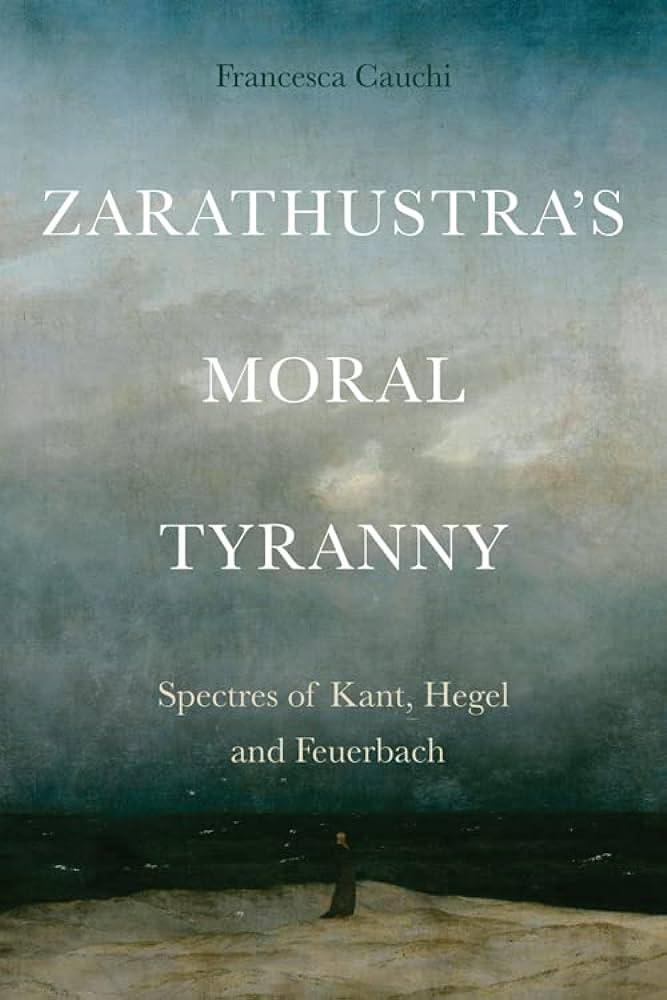
Zarathustra’s Moral Tyranny: Spectres of Kant, Hegel, and Feuerbach by Francesca Cauchi is a philosophical analysis that reshapes our understanding of Nietzsche’s Thus Spoke Zarathustra, often regarded as one of his most enigmatic and richly layered texts. Cauchi provocatively reinterprets Zarathustra not merely as a herald of values opposed to Christianity, but as an advocate of a morally tyrannical doctrine of self-overcoming—a doctrine that paradoxically mirrors the very ethical constraints it aims to surpass. In this reexamination, Zarathustra is seen not simply as a liberator from Christian morality but as a figure enforcing an equally rigorous, if not more exacting, ethical framework. Cauchi’s portrayal of Zarathustra is that of a moral tyrant, whose standards for self-mastery and transformation demand a degree of personal asceticism and sacrifice rivaling or even surpassing those imposed by the Christian morality he seeks to overturn.
In this sustained polemic, Cauchi goes deeply into the concept of self-overcoming as prescribed in the first two parts of Thus Spoke Zarathustra, dissecting its operative mechanisms, which Nietzsche articulates through complex notions of self-legislation, self-denial, and self-sacrifice. Cauchi traces the intellectual lineage of these concepts back to the philosophies of Kant, Hegel, and Feuerbach, uncovering surprising affinities between Zarathustra’s values and the ethical constructs they devised. Through Kantian self-legislation, Zarathustra’s followers are urged to impose a rigid moral order upon themselves—a law unto themselves, echoing Kant’s doctrine of rational autonomy. Similarly, Hegel’s dialectical “labour of the negative,” a process of self-negation that propels the spirit’s development, reverberates in Zarathustra’s call for self-overcoming as a means to confront and nullify one’s internalized remnants of Christian morality. Cauchi even draws parallels with Feuerbach’s emphasis on love, sacrifice, and suffering, showing how Zarathustra’s philosophy requires a devotion akin to spiritual sacrifice and suffering for one’s ideals. These philosophical undertones reveal Zarathustra’s doctrine to be a complex amalgam of self-eviscerating ethical demands that, rather than liberating the individual, place him under a form of relentless internal tyranny. Zarathustra’s brand of self-overcoming emerges as a path fraught with self-inflicted violence, a “vivisection” of the soul as one forcibly reconfigures inner drives and passions to align with a higher, self-imposed standard of truth.
Cauchi shows how Nietzsche’s Zarathustra does not simply suggest a new set of values; he demands rigorous self-discipline and the ruthless excision of any impulses that fall short of his ideal. In this sense, Zarathustra becomes a kind of autocratic overseer within the self, prompting Cauchi to argue that his ethics might ultimately be more “tyrannical” than the Christian values they intend to replace. Zarathustra’s project is marked by an extreme inward discipline, an asceticism that repurposes the Christian model of self-renunciation towards the goal of creating a stronger, more autonomous individual. Yet, as Cauchi shows, this relentless push for autonomy paradoxically leads to a new form of moral bondage, binding the individual not to an external authority but to a rigorous self-imposed standard that demands perpetual self-surveillance, sacrifice, and denial. Thus, Zarathustra’s teachings appear as a paradox: though they advocate freedom from Christian constraints, they simultaneously impose a rigorous self-governance that leads to a self-enforced captivity.
Cauchi’s analysis is particularly original in her discussion of Nietzsche’s engagement with the naturalist-normative debate, a contentious point within contemporary Nietzsche scholarship. Nietzsche’s writings have often been characterized by a naturalistic view of humanity, where will, reason, and morality are understood as products of biological, psychological, and sociopolitical forces. Yet Thus Spoke Zarathustra introduces a tension with this perspective, as Zarathustra’s teachings presuppose a form of rational autonomy and ethical normativity that, in Cauchi’s reading, paradoxically appears incompatible with a naturalist understanding. This normative stance, driven by an idealized notion of self-transformation, necessitates a degree of self-determination that seems to clash with the deterministic implications of Nietzsche’s naturalist perspective. Cauchi contends that Zarathustra’s ethical demands go beyond merely acknowledging these forces, instead demanding a kind of transcendence that would supposedly allow the individual to rise above these naturalistic constraints.
In her incisive critique, Cauchi addresses this “naturalist-normative problem,” situating Nietzsche’s Zarathustra at a philosophical fault line that has perplexed scholars. If Nietzsche’s view of human beings is fundamentally naturalistic, denying the existence of an immaterial soul or an autonomous “I,” then how are we to understand Zarathustra’s exhortations to self-overcome, which appear to require a rational autonomy and a dualistic self? Cauchi skillfully navigates this complex terrain, showing how Zarathustra’s ethical demands both presuppose and undermine traditional notions of autonomy. In an ironic twist, Zarathustra’s calls for self-overcoming become yet another form of tyranny, not over the body but over the psyche, forcing the individual to submit to an internalized authority as unyielding as any external moral code. Cauchi’s insights thus paint Zarathustra’s path as a grueling journey, one that requires the individual to become both the oppressor and the oppressed, torn between the demands of natural impulses and the ascetic imperatives of a newly fashioned morality.
Zarathustra’s Moral Tyranny is a formidable contribution to Nietzschean scholarship, combining rigorous textual analysis with a deep understanding of the intellectual landscape Nietzsche himself navigated. Cauchi not only illuminates the philosophical roots of Nietzsche’s ethics but also exposes the contradictory tensions within Zarathustra’s doctrine of self-overcoming. This tension, Cauchi argues, reflects Nietzsche’s own ambivalence toward morality itself—an ambivalence that reveals Nietzsche’s refusal to offer a simplistic path to freedom, instead presenting a complex, and often troubling, portrait of human self-creation. For Cauchi, Zarathustra’s self-overcoming is not a doctrine of liberation but a perpetual struggle, demanding nothing less than the continual disassembly and reassembly of the self in pursuit of a distant, and perhaps unreachable, ideal.
Through Cauchi’s lens, Thus Spoke Zarathustra becomes a rich, self-conflicted text that repays sustained philosophical inquiry. Zarathustra’s teachings, ostensibly aimed at transcending Christian morality, are shown to constitute a rigorous moral framework of their own, one that demands the utmost self-discipline and, ultimately, imposes a new set of moral restrictions. In a poignant irony, Nietzsche’s anti-Christian polemic becomes a paradoxical reaffirmation of the need for ethical discipline—albeit one that turns inward, setting the individual at war with their own drives and desires in the name of self-overcoming. Cauchi’s work reveals Nietzsche’s Zarathustra not as a prophet of liberation, but as a figure of moral tyranny whose ethical teachings impose a discipline as demanding as any external moral law, casting doubt on the very possibility of achieving true freedom through self-mastery.
 Simon Gros
Leave a comment