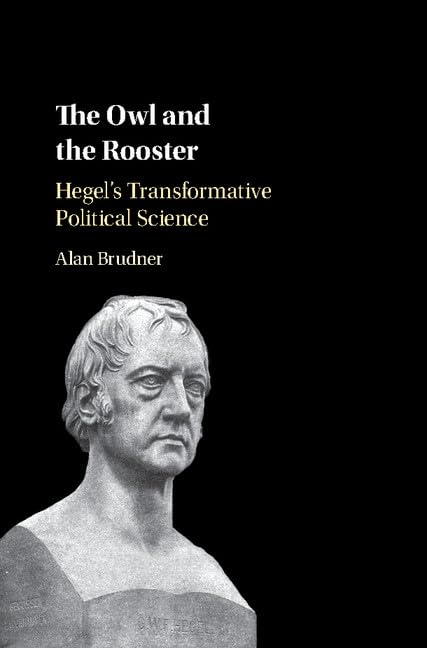
In The Owl and the Rooster, Alan Brudner undertakes an ambitious reexamination of G.W.F. Hegel’s political thought, presenting a perspective that navigates through the convoluted terrain of Anglo-American interpretations since 1945. This scholarly work is grounded in the historical context of two prominent waves of Hegelian scholarship: the first sought to rehabilitate Hegel’s reputation from accusations of being an apologist for Prussian authoritarianism and a proponent of totalitarian nationalism, while the second positioned him as a civic humanist challenging liberal individualism in the tradition of Rousseau. However, both waves, as Brudner elucidates, fail to capture the richness and complexity of Hegel’s philosophy, particularly in its implications for political justice, theism, and the intersection of individual autonomy with communal ethical life.
Brudner’s critique of these interpretive waves is rigorous and pointed. He articulates how the first wave, while effectively dispelling the totalitarian readings that gained traction following the horrors of the twentieth century, inadvertently domesticated Hegel’s thought, rendering it palatable by stripping away its more unsettling elements. This oversimplification has led to a portrayal of Hegel as merely an Enlightenment thinker akin to Hobbes or Locke, thereby neglecting the revolutionary aspects of his ideas regarding the state, which he describes as the “divine Idea on earth.” The author reveals that such simplifications obscure Hegel’s assertions about the ethical significance of the state, wherein individual duty finds fulfillment not in isolation but in the participation within a rational and ethical community that transcends the individualistic tendencies prevalent in liberal thought.
In contrast, the second wave of scholarship, which emerged in the mid-1970s, frames Hegel as a counterweight to the resurgence of contractarian liberalism exemplified by thinkers like John Rawls. Brudner acknowledges the strengths of this perspective, particularly in its recognition of Hegel’s contributions to the civic humanist tradition, which emphasizes communal life and historical particularity. Yet he criticizes this interpretation for sidelining Hegel’s theism, either by outright denial or by presenting it as an outdated relic unworthy of serious consideration in contemporary political discourse. This dismissal, according to Brudner, leads to a significant loss: the understanding that Hegel’s conception of Spirit—a rational, divine force—plays a crucial role in mediating the relationship between the individual and the collective, thus forming the basis for a deeper understanding of political justice.
Brudner endeavors to recover these lost dimensions of Hegel’s thought by reestablishing rational theism as a central tenet of his political philosophy. He argues that Hegel’s insistence on the compatibility of faith and rational insight offers a compelling vision for integrating theism into the public sphere in a manner that is both justifiable and necessary for political discourse. Brudner’s reading emphasizes that for Hegel, the realization of a truly ethical state is not only a political aspiration but a reflection of divine wholeness achievable among humans. This proposition challenges the reductionist readings that either neglect or distort Hegel’s theistic commitments, illuminating how these commitments are not merely personal beliefs but foundational to his understanding of a just and rational political order.
Furthermore, Brudner engages with Hegel’s Phenomenology of Spirit to illuminate its transformative role in political science. He asserts that Hegel’s dialectical method enables a reconciliation of the ancient ideals of the polis with modern individualism, proposing a synthesis that transcends the dualism of communitarian and liberal thought. This synthesis, Brudner suggests, is critical for addressing the ideological divides that currently animate political discourse, framing Hegel not merely as a thinker of his time but as one whose insights remain urgently relevant in contemporary debates about freedom, justice, and the role of the state.
He does not shy away from the challenging implications of Hegel’s thought and confronts the historical and institutional conditions that must be met for philosophy to enact its transformative potential in political life. His analysis acknowledges that the perfect realization of Hegel’s vision—a state that embodies both individual freedom and ethical community—remains an aspiration that has yet to be fulfilled. This acknowledgment does not lead to resignation; rather, it serves as a clarion call for philosophical engagement and political reform, urging readers to consider what structural changes are necessary to cultivate the conditions for such a state to emerge.
Brudner’s argument is the assertion that Hegel’s political philosophy is sui generis, standing apart from traditional classifications like liberalism or nationalism, and that it must be engaged with on its own terms. By recovering the divine-human nexus inherent in Hegel’s notion of Spirit, Brudner reopens discussions about the potential for a rational theism to inform contemporary political theory, thus proposing a pathway toward a more comprehensive understanding of political justice that respects both individual autonomy and communal ethical life.
In a landscape marked by ideological polarization, The Owl and the Rooster is a significant contribution to Hegelian scholarship, offering a clear and accessible exploration of Hegel’s transformative political science. Brudner’s prose is both erudite and engaging, making complex ideas approachable without sacrificing their depth. He combines historical insight with contemporary relevance, challenging readers to reconsider Hegel’s place within the canon of political philosophy. The book not only enriches our understanding of Hegel’s political thought but also serves as a timely reminder of the enduring significance of philosophical inquiry in navigating the complexities of modern political life. Ultimately, Brudner’s work is an invitation to rethink the foundational premises of liberalism and its alternatives, urging a return to the profound insights offered by Hegel, insights that are as necessary today as they were in his time.
 Simon Gros
Leave a comment