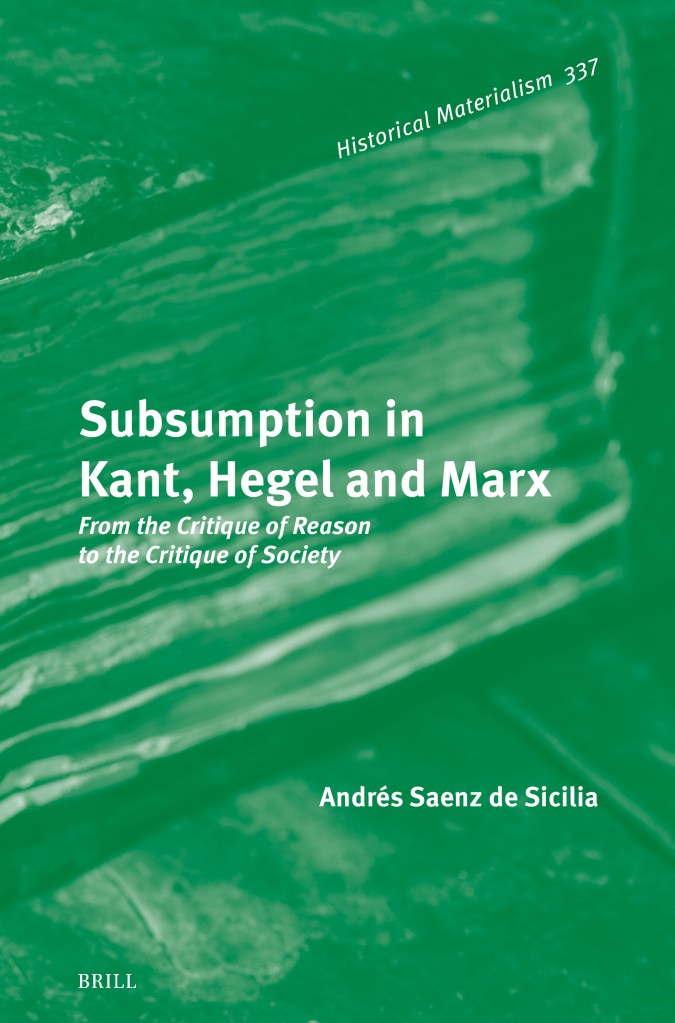
In Subsumption in Kant, Hegel and Marx, Andres Saenz De Sicilia analyses the philosophical and socio-economic dimensions of the concept of “subsumption,” combining together the ideas of modern philosophy with critical social theory to examine how this notion operates within the framework of capitalism. At the basis of this inquiry is the recognition of capitalism as a complex and pervasive social force that seeks to “subsume” various aspects of human life under its logic of value, production, and reproduction. This book serves as an intellectual intervention into the debates surrounding the historical trajectories of capitalism, countering the prevailing thesis that contemporary society is characterized by a stage of “total” capitalist subsumption, which allegedly leaves no space for refuge or resistance.
This study presents a critical reconstruction of the concept of subsumption, tracing its evolution from the philosophical frameworks of Kant and Hegel to its rearticulation in Marx’s materialist critique. It argues that a comprehensive theory of subsumption must not only reveal the logical relationships inherent in the synthesis of concepts but also actively interrogate the process of synthesis, including its conditions, structure, and effects. By elucidating the connections between specific instances of objectivity and the subjects and contexts from which they arise, this theory moves beyond mere categorization to engage with the broader implications of how categories themselves are constituted. This highlights the dual status of particular and universal as simultaneously heterogeneous and homogeneous.
The first chapter goes into the evolution of the concept within Kant and Hegel’s writings, analyzing how Kant’s subsumptive judgments reflect a productive relation of determination among heterogeneous elements. It examines Hegel’s critique of this framework, presenting subsumption as a dynamic mediation within a dialectical process that transcends Kant’s static categories. While Hegel expands the critical concept of subsumption to include social-relational dimensions, he also exposes its constraining aspects, setting the stage for Marx’s transformative approach.
Marx’s critique fundamentally alters the discourse by challenging the idealist foundations laid by Kant and Hegel. He reframes subsumption as a socio-historical problem, emphasizing the active role of human practice in shaping objectivity. This perspective shifts subsumption from a purely cognitive operation to a social practice embedded within the collective actions of individuals. Marx contends that the metabolic interactions between productive subjects and their material conditions generate forms of existence that are historically contingent and continuously evolving.
In subsequent chapters, the study systematically explores Marx’s theory of capitalist subsumption, investigating how economic abstractions mediate the reproduction of capitalist societies. It identifies two interconnected levels of subsumption: first, the subsumption under abstract economic categories and market forces, and second, subsumption under direct capitalist control in production. This dual framework elucidates the distinctive synthesis of capitalist subsumption, where abstract economic determinations shape concrete productive practices.
Chapter four critically assesses Marx’s treatment of subsumption, proposing a dynamic conception that reconciles his abstract schema with historical realities. By rejecting overly simplistic historical schematizations and reductive systematic dialectics, the study advocates for a nuanced understanding of subsumption that acknowledges the interplay between local mechanisms of control and broader global structures of domination. This approach facilitates a deeper analysis of contemporary forms of subsumption, including the ongoing tensions between capitalist reproduction and non-capitalist forms of existence.
Through this investigation, the study develops a robust theoretical framework that clarifies the mechanisms of capitalist power while engaging with the complexities of resistance and transformation within the global socio-economic landscape. By advancing the discourse on subsumption, this work seeks to illuminate the stakes of contemporary struggles against domination, enriching our understanding of what it means for entities and practices to be ‘subsumed.’
Subsumption in Kant, Hegel and Marx is a dense and incisive examination of how the philosophical discourse surrounding subsumption can inform our understanding of the capitalist condition. Saenz De Sicilia not only contributes to the ongoing debates within critical theory and social philosophy but also emphasizes the importance of revisiting these foundational thinkers to uncover insights that remain relevant in our contemporary struggles against capitalist domination. This work invites readers to consider how the interplay between concepts and social realities can be harnessed to envision alternative forms of social organization and collective resistance, ultimately advocating for a more critical and engaged approach to the study of subsumption and its implications for society.
 Simon Gros
Leave a comment