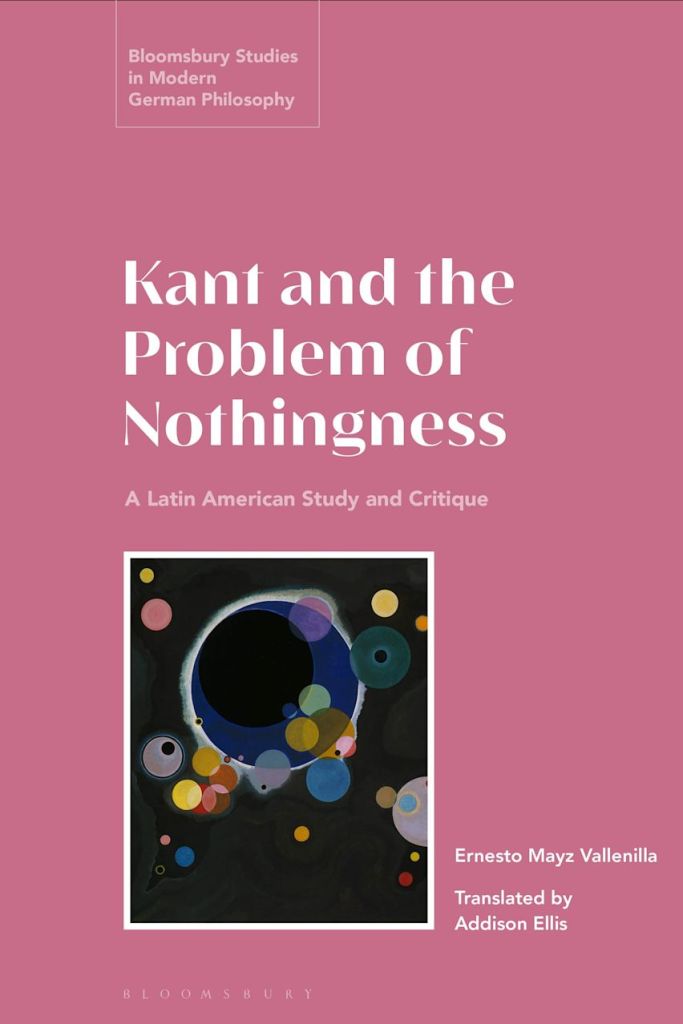
In Kant and the Problem of Nothingness, Ernesto Mayz Vallenilla does a crucial analysis of Immanuel Kant’s concept of “nothing” through a uniquely Latin American philosophical lens, fusing the Continental tradition with a keen analysis of Kant’s metaphysics. Originally published in 1965, this work represents a pioneering study in the Spanish-speaking world, delving into the obscure yet significant “Table of Nothings” (TON) within the Critique of Pure Reason, particularly in its “Amphiboly of the Concepts of Reflection” section—a part of the Critique that often escapes the notice of even devoted Kantian scholars. Vallenilla’s focus on Kant’s Table of Nothings and the corresponding structures of “real nothing” and “nihil negativum” sheds light on a concept central not just to Kantian thought but to the very structure of transcendental philosophy, underscoring the necessity of “nothing” as a counterpart to being within the architecture of cognition itself.
In examining the implications of “nothing,” Mayz Vallenilla positions Kant’s Table as a locus for understanding both the bounds and horizons of human cognition, emphasizing temporality as the horizon of possible experience. Through the TON, Kant, Vallenilla argues, was acutely aware of the necessity of defining the limits of cognition, requiring a structured approach not only to “being” but also to “non-being” as foundational to transcendental philosophy. This attention to the “nothing” problem is significant within the broader historical context, particularly as it pertains to Heideggerian and post-Heideggerian Continental thought. Vallenilla’s reading is informed by a thorough engagement with Heidegger, whose interpretations of Kant opened new pathways for existential and ontological investigations of Kantian categories, yet Vallenilla critiques Heidegger by suggesting a deeper Latin American conceptualization that acknowledges temporality’s critical role in shaping the phenomenology of nothingness. By situating temporality as central to the cognitive apprehension of both being and nothingness, Vallenilla emphasizes how this temporal structure informs and conditions all philosophical reflection on human finitude.
This work’s approach to Kant’s treatment of nothingness also challenges the traditional role language has played in philosophy’s attempts to grapple with existence and non-existence. Vallenilla critiques the assumption that philosophical language can, in fact, adequately address the ontological complexities of nothingness. In particular, he considers the ways in which linguistic structures, deeply embedded in ontological assumptions about being, hinder the philosophical expression of nothingness in its own right. This critique is traced back to Hegel’s view of language as a transparent medium for philosophical inquiry—a view Vallenilla challenges by emphasizing how language, deeply rooted in ordinary perception, often fails to address radical concepts outside of traditional ontological frameworks. Drawing on Heidegger’s notion of the “forgetfulness of Being,” Vallenilla explores how this forgetfulness complicates our approach to nothingness, ultimately contending that traditional metaphysical language cannot encapsulate or express nothingness without being influenced by latent presuppositions about being itself. Here, Vallenilla suggests that the limitations of language reflect an even deeper problem: the ontological and epistemological difficulties inherent in confronting nothingness, or “non-being,” as an authentic philosophical category.
Mayz Vallenilla does not shy away from acknowledging the immense difficulty of directly engaging with nothingness. He calls attention to the challenges philosophers face in reconciling the abstract and often bewildering task of understanding nothingness, precisely because the categories and terminologies we rely on are inherently tied to existence and being. In attempting to conceptualize nothingness, philosophers encounter what Vallenilla describes as “ontological barriers”—limitations that arise from the very nature of existence and cognition. For Vallenilla, these barriers are not merely semantic or linguistic but are ontologically constitutive, preventing a seamless or direct apprehension of nothingness within the metaphysical tradition. He argues that Kant’s delineation of “real nothing,” as outlined in the TON, is a rigorous attempt to carve out space for nothingness that is not merely the absence of something but a distinct concept within the framework of transcendental philosophy, allowing a glimpse into a fundamental dimension of reality that transcends categorical logic.
Addison Ellis’s translation, with its careful preservation of Vallenilla’s terminology and phrasing, introduces Anglophone readers to this foundational Latin American interpretation of Kant, embedding Vallenilla’s study in the broader philosophical dialogue between Latin America, Europe, and the English-speaking world. Accompanying Vallenilla’s text are extensive translator’s notes, a glossary, and an insightful introduction that provides context regarding both Kantian and Heideggerian influences, as well as an analysis of the original Spanish sources. Ellis’s work enables readers to engage with Vallenilla’s philosophical language, which combines rigorous analysis with an aesthetic sensitivity to the challenges of discussing non-being. Through careful annotations and commentaries, Ellis elucidates some of the more nuanced aspects of Vallenilla’s critique, such as his dissection of Heidegger’s ontology and the philosophical implications of temporality and language as they pertain to the study of nothingness.
Kant and the Problem of Nothingness is a key examination of the philosophical necessity of “nothing” as a central category in transcendental philosophy, demanding that we reconsider the implications of nothingness not just as an absence or negation, but as an integral concept with real ontological weight. Vallenilla’s unique synthesis of Kantian thought with the Continental tradition and Latin American philosophy reveals an often-overlooked dimension of transcendental philosophy, one that underscores the limits and possibilities of human cognition. This work invites readers to rethink the role of language, temporality, and existential experience in shaping our understanding of nothingness, proposing that any true engagement with “being” must necessarily include an account of “nothing,” thus bringing forth the profound and unsettling questions that arise when philosophy contemplates the void.
 Simon Gros
Leave a comment