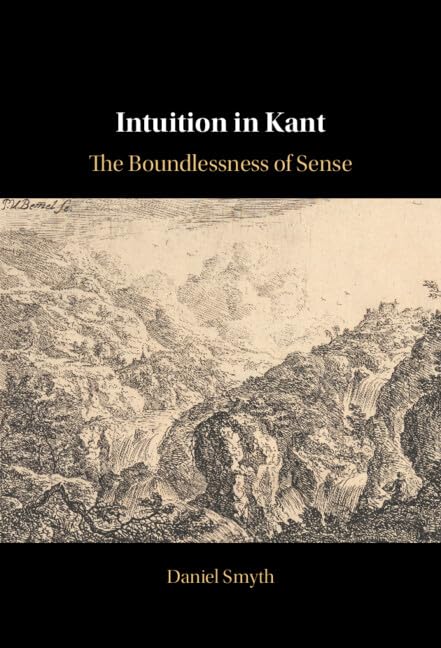
Daniel Smyth’s Intuition in Kant: The Boundlessness of Sense offers a deep exploration of Immanuel Kant’s multifaceted conception of intuition, which Smyth presents as not merely a perceptual tool but as a crucial epistemic function that complements and enhances the intellect’s capabilities, filling gaps left by its discursive nature. By delineating intuition’s varieties—divine, receptive, sensible, and specifically human—Smyth tackles Kant’s assertion that, paradoxically, human intuition is both finite in sense perception yet able to represent infinities in mathematical and spatial concepts. In a way that brings coherence to this seeming contradiction, Smyth argues that Kantian intuition operates as a cognitive counterpart to the intellect, working hand-in-hand with it to make human knowledge possible.
Smyth’s analysis illuminates Kant’s innovation in ascribing a boundary-breaking capacity to human sensibility, a move he regards as equally revolutionary as Kant’s more commonly discussed theory of understanding. This innovation, Smyth contends, lies in Kant’s treatment of intuition as a tool for overcoming cognitive deficiencies inherent in a purely discursive intellect. Kant identifies sense perception as the paradigm of intuition, and yet holds that intuitive representations can contain infinite properties, an idea that challenges both rationalist and empiricist traditions. Traditional empiricists like Hobbes and Hume argue that sense perception’s limitations preclude knowledge of mathematical infinity, advocating a finitistic geometry grounded in minimal perceptible units. Rationalists, in contrast, assign the task of infinitary cognition to intellect, dismissing the senses as inherently limited. Kant, however, diverges radically from both camps, positing that it is precisely within the sensible, intuitive aspects of cognition that we can encounter representations of infinity.
To support this notion, Smyth takes a novel approach to Kant’s faculty psychology, wherein the mind is understood as an ensemble of distinct yet interrelated capacities. These capacities are defined not by their intrinsic properties but by their function in producing knowledge. Hence, for Kant, any representation that performs the function of intuition—even if it surpasses human sensory limits—qualifies as an intuition. This functionalist view allows Kant to claim that intuitions can bear infinitary structures without denying the sensory limitations of human perception. Smyth argues that Kant’s conception of infinite representations within intuition is rooted in the forms of space and time, which Kant considers inherently infinite and given to us through intuition. Kant’s insistence that space and time are not finite but rather infinitely divisible challenges readings that attempt to reconcile his views with finitistic interpretations, in which infinity is only a potentiality or open-ended possibility.
This leads Smyth into a detailed reconstruction of Kant’s apperceptive method—a form of self-knowledge by which the intellect not only performs cognitive acts but also reflects on its limitations and presupposes other faculties to fulfill its knowledge aims. For Kant, understanding and self-consciousness are deeply intertwined. The intellect knows itself through its own functions, such as judgment, which implicitly requires recognition of the activity of judging. This self-reflective awareness, or apperception, allows the intellect to distinguish its own discursive limits and thus to posit a separate cognitive role for intuition. Smyth argues that the intellect, by recognizing what it cannot achieve alone, implicitly requires an intuitive partner that can bridge the cognitive gap between mere discursive thought and empirical knowledge. Intuition emerges as a faculty designed to actualize and ground the intellect’s representational acts.
Kant’s apperceptive faculty psychology thus leads Smyth to a striking interpretation of Kant’s philosophical method: rather than viewing knowledge as derived solely from a mix of sensory and rational inputs, Kant sees knowledge as requiring a faculty of intuition to substantiate the intellectual content of concepts. This conception of intuition is not merely receptive but is tied to a first-personal grasp of the limits of judgment and discursive cognition. Smyth positions Kant’s faculty psychology as an advanced, self-reflective theory in which the intellect’s limitations point toward a non-discursive, intuitive mode of cognition.
Smyth’s work breaks new ground in Kantian scholarship by elucidating Kant’s views on sensibility and the intellect’s role in self-conscious cognition. Kant’s apperceptive model of faculty psychology, as Smyth describes it, provides a framework for understanding how sensibility is as much a part of cognitive self-knowledge as discursive thought. This innovative account of sensibility, Smyth argues, leads to a more nuanced understanding of how the mind’s cognitive functions cooperate, especially in tasks that seem to surpass sensory limitations. Intuition, by making sense of infinity within a finite cognition, serves as a conduit for forms of knowledge that would be otherwise inaccessible through intellect alone. By grounding the intellect’s need for intuitive support within the apperceptive method, Smyth’s interpretation reshapes our understanding of Kant’s critical philosophy, presenting intuition as an indispensable, boundary-expanding element of human cognition.
In Intuition in Kant: The Boundlessness of Sense, Smyth reveals Kant’s intuition as both a groundbreaking innovation and an epistemic necessity, fundamentally altering our understanding of knowledge, cognition, and the complex interplay between sensibility and intellect. This dense and detailed work sheds light on Kant’s philosophical methodology and pushes readers to reconsider Kant’s insights into the limits and possibilities of human knowledge.
 Simon Gros
Leave a comment