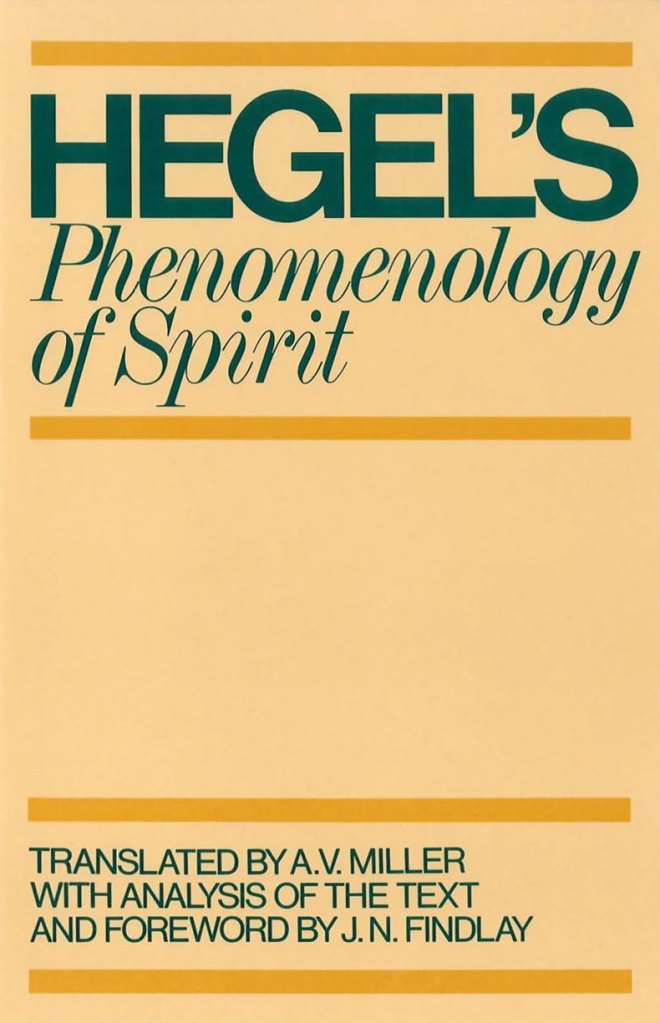
In Phenomenology of Spirit, G.W.F. Hegel crafts a complex philosophical journey, guiding readers through the mind’s ascent from immediate sense-consciousness to a full understanding of absolute knowledge, achieved only through scientific philosophy. Written in 1807, a time of political turmoil and revolutionary fervor, the work itself is as radical in the philosophical domain as Napoleon’s conquest was in the political sphere. Hegel presents a narrative of consciousness that seeks not simply to capture truths in isolation but to narrate the essential evolution of human thought, a transformation that mirrors humanity’s progression toward intellectual and spiritual liberation. This trajectory of mind through self-alienation and reconciliation reflects the historical process of reason, marked by conflicts, contradictions, and ultimately, a synthesis in the form of science.
Hegel does not merely propose a set of abstract principles, he rather unfolds a dialectical process that the mind itself must enact to achieve genuine understanding. This undertaking is, therefore, not a passive reception of ideas but an active engagement that traces the necessary developmental stages of consciousness. It begins with sense-certainty, an immediate and seemingly concrete awareness of the world that soon reveals itself as empty and devoid of true determinacy. As consciousness attempts to ground itself, it progresses through stages such as perception and understanding, each unveiling its own inherent contradictions, forcing a leap to a higher level of awareness. Each phase represents both a subjective experience and an objective reality, compelling the reader to witness, in real-time, the limitations of each viewpoint and the necessity of their transcendence. The achievement of absolute knowing is not merely the endpoint of this journey but also its justification, for Hegel holds that this comprehensive standpoint alone—the scientific system of knowledge—can reconcile the fragmentation of experience into a coherent unity.
A.V. Miller’s translation, equipped with J.N. Findlay’s insightful foreword and a close analysis, aims to make accessible Hegel’s notoriously challenging prose, which often appears elliptical and impenetrable. Hegel’s writing style, filled with terminological precision and syntactic density, mirrors the complexity of his ideas. His dialectical method operates through negations and sublations (Aufhebung) that reveal each position’s insufficiencies while preserving its insights within a higher synthesis. The reader encounters a philosophical process that is neither linear nor purely intuitive but instead unfolds through immanent contradictions, revealing the “life of the concept” as a dynamic, evolving structure. In this way, Phenomenology of Spirit is as much an existential exploration as it is a philosophical treatise, challenging readers to re-evaluate not only their understanding of knowledge but also their very approach to thinking and self-consciousness.
Hegel’s preface alone lays out his philosophy of philosophical methodology, a prelude to the narrative of consciousness that follows. He argues against the detached, analytic style that treats philosophy as an array of discrete truths, instead proposing that philosophy is an organic, unfolding system in which each stage finds meaning only in its connection to the whole. As Hegel illustrates through the imagery of the bud, blossom, and fruit, each philosophical viewpoint is subsumed in the next, not as a mere negation but as a necessary moment within the total process. Thus, Hegel critiques the prevailing mode of intellectual thought, which often seeks to categorize and judge philosophical systems as independent and opposing entities. Instead, he proposes that every system represents a particular stage in the unfolding of truth, contributing to the living totality of philosophical understanding.
The concept of dialectic—central to Hegel’s system—is here shown as a movement through oppositions, a self-transcending process that forms the backbone of consciousness’s path toward absolute knowledge. Dialectic for Hegel is not merely logical contradiction but an ontological process wherein each stage of awareness must confront its own limitations. Consciousness, in its immediate forms, assumes the reality of its perceptions, only to discover through experience that its knowledge is incomplete. This realization propels consciousness to a higher level of understanding, a continual cycle of alienation and reconciliation that culminates in self-recognition. The reader experiences this development as an almost autobiographical account of reason itself, in which every phase, from sense-certainty to absolute knowing, is both a subjective transformation and an objective progression, with each step necessary yet contingent upon the historical spirit of the time.
Hegel’s inclusion of a dialectical approach is not an arbitrary stylistic choice but a necessity dictated by the nature of his subject. While mathematical or formal logic operates within the realm of stable identities and fixed propositions, Hegel’s dialectic demands a richer, more fluid engagement that transcends mere logical inference. It is, as he asserts, a method that allows for multiple routes to truth, accommodating the variations of historical and individual experience. The dialectical process reflects a developmental pattern that, although necessary, is not singularly prescriptive; it reveals the freedom within the structures of necessity, acknowledging that alternate historical pathways could also lead to scientific knowledge. Thus, Hegel’s phenomenological journey is as much a statement about the contingency of philosophical history as it is a proclamation of an inevitable endpoint. The path taken by humanity and the individual consciousness alike may be shaped by circumstances, yet the movement toward absolute knowing remains an immanent teleological goal within each experience.
In his later years, Hegel reflected on Phenomenology of Spirit as a unique work that belonged to the era of its writing. He suggested that while its dialectical journey represented a path to scientific knowledge for the consciousness of his time, it might not dictate future routes toward philosophical science. This acknowledgement of variability within necessity is part of what makes Phenomenology so compelling. Hegel does not posit an ahistorical, unchanging blueprint for philosophical progress but rather captures the nuances of an evolving spirit—both collective and individual—that must reconcile with the challenges of its context. The book remains as a testament to the philosophical spirit of the age, grappling with the remnants of metaphysical abstraction and advancing toward a system of philosophy that could claim scientific validity. It addresses not only the reality of abstract thought but also the lived experience of philosophical engagement, a labor of the spirit that grapples with itself as much as with the world.
Hegel’s work stands as both a self-contained philosophical journey and as an entryway into the greater systematic philosophy that would later be laid out in his Encyclopaedia of the Philosophical Sciences. Phenomenology of Spirit is at once an introduction and a completion; it offers the reader a glimpse into the necessity of dialectical development while encouraging a leap beyond mere phenomenology to the science of logic. In traversing the stages of consciousness—self-consciousness, reason, spirit, and ultimately absolute knowledge—Hegel challenges us to move beyond a passive understanding and to actively reconstruct the steps necessary to reach a scientific philosophy. This text becomes, then, a rite of passage for the philosopher, demanding not just intellectual comprehension but a transformation of perspective that aligns with the highest form of self-consciousness.
Phenomenology of Spirit is a bold and revolutionary endeavor that attempts to reconstitute philosophy as a living science, integrating subject and object, knower and known, within a single, dynamic movement. It remains a crucial work in Western philosophy, not only as a historical document but as a living system of thought that invites readers to retrace consciousness’s steps toward absolute knowing. Hegel’s work continues to challenge, engage, and inspire, offering no simple answers but instead demanding of its readers an active participation in the dialectical process—a journey toward understanding that, once taken, reveals the very nature of philosophical truth as an evolving, self-aware unity.
 Simon Gros
Leave a comment