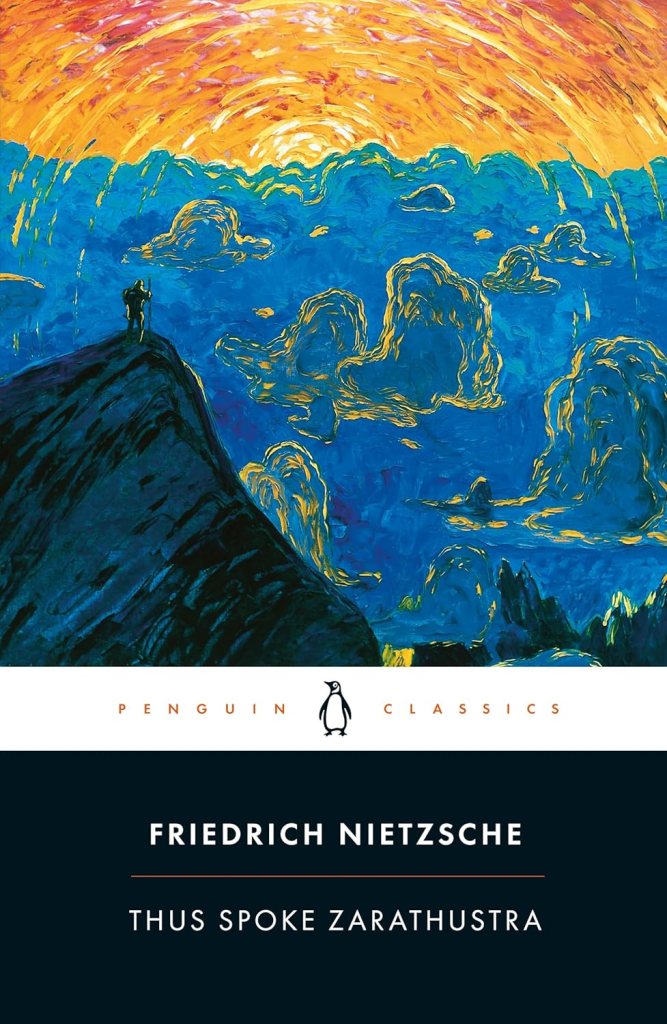
Thus Spoke Zarathustra is Friedrich Nietzsche’s most radical and enigmatic work, a multi-layered philosophical narrative that combines fervent polemics with lyrical prose to challenge the deepest assumptions of Western morality, metaphysics, and religion. Nietzsche’s Zarathustra descends from the mountains, emerging as a paradoxical figure who blends the prophetic with the ironic, both heralding the “death of God” and proclaiming the advent of the “Übermensch,” the Overman, as an ideal of self-overcoming and individual realization. This work is not a simple manifesto but a dense, poetic composition that compels readers to re-examine their preconceptions about the role of belief, morality, and authority in human life. Nietzsche’s self-proclaimed “most important work” does not merely propose ideas; it embodies them through a symphony of parables, epigrams, allegories, and dreams, presenting a literary and philosophical labyrinth in which meaning is perpetually elusive, yet always forcefully intimated.
Nietzsche’s provocative proclamation that “God is dead” reverberates through the entire text, stripping away the certainties of religion, authority, and conventional morality, thereby thrusting humanity into an existential crisis. The death of God is not simply a declaration of atheism; it is a metaphor for the collapse of absolute values and the void left in their absence. Zarathustra’s message to the people is one of radical independence, exhorting them to abandon inherited doctrines and to seek meaning within themselves. The character of Zarathustra, with his cryptic teachings and recurring self-doubt, is a hero for a world left without transcendental guides, challenging the very possibility of certainty in the pursuit of human purpose. Through him, Nietzsche rejects passive acceptance and submission, urging instead a life driven by what he calls the “will to power,” an intense, creative force that he sees as essential to realizing one’s fullest potential.
Central to Zarathustra’s teaching is the idea of the Übermensch, or Overman, an archetype for a future human being who embodies a new set of values grounded in self-overcoming and self-mastery. This Overman represents a form of human existence that transcends traditional morality, rising above both herd instincts and the comforting, limiting doctrines of the past. Yet, Nietzsche leaves the figure of the Overman tantalizingly undefined, more an idealized vision than a practical guide. Through this concept, Nietzsche posits an ongoing process of becoming rather than a static end state, urging individuals to continually create and recreate themselves in a movement toward personal greatness. Zarathustra’s journey reflects this ceaseless striving; his repeated confrontations with various symbolic figures—each embodying aspects of human weakness, stagnation, and limitation—serve as trials that underscore the impossibility of complete fulfillment and the necessity of continual effort.
Thus Spoke Zarathustra is a monumental work that defies easy categorization, operating on multiple levels as a philosophical treatise, a poetic exploration, and a subversive parody of religious prophecy. The book presents the wandering sage Zarathustra, who descends from isolation in the mountains to communicate his startling, disquieting revelations to humanity. Zarathustra’s journey serves as both a framework for Nietzsche’s philosophical innovations and a meditation on the process of enlightenment itself. Nietzsche’s call to reimagine humanity’s purpose within a post-theistic world remains central to the text, as Zarathustra challenges his disciples and readers alike to confront the existential meaning of life unanchored from divine absolutes.
The literary style of Thus Spoke Zarathustra is as revolutionary as its themes, merging homilies, aphorisms, parables, and dreams in a rich, almost biblical prose that challenges conventional philosophy’s reliance on clarity and reasoned argument. Nietzsche’s philosophical vision unfolds through the highly symbolic and often enigmatic language of Zarathustra, with profound metaphors and provocative imagery that urge readers to engage actively with the text. This engagement is not merely intellectual; it is deeply existential, compelling readers to confront the limits of human understanding and the seductive illusions of meaning provided by traditional morality and metaphysics. Zarathustra’s sermons on virtues, friendship, self-overcoming, and mortality are punctuated by poetic interludes, such as the famous “Night Song” and “Grave Song,” which give voice to the existential angst and creative longing that permeate Nietzsche’s vision. In this way, the work resists reduction to simple propositions, instead demanding that readers experience and interpret its message through an immersion in Zarathustra’s vivid symbolic world.
Nietzsche’s Zarathustra is no ordinary prophet. He is both a seeker of truth and a skeptic of traditional paths to it, urging his followers to abandon the moral dualisms that underpin Christian and Platonic metaphysics. By choosing Zarathustra—also known as Zoroaster, the Persian prophet who first framed existence in terms of the opposition between good and evil—Nietzsche both evokes and critiques this foundational moral dualism. For Nietzsche, the figure of Zarathustra encapsulates a profound irony: the originator of humanity’s most damaging moral dichotomies becomes the teacher who leads us beyond them. Zarathustra’s teaching calls for an overcoming of traditional values and beliefs, but Nietzsche’s language here is slippery and self-aware, often veering into parody. In Ecce Homo, Nietzsche even hints at the satirical elements of Thus Spoke Zarathustra, suggesting it should be read as both tragedy and parody. Zarathustra is the prophet of a philosophy that is, paradoxically, suspicious of prophecy itself, a teacher whose lessons often come as warnings rather than prescriptions.
One of the most striking elements of Thus Spoke Zarathustra is the concept of the “eternal return of the same,” a doctrine Zarathustra presents as his deepest teaching and as a test of existential courage. The notion of eternal recurrence, in which every moment recurs infinitely, challenges readers to confront their relationship with time, value, and action. It demands a form of radical acceptance and a commitment to life that affirms even its darkest aspects—a willingness to embrace existence as it is, in all its repetitions, without appeal to transcendent redemption. Zarathustra himself is plagued by this vision, suffering from what Nietzsche calls the “heaviest weight,” until he ultimately comes to embrace it as a form of spiritual liberation. The eternal return thus becomes a way of exploring what it means to live without the consolation of finality or purpose, a vision that is both inspiring and terrifying. It asks us to consider whether we can affirm our lives in their entirety, with every joy and sorrow, as if each moment were to recur endlessly.
Thus Spoke Zarathustra also introduces the idea of the “last human being,” a cautionary figure representing the ultimate degeneration of human potential—a future in which comfort and mediocrity have replaced ambition and greatness. This figure stands in stark contrast to the Übermensch, embodying Nietzsche’s fear that humanity may choose ease over self-overcoming, contentment over creativity. Zarathustra scorns the “last human” as the antithesis of what human life could aspire to be, a warning against the complacency bred by modernity and a loss of spiritual direction. Nietzsche’s vision of the Übermensch, in contrast, is not a tyrant or conqueror, but a creative force who shapes values and meaning from within, unbound by conventional morality. This concept has been frequently misinterpreted and misappropriated, most notoriously by Nazi ideologues who twisted Nietzsche’s philosophy to fit their own agenda. Yet in Nietzsche’s original vision, the Übermensch is not a political or racial ideal, but a philosophical and existential aspiration, a model of self-transformation that remains open to all.
The figure of Zarathustra moves through a world populated by characters who embody different facets of human failings and aspirations, each encounter serving as a mirror reflecting Zarathustra’s complex relationship with humanity. These symbolic characters—the despisers of the body, the pale criminal, the tarantulas, the saints, and the scholars—represent the psychological and moral pitfalls that Nietzsche seeks to overcome. Zarathustra’s path is one of constant self-overcoming, a journey that ultimately circles back upon itself, reflecting the cyclical nature of Nietzsche’s thought. In this way, Zarathustra’s teaching is not a linear progression but an iterative process, a series of ascents and descents that reveal the fractured, non-linear nature of existential growth. The work resists closure, leaving readers in a state of tension, caught between Zarathustra’s aspirational vision and his unsettling doubt about whether humanity is capable of rising to it.
Nietzsche’s literary style in Thus Spoke Zarathustra itself forms part of the book’s philosophy, embodying a resistance to traditional modes of philosophical discourse. By writing in parables and songs rather than arguments and syllogisms, Nietzsche challenges the very way philosophy is communicated, suggesting that philosophical insight requires not just rational analysis but an immersion in symbolic experience. For Nietzsche, language itself is a creative force, a means of conjuring new ways of seeing and being in the world. He believed that the form of a philosophical work could be as expressive of its meaning as its content, that a work could philosophize through its aesthetic, through its rhythm, and through the images it evokes. Thus Spoke Zarathustra is thus the example of Nietzsche’s belief that philosophy must be lived as well as thought, felt as well as understood, and that it must speak to the whole person, not just the intellect.
The complexity and ambiguity of Thus Spoke Zarathustra have left it open to diverse interpretations and persistent misunderstandings, ranging from idealistic readings that see in Zarathustra a heroic, quasi-religious figure, to nihilistic interpretations that focus solely on Nietzsche’s rejection of conventional morality. But Nietzsche resists categorization, and his Zarathustra embodies this resistance in his refusal to conform to expectations or to offer easy answers. Instead, Thus Spoke Zarathustra remains a deep meditation on the nature of self-creation, the challenges of spiritual independence, and the existential courage required to live authentically in a world without inherent meaning. By casting off the structures of religious and moral absolutes, Nietzsche does not lead his readers into moral chaos but toward a more demanding freedom—one that requires the forging of values from the very depths of individual experience and the unyielding affirmation of life itself.
Nietzsche’s Thus Spoke Zarathustra offers no consolations, only a call to embrace the creative struggle of existence without illusions. It asks its readers to consider the possibility of a life lived in radical autonomy, guided by a self-determined will to power and an uncompromising acceptance of reality. Nietzsche’s Zarathustra, as prophet, poet, and skeptic, leaves behind a legacy not of doctrines, but of questions—questions that demand the reader’s own engagement, the willingness to embark on a path that, like Zarathustra’s, offers no final answers, only the possibility of self-discovery. This open-ended challenge ensures that Thus Spoke Zarathustra remains as relevant and provocative today as when it was first published, inviting each new generation to grapple with its unsettling insights and, perhaps, to find in its pages a mirror for their own aspirations, fears, and capacities for transformation.
 Simon Gros
Leave a comment