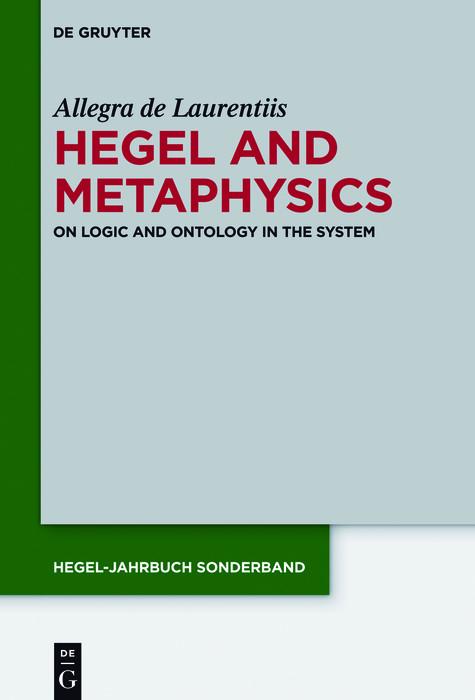
Hegel and Metaphysics: On Logic and Ontology in the System, edited by Allegra de Laurentiis with Soren Whited, offers us an analysis of Hegel’s philosophical system and its relationship to the complex, often contentious domain of metaphysics. As a collection of scholarly essays, this volume goes deeply into the fundamental question that continues to animate debates around Hegel: does his philosophy transcend metaphysics, or does it constitute a renewed and radical form of metaphysical thinking? The contributors here argue convincingly that Hegel does not abandon metaphysical inquiry; rather, he reformulates it in ways that challenge traditional boundaries and assumptions. Through Hegel’s intricate synthesis of logic and ontology, his philosophy illuminates what might be termed a “dialectical metaphysics,” which departs from earlier frameworks even as it inherits and transforms them.
This volume represents a significant contribution to the scholarly discourse surrounding Hegel’s metaphysics by bringing together perspectives that navigate the polarities between metaphysical and anti-metaphysical interpretations. With striking clarity, the authors dissect the nuances of Hegel’s dialectical method and his conceptualization of metaphysics as neither a simple affirmation nor a mere rejection of traditional metaphysical categories. Instead, they reveal Hegel’s commitment to a reconstituted metaphysical framework in which logic itself becomes an ontological structure—a system of thought that captures the dynamic unfolding of reality. This approach, they argue, reflects Hegel’s unique conception of the “unity” of logic and metaphysics, in which thought and being are not isolated but rather mutually constitutive.
As the essays show, Hegel’s metaphysical commitments are anything but straightforward. His philosophical project moves beyond the limitations of “old metaphysics” while also avoiding the wholesale rejection of metaphysical questions that characterized much of twentieth-century philosophy. In Hegel’s view, the framework of traditional metaphysics, characterized by a static and pre-critical ontology, fails to grasp the inherently self-developing nature of reality and thought. Hegel replaces this with a speculative system wherein metaphysical concepts such as essence, substance, and being are dynamically reinterpreted through the dialectical logic of becoming, negation, and synthesis. This reimagining of metaphysics underscores the need for philosophical inquiry to engage not with fixed structures but with processes that reveal the dialectical movement of concepts and their transformation.
By carefully examining Hegel’s critique of previous metaphysical doctrines, particularly his response to Kant’s critical philosophy, the contributors underscore Hegel’s rejection of a metaphysical subject that stands outside of and imposes order upon reality. Instead, Hegel’s Logic articulates a subject-less, self-determining realm of thought that exists without recourse to any transcendental entity or external grounding. Hegelian logic thus emerges as an immanent process in which categories such as “infinity,” “the Concept,” and “teleology” are grasped in their fluid interconnections, rather than as isolated metaphysical absolutes. Such notions as the “true infinite” epitomize the difference between Hegel’s speculative system and both pre-critical metaphysics and Kant’s critical framework, suggesting that Hegel’s philosophy may represent a metaphysics of becoming, where the process itself is ontologically definitive.
The contributors to this volume bring these abstract ideas to bear on a wide array of specific themes within Hegel’s corpus, including self-consciousness, practical philosophy, teleology, naturalism, language, infinity, and human agency. Through close textual analysis, they reveal how these themes exemplify Hegel’s metaphysical orientation. For instance, Hegel’s treatment of human agency in the Philosophy of Spirit exemplifies his distinctive metaphysical commitments, showing how human action is grounded in the self-realizing movement of the Concept. This ontological view of agency reflects a break from traditional metaphysical conceptions of the subject as an isolated, self-subsisting entity, situating it instead within a dynamic process of dialectical self-determination.
The authors also engage with the historical legacy of metaphysics and its perceived decline in contemporary philosophy, especially given the twentieth century’s “anti-metaphysical” turn in both analytic and continental traditions. In these essays, metaphysics is not merely dismissed or rehabilitated but is rather subjected to a Hegelian sublation—a synthesis that preserves essential aspects of metaphysical inquiry while reconfiguring its scope and method. Contributors argue that Hegel’s metaphysical logic offers a response to both the analytic and continental traditions’ critiques of metaphysics, by framing metaphysical questions within a dialectical process that resists reduction to either formal abstraction or existential phenomenology.
Indeed, this collection demonstrates that Hegel’s metaphysics, while rooted in the Aristotelian tradition, is nevertheless a modern and complex response to the metaphysical questions of his time—questions that continue to reverberate in contemporary philosophy. By affirming the “identity of logic and metaphysics,” Hegel reframes ontology not as a static field but as a living, rational structure that unfolds within history and thought. In doing so, he anticipates many of the debates that shape current metaphysical inquiry, including issues surrounding realism, naturalism, and the ontology of mind and matter. Through their respective analyses, the authors reveal Hegel’s metaphysical project as an ongoing philosophical task rather than a completed system. The contributions here suggest that Hegel’s dialectical ontology challenges both scientific reductionism and existential hermeneutics, proposing instead a speculative account of being that is rooted in the self-movement of concepts.
By drawing on Hegel’s Logic and his philosophy of nature and spirit, the essays in this volume establish a rigorous framework for interpreting Hegel’s work as an attempt to reinvigorate metaphysical thought in a manner that remains attuned to the self-disclosing nature of reality. The contributors argue that this metaphysical approach is not an esoteric abstraction but a systematic engagement with concrete phenomena, from the structures of human consciousness to the natural and social dimensions of existence. This approach underscores the interdependency between Hegel’s metaphysical logic and his practical philosophy, suggesting that metaphysics for Hegel is deeply connected to questions of freedom, ethical life, and human action.
Through their varied perspectives, the essays in Hegel and Metaphysics illuminate the philosophical significance of Hegel’s metaphysics in a manner that speaks to both historical and contemporary audiences. The collection challenges readers to grapple with the dialectical structure of Hegel’s thought, in which metaphysical categories are not static but are rather part of an evolving philosophical system. This dialectical view resonates with contemporary debates about the nature of metaphysics, especially in an era that increasingly questions the role and relevance of metaphysical inquiry. By addressing these debates within the context of Hegel’s system, the contributors underscore the enduring relevance of Hegel’s metaphysics for understanding the relationship between thought and reality, and for situating metaphysical questions within the horizon of human experience.
This collection offers a compelling and sophisticated examination of Hegel’s metaphysics that not only provides insights into his philosophical system but also engages with broader questions about the nature and purpose of metaphysical thought. By exploring the depth and nuance of Hegel’s speculative metaphysics, Hegel and Metaphysics makes a persuasive case for the necessity of metaphysical inquiry in contemporary philosophy, demonstrating that Hegel’s legacy continues to offer profound insights into the nature of reality, logic, and human existence.
 Simon Gros
Leave a comment