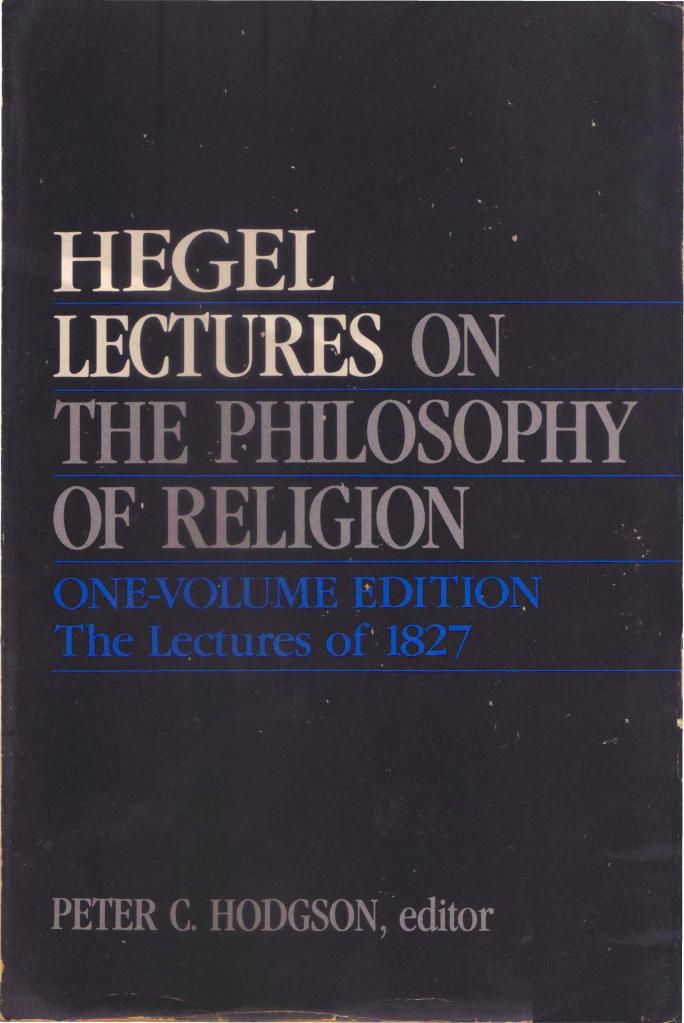
The Lectures on the Philosophy of Religion in their 1827 iteration represent one of the clearest and most mature expressions of Hegel’s complex and comprehensive philosophical system, focusing explicitly on the concept of religion and its place in human life and thought. Hegel, a towering figure in German Idealism, integrates religion into his broader dialectical framework, seeking to elevate the understanding of religious consciousness to a place of speculative rigor. This one-volume edition, extracted from the larger three-volume critical collection of his Lectures on the Philosophy of Religion, is a concentrated yet expansive presentation of Hegel’s thought on this critical subject, retaining both the rich intellectual depth and the accessibility that make these particular lectures more approachable compared to earlier versions.
Hegel’s 1827 lectures are notably significant as they reflect the culmination of decades of intellectual labor, theological reflection, and engagement with philosophical tradition. These lectures, delivered at the University of Berlin during a period of intense scholarly production, mark Hegel’s final and most lucid articulation of the philosophical significance of religion. Unlike earlier, more tentative formulations, the 1827 lectures are marked by an increased clarity and a refined systematization of the relationship between philosophy and religion. They are marked by an effort to reconcile the theological with the philosophical, aiming to demonstrate that the deepest truths of religion—specifically Christianity—are comprehensible and communicable within the framework of speculative philosophy.
In this edition, the reader finds Hegel in vigorous dialogue with his contemporaries, particularly with the theological framework offered by Friedrich Schleiermacher. The polemical undercurrent against Schleiermacher’s subjectivist approach to religion is palpable, as Hegel seeks to establish a philosophy of religion that transcends mere feeling or intuition and elevates religion to a level of objective thought. Hegel critiques Schleiermacher’s emphasis on religious experience and feeling as insufficient for grasping the true essence of religion, which for Hegel, lies in its role as the self-consciousness of spirit, manifesting in the rational comprehension of the divine.
Central to these lectures is Hegel’s elaboration on the concept of God, which, in his system, is not a being external to the world but is the absolute, the immanent and transcendent unity of all things. Hegel moves beyond traditional metaphysical proofs for the existence of God, framing God instead as the ultimate self-realization of the Idea, manifesting in the dialectical process of the world and human history. Here, God is understood as both the beginning and the end, the Alpha and Omega, the principle that underlies the unfolding of the universe. This marks a deep departure from deistic or personalist conceptions of the divine, positioning God as the absolute spirit whose nature can be comprehended through the movement of dialectical reason.
The Lectures on the Philosophy of Religion chart the development of religious consciousness through history in detail. Hegel organizes the lectures into three primary sections: the Concept of Religion, Determinate Religion, and Consummate Religion. The historical evolution of religious consciousness is not merely a historical recounting but a philosophical investigation into the progressive self-revelation of the absolute spirit through different cultural and religious forms. Hegel’s treatment of Determinate Religion—covering the religious systems of the Orient, Judaism, and the pre-Christian religions—serves as a rich philosophical anthropology, examining how each of these religious systems represents a stage in the unfolding of absolute spirit. These religions are not seen as simply superseded but are understood as necessary stages in the dialectical development of the absolute’s self-consciousness.
In particular, Hegel’s analysis of Judaism and Christianity is contentious. Judaism, according to Hegel, represents a stage of alienation, wherein God is understood as an abstract, transcendent authority that stands apart from the world and the individual. Christianity, however, is positioned as the culmination of religious development—what Hegel calls the “Consummate Religion”—wherein the divine becomes fully actualized in the world through the incarnation of Christ. For Hegel, the doctrine of the Trinity embodies the speculative truth of the unity of the particular and the universal, the finite and the infinite. The Christian religion, in its philosophical essence, expresses the reconciliation of humanity with the divine, a reconciliation achieved through the dialectical process of death and resurrection, both existentially in the figure of Christ and metaphysically in the self-realization of spirit.
This one-volume edition, while necessarily abridged, does not lose the dense interplay of philosophical concepts that Hegel creates throughout the lectures. The Concept of Religion, which opens the series, deals with the fundamental nature of religious thought and its necessity for human freedom. For Hegel, religion is not a mere set of beliefs or practices, but the consciousness of freedom, the realization of the spirit’s true nature. This is the locus where human beings transcend their finite existence and participate in the infinite, an ontological ascent that mirrors the structure of Hegel’s larger philosophical system, particularly his Science of Logic and the Phenomenology of Spirit.
The relationship between religion and philosophy, one of the key themes of these lectures, is explored with detailed care. Hegel argues that while religion and philosophy both aim at the same truth—the absolute—they approach it differently. Religion presents the truth in the form of representation (Vorstellung), employing images and symbols, whereas philosophy approaches it through conceptual thought. For Hegel, the task of philosophy is to make explicit what religion presents in an intuitive and representational form. Thus, philosophy does not destroy or replace religion but brings to full consciousness what is implicit in religious experience.
Another critical feature of these lectures is Hegel’s engagement with the God-world relationship. Hegel rejects both the dualistic separation of God and the world found in certain theistic traditions and the pantheistic identification of God with the world. Instead, Hegel proposes a dynamic, dialectical relation where God is both immanent in the world and transcendent of it. The world, as the expression of God’s self-realization, is a process in which the divine comes to know itself. This process is not one of simple identity but of contradiction and resolution, a movement from alienation to reconciliation that mirrors Hegel’s overarching dialectical method.
This edition is not only significant for its philosophical content but also for the scholarly apparatus that accompanies it. The critical footnotes, glossary, and bibliography provided by the editors offer invaluable tools for navigating Hegel’s dense and often difficult prose. The glossary, in particular, helps to clarify Hegel’s specialized use of terms, many of which have no straightforward English equivalent. Furthermore, the comparative tables that trace the structural differences between the various series of lectures enable scholars to better understand the development of Hegel’s thought over time, particularly the differences between the 1827 lectures and the earlier 1824 series.
This one-volume edition of Hegel’s Lectures on the Philosophy of Religion is an indispensable resource for both scholars and students alike. It offers a deep engagement with the philosophical dimensions of religion, revealing Hegel’s deep commitment to understanding religion as a central aspect of human existence. Through his dialectical method, Hegel elevates religion from the domain of subjective feeling to that of objective knowledge, positioning it as a necessary stage in the self-realization of spirit. This text not only enriches our understanding of Hegel’s philosophy but also provides a powerful framework for grappling with the perennial questions of God, freedom, and human destiny.
 Simon Gros
Leave a comment