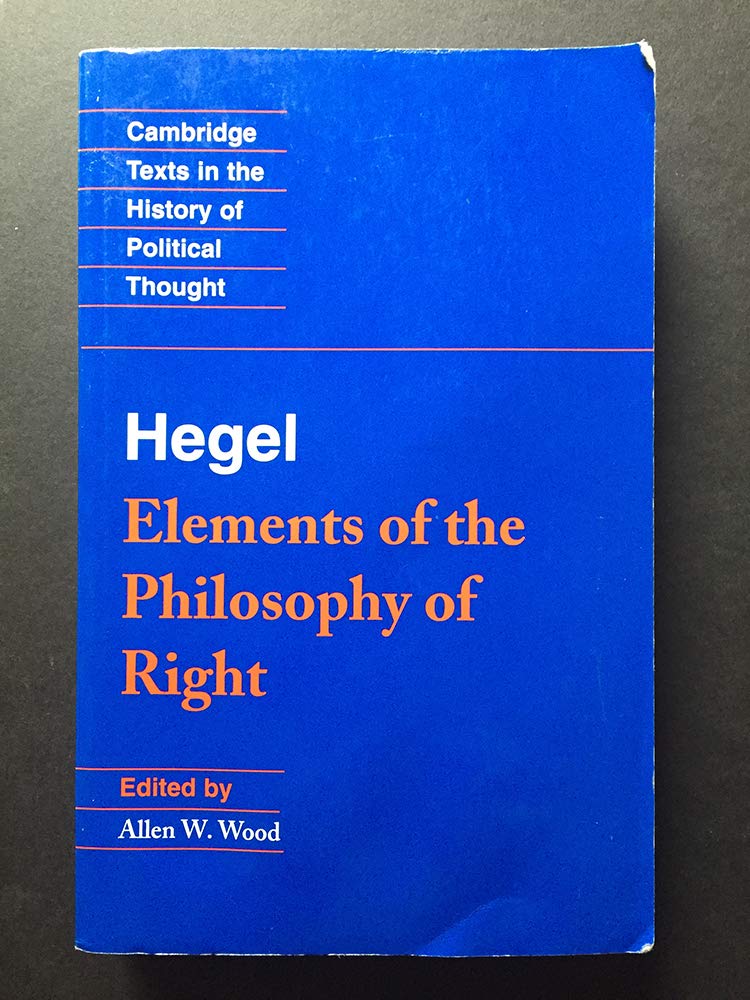
In Elements of the Philosophy of Right, Georg Wilhelm Friedrich Hegel presents a monumental exposition of ethical theory, natural rights, the philosophy of law, and political theory, combining these areas into a comprehensive examination of modern sociopolitical life. Edited by Allen W. Wood and translated by H. B. Nisbet, this edition is particularly significant as it embodies a literal translation that remains accessible, effectively bridging the gap between Hegel’s philosophical language and the contemporary reader. The work displays Hegel’s ambition to articulate a coherent framework for understanding the ethical dimensions of society, the nature of freedom, and the complex interplay between the individual and the state, situated within his broader philosophical narrative of history.
Hegel’s “Philosophy of Right” represents his final major contribution to philosophical thought, crystallizing ideas that had evolved throughout his career. As a pivotal text in the canon of modern political philosophy, it challenges simplistic interpretations of Hegel as a staunch conservative or a precursor to totalitarian ideologies. Instead, it reveals a thinker deeply engaged with the historical context of his time, particularly the political turbulence of early 19th-century Prussia following the Napoleonic Wars. The text emerged against a backdrop of reform and reaction, as Hegel navigated the ideological currents that threatened to undermine the nascent constitutional state. His work is not merely a reflection of the status quo of the time but an explanation of the rational state that embodies the ideals of freedom and ethical life.
Central to Hegel’s philosophy is the concept of freedom, which he defines in ways that diverge from common understandings. For Hegel, true freedom is not simply the absence of constraints or the capacity for arbitrary action; rather, it involves self-determination and the integration of individual aspirations within a rational social order. Freedom, therefore, is articulated through the lens of ethical life (Sittlichkeit), which encompasses the institutions and customs that shape individual character and facilitate the realization of personal and collective goals. Hegel’s insistence that freedom is realized through participation in rational social institutions counters individualistic interpretations of freedom that can lead to fragmentation and alienation.
In examining the nature of the state, Hegel argues that it is the embodiment of ethical life, a realization of rational freedom that transcends individual desires. He posits that the state serves not merely as a mechanism for enforcing law but as a manifestation of the ethical will of a people, whereby individual freedoms find their fullest expression. The state, in Hegel’s view, is rational and ethical when it reflects the common good, enabling citizens to recognize their freedom as part of a larger whole. This key connection between individual and state becomes a foundational aspect of Hegel’s critique of liberalism. While acknowledging the contributions of liberal thought to the understanding of individual rights, he critiques its limitations, particularly its propensity to fragment social bonds and promote a narrow self-interest that can undermine the collective good.
Hegel’s approach to ethics and the political state distinguishes between the objective and subjective dimensions of ethical life. Objective ethical life refers to the structures of society—laws, institutions, and social customs—that provide a framework within which individuals can realize their freedom. Subjective ethical life, on the other hand, pertains to individual character and disposition, emphasizing the alignment of personal inclinations with the rational demands of the ethical community. This synthesis of objective and subjective ethical life positions Hegel’s philosophy as a dynamic interaction between individual agency and communal structures, challenging reductive notions that prioritize either aspect in isolation.
Hegel’s engagement with the philosophical traditions preceding him, particularly his dialogue with Kantian ethics, reflects his aspiration to transcend their limitations. He critiques Kant’s dichotomy between duty and inclination, arguing that a truly rational ethical framework harmonizes personal motivations with social obligations. In Hegel’s view, ethical life does not impose restrictions on freedom; rather, it actualizes freedom by cultivating a sense of duty that resonates with individual fulfillment. The ethical disposition, which emerges from a rational societal context, allows individuals to pursue their interests in ways that are consonant with the common good, fostering a sense of belonging and responsibility within the social order.
The historical context of Hegel’s thought further enriches the interpretation of his Philosophy of Right. The political climate of early 19th-century Prussia was marked by significant upheaval, with reformist impulses emerging in response to the failures of absolutism. Hegel’s philosophical inquiries into the nature of the state and civil society were shaped by the pressing questions of his time: How can freedom be reconciled with authority? What role do institutions play in the realization of ethical life? The text can be seen as Hegel’s response to these inquiries, offering a vision of a rational state that is not merely an instrument of power but a facilitator of human freedom.
This edition of Hegel’s Elements of the Philosophy of Right is augmented by substantial editorial material that illuminates the historical backdrop of Hegel’s work, contextualizing his references to Roman law and other philosophical sources. The editors provide critical insights into the ideological debates that shaped Hegel’s thought and the reception of his work, highlighting the contentious interpretations that have emerged over time. From radical critiques to conservative readings, Hegel’s philosophy has sparked diverse reactions, reflecting its enduring relevance and the complexities inherent in his ideas.
The legacy of Hegel’s Philosophy of Right extends far beyond its immediate historical context, influencing a wide spectrum of political movements and philosophical discourses, from leftist critiques to conservative appropriations. Its themes resonate in contemporary discussions surrounding the role of the state, the nature of freedom, and the ethical dimensions of social life. The text serves as a foundational reference point for scholars and students alike, prompting critical engagement within the relationships between individuals, society, and the state.
This translation of Hegel’s work, with its careful attention to detail and clarity, provides an invaluable resource for those seeking to grapple with one of the most challenging yet rewarding texts in the history of political thought. By rendering Hegel’s complex ideas in a form that is both readable and academically rigorous, this edition positions itself as an essential tool for navigating the rich landscape of Hegelian philosophy, ultimately inviting readers to reconsider their own assumptions about freedom, ethics, and the nature of the state in the modern world. Through Hegel’s lens, we are encouraged to perceive freedom not as an abstract ideal but as a lived reality, intricately engaged within the areas of social institutions that nurture and sustain our ethical life.
 Simon Gros
Leave a comment