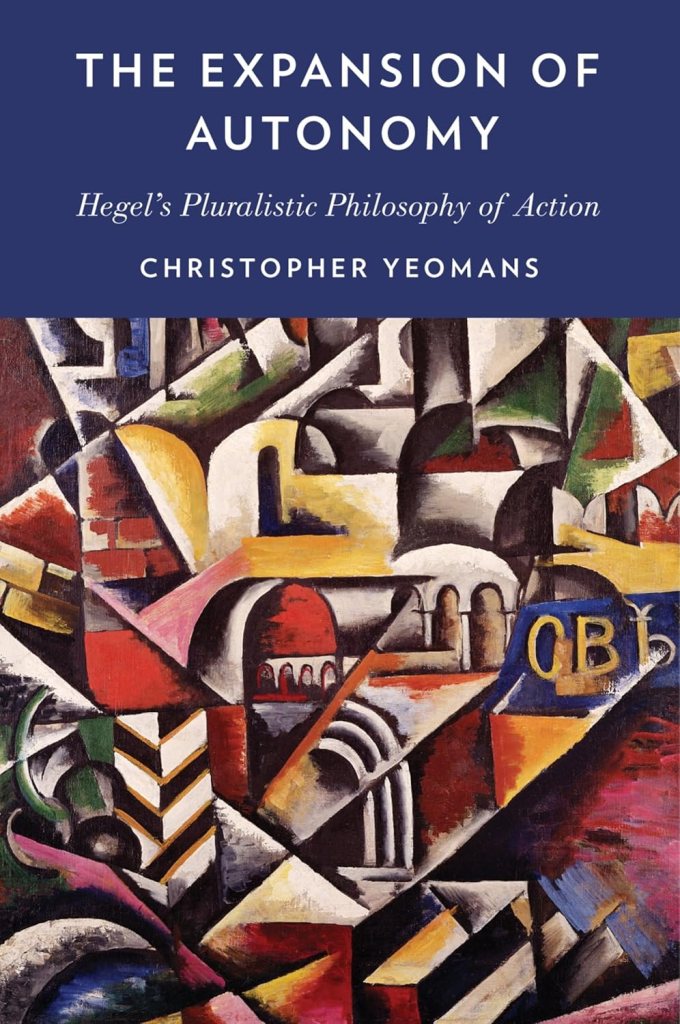
Christopher Yeomans’ The Expansion of Autonomy: Hegel’s Pluralistic Philosophy of Action explores the tension within modern ethical thought surrounding the nature of autonomy—a problem rooted in the contrasting philosophical systems of Kant and Hegel. Yeomans aims to reveal the subtle complexity of Hegel’s critique of Kantian morality and the revolutionary ways in which Hegel addresses the limits of Kant’s ethics, particularly through his concept of Sittlichkeit (ethical life), which surpasses the Kantian moral formalism by rooting freedom in concrete social and institutional contexts. Yeomans does not merely provide a static account of Hegel’s critique, but articulates the manner in which Hegel appropriates and transforms key Kantian themes into a rich, pluralistic framework that offers a more comprehensive and dynamic understanding of self-determination.
Yeomans’ interpretation is an exploration of how Hegel responds to Kant’s moral psychology, specifically Kant’s attempt to reconcile autonomy with individual diversity—how autonomous agents can pursue qualitatively distinct projects and relations while remaining anchored in universal moral demands. Yeomans dissects Kant’s effort to infuse the concept of autonomy with concrete ethical content through his Doctrine of Virtue, and demonstrates how Hegel’s account reframes this effort by focusing on the vital notions of talent and interest. These notions serve as the keystones in Hegel’s effort to ground autonomy not in abstract moral laws but in the lived, practical realities of individuals embedded within diverse social structures.
Yeomans argues that Hegel’s philosophy of action represents a kind of pluralism that resists reducing human agency to a single form. Hegel, Yeomans explains, does not conceive of autonomy as a monolithic capacity for abstract moral reasoning, as Kant did, but rather as a dynamic interaction of different forms of agency, each one tied to distinct social roles and institutions. Autonomy, in Hegel’s framework, emerges from the dialectical interplay of the individual and the collective, and Yeomans masterfully shows how Hegel positions this plurality within a framework of mutual recognition. Each form of agency represents a specific way of solving the problem of self-determination, and although these solutions may differ, each deserves respect from the perspective of the others.
The scope of The Expansion of Autonomy is not limited to a direct comparison of Kant and Hegel. Yeomans places Hegel’s critique within the larger historical and philosophical context of German Idealism, tracing how Fichte’s moral philosophy also plays a crucial role in Hegel’s reworking of autonomy. Yeomans highlights the details of Hegel’s engagement with Fichte’s emphasis on the self-positing “I,” which provides a foundation for agency but, in Hegel’s view, remains trapped within an abstract formalism that fails to account for the concrete particularities of human life. Yeomans shows how Hegel’s treatment of Sittlichkeit addresses this limitation by offering a vision of ethical life in which the self does not stand apart from its social environment but rather finds its freedom through participation in it.
One of the most compelling aspects of Yeomans’ book is his demonstration of how Hegel’s pluralism extends beyond individual ethics into the realm of social and political life. Yeomans elucidates how Hegel’s theory of the estates (Stände)—social groups that include, for instance, the family, civil society, and the state—provides concrete forms for the realization of different kinds of agency. Each estate embodies a distinct form of accountability that corresponds to a particular way of integrating personal interests and talents with broader social norms. Yeomans emphasizes that Hegel’s analysis of these estates is not merely descriptive but serves as a blueprint for understanding the diversity of ways in which autonomy can be realized within different social contexts. By exploring the estates, Hegel seeks to show that true freedom is found not in abstract moral laws but in the concrete institutions that shape our lives and provide the means for the actualization of our unique talents and interests.
Yeomans’ work provides a highly detailed and comprehensive analysis of how Hegel’s moral psychology, as it is articulated through the concepts of talent and interest, represents a distinctively expressivist form of autonomy. Hegel, according to Yeomans, rejects Kant’s rigid formalism in favor of an account of the will that is inherently social and historical. This account does not isolate the self from the world but views freedom as something achieved through active engagement with one’s social surroundings. Autonomy, in Hegel’s view, is not a withdrawal from the contingencies of life into the purity of moral law, but rather the active shaping of one’s life in accordance with both internal capacities (talent) and external opportunities (interest).
In making this case, Yeomans also engages with contemporary debates in moral and political philosophy, positioning Hegel as a serious contender in discussions about the nature of freedom and autonomy. His interpretation of Hegel offers a strong counterpoint to modern liberal conceptions of autonomy, which often emphasize individual rights and freedoms at the expense of communal ties and social obligations. Yeomans argues that Hegel’s pluralism offers a more nuanced understanding of autonomy, one that acknowledges the importance of social structures while still preserving the individual’s capacity for self-determination.
What makes The Expansion of Autonomy particularly important is that it does not treat Hegel’s philosophy of action as an isolated theoretical framework. Rather, Yeomans situates Hegel’s account within the broader historical context of post-Kantian philosophy, drawing connections between Hegel’s ethical theory and contemporary concerns about the role of the individual in a rapidly changing social world. Yeomans’ Hegel is a philosopher who grapples with the same problems of agency, freedom, and social identity that continue to challenge modern thinkers, offering a vision of autonomy that is as relevant today as it was in Hegel’s time.
By reconstructing Hegel’s account of individuality and social differentiation, Yeomans makes a persuasive case for seeing Hegel’s ethical theory as an elaboration, rather than a rejection, of the Kantian concept of autonomy. He demonstrates that Hegel’s critique of Kant’s formalism is not a dismissal but a deepening of the concept of freedom, grounded in a richer understanding of the social and historical conditions that shape human action. This makes Yeomans’ book a major contribution to Hegelian scholarship, offering new insights into the way that Hegel’s practical philosophy addresses enduring questions about the nature of freedom, individuality, and community.
The Expansion of Autonomy is an ambitious and deeply intellectual work that challenges readers to rethink the nature of autonomy in light of Hegel’s pluralistic and historically grounded philosophy of action. Yeomans offers a powerful reinterpretation of Hegel’s thought that will undoubtedly influence scholarship on German Idealism and contemporary ethical theory. Through a detailed engagement with Hegel’s texts and a nuanced understanding of the philosophical issues at stake, Yeomans succeeds in bringing to life the richness and relevance of Hegel’s vision of freedom for the modern world.
 Simon Gros
Leave a comment