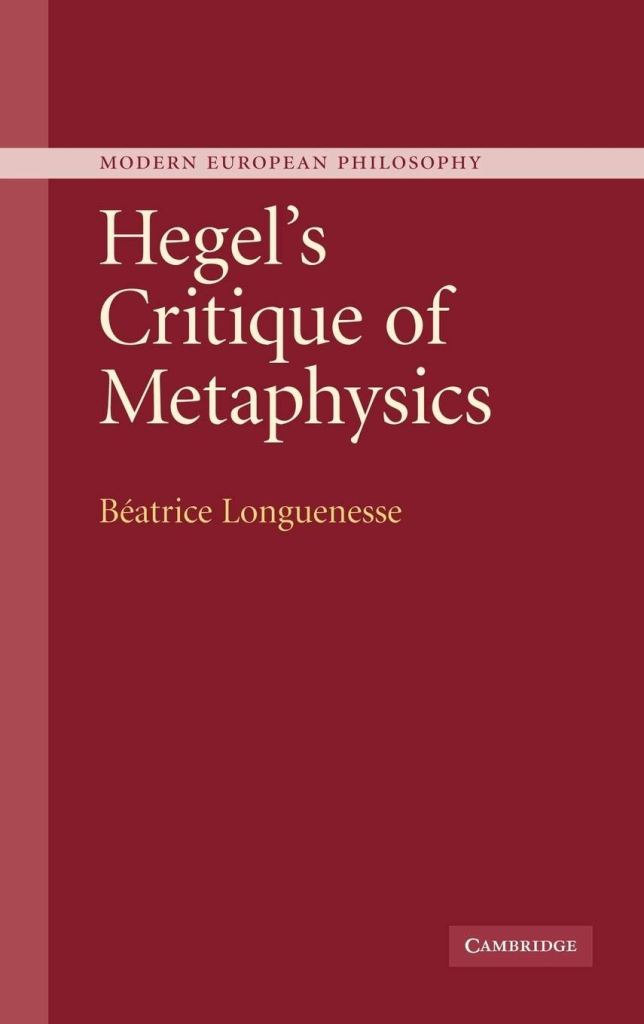
Hegel’s Critique of Metaphysics by Béatrice Longuenesse (translated by Nicole J. Simek) is a masterful and deeply considered philosophical investigation that delves into the complexities of Hegel’s Science of Logic. Despite the longstanding prominence of Hegel’s Phenomenology of Spirit in philosophical discourse, Longuenesse draws attention to what Hegel himself considered his most important work: the Science of Logic. In doing so, she elucidates the crucial themes and conceptual frameworks that underpin Hegel’s dialectical logic, while placing his project in dialogue with the critical philosophy of Immanuel Kant. This book is a remarkable feat of philosophical scholarship, offering a dense interpretation of the major issues surrounding Hegel’s metaphysical inquiry, all while engaging with Kant’s transcendental philosophy, which Hegel both drew from and reacted against.
At the core of Longuenesse’s analysis lies Hegel’s dialectical logic, a system that seeks to overcome the shortcomings of both traditional metaphysics and Kantian critical philosophy. In contrast to the analytic rigidity of formal logic, Hegel’s logic is inherently dynamic, rooted in the principle of contradiction and the self-development of concepts. Longuenesse unpacks Hegel’s assertion that contradiction is not merely an obstacle to thought but the very motor of conceptual progression. It is through contradiction that determinate being unfolds into more complex forms of unity. Her analysis of Hegel’s concept of contradiction not only clarifies one of the most difficult aspects of his logic but also situates it within Hegel’s broader metaphysical ambition to demonstrate that reality is constituted by the movement of thought itself.
Longuenesse further explores Hegel’s provocative dictum that “what is actual is rational, what is rational is actual.” This is not a straightforward assertion of the identity of thought and reality, but a carefully argued claim about the role of rationality in structuring both our understanding of the world and the world’s very nature. Hegel’s logic aims to show how the rational structure of thought is immanent in the very being of things. The real challenge, as Longuenesse illustrates, is to see how Hegel positions this claim as a critique of both dogmatic metaphysics, which presupposes a fixed, external reality, and Kantian transcendental idealism, which places the rational unity of experience exclusively within the mind’s subjective faculties. Hegel seeks to overcome this dualism, and Longuenesse’s exposition highlights how this overcoming is intricately tied to the dialectical development of logical categories.
Throughout, Longuenesse carefully traces Hegel’s reliance on Kant’s Critique of Pure Reason, particularly Kant’s transcendental logic. She argues that Hegel’s Science of Logic can only be fully understood as a continuation and radical transformation of Kant’s project. Where Kant sought to limit metaphysical claims to those justifiable by the structures of human cognition, Hegel expanded the scope of these structures to encompass the very reality they describe. In particular, Longuenesse focuses on the pivotal transition from Kant’s “transcendental unity of apperception” to Hegel’s concept of the “absolute idea,” a move that marks Hegel’s shift from epistemology to ontology. This transition is key to understanding Hegel’s claim that logic is not simply a tool for thinking about being, but the very process of being itself.
One of Longuenesse’s most significant contributions in this work is her analysis of the Doctrine of Essence, the second part of Hegel’s Science of Logic. Here, Hegel elaborates the crucial logical categories of “ground,” “contradiction,” and “actuality,” all of which serve as the foundation for his later exposition of the concept and the idea. Longuenesse expertly unpacks Hegel’s treatment of these categories, demonstrating their importance in the context of his larger metaphysical system. Her examination of Hegel’s notion of ground, for example, reveals its deep connection to Kant’s idea of the unity of reason, while also showing how Hegel goes beyond Kant by reinterpreting this unity in terms of the dynamic interrelation of opposites. For Hegel, ground is not merely a static foundation but the movement through which the multiplicity of empirical conditions finds its unity in thought. This insight is crucial for understanding how Hegel conceives the relationship between thought and being, a relationship that is central to his entire philosophical enterprise.
In the second part of the book, Longuenesse offers a more nuanced view of Hegel’s Science of Logic in light of her further study of Kant. These essays reflect her growing ambivalence about the extent to which Hegel can truly be seen as a successor to Kant’s critique of metaphysics. While her initial analysis emphasized Hegel’s debt to Kant’s transcendental logic, she later recognizes the profound differences between the two thinkers, particularly with respect to the role of judgment and the nature of reason. In her essay on Hegel’s concept of judgment, for example, she demonstrates how Hegel’s logic departs from Kant’s by elevating the concept of judgment from a merely formal operation of the mind to a fundamental process of reality’s self-determination. This shift highlights Hegel’s ambition to restore metaphysics in a post-Kantian age, an ambition that remains contentious even within the framework of his own system.
Longuenesse’s work is not only a key commentary on Hegel but also an invaluable contribution to contemporary philosophical debates on the nature of metaphysics and logic. By drawing connections between Hegel’s dialectical method and ongoing discussions in philosophy of mind, epistemology, and social theory, she positions Hegel’s thought as a vital resource for addressing contemporary issues. The book’s rigorous and detailed engagement with both Hegel and Kant will appeal to scholars interested in German Idealism, but its implications extend far beyond historical scholarship. Longuenesse shows that Hegel’s logic, despite its complexity, has enduring relevance for anyone concerned with the fundamental questions of how we think, how we know, and how the world is structured by thought.
Hegel’s Critique of Metaphysics is a monumental achievement that offers an indispensable guide to Hegel’s most challenging work. Longuenesse’s interpretation is thorough, making clear the stakes of Hegel’s project and its philosophical significance. Her careful reconstruction of Hegel’s relation to Kant deepens our understanding of both philosophers and sheds new light on the ongoing relevance of their ideas. For anyone interested in Hegel, Kant, or the history of metaphysics, this book is an essential resource, offering a richly detailed and philosophically sophisticated account of Hegel’s Science of Logic and its place within the broader tradition of critical philosophy.
 Simon Gros
Leave a comment