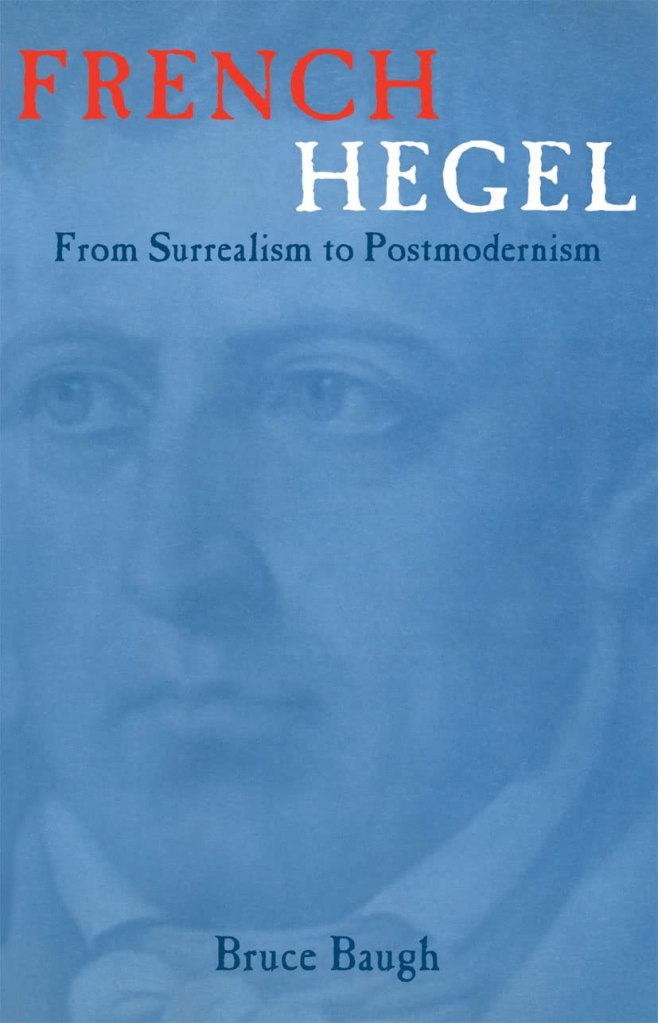
In French Hegel: From Surrealism to Postmodernism, Bruce Baugh presents a detailed history of ideas that traces the impact of Hegel on French philosophy from the 1920s to the present day. This work provides a lucid narrative that illuminates Hegel’s influence across various intellectual movements and key thinkers in France throughout the twentieth century. Baugh identifies a lineage of Hegelian thought that spans from Jean Wahl, Sartre, and Bataille to Foucault, Deleuze, and Derrida. At the heart of Baugh’s analysis is Hegel’s notion of the “unhappy consciousness,” which serves as a focal point through which he offers a bold reappraisal of Hegel’s early reception in French intellectual history.
The book establishes a vital premise: that twentieth-century French philosophy was deeply engaged with German thought, particularly the works of Husserl, Heidegger, Nietzsche, Marx, and Hegel. Among these, Hegel emerges as the most complex and elusive figure, eliciting ambivalence and conflict within French philosophical discourse. Baugh asserts that French thinkers have striven to resist and correct Hegel even as they are irresistibly drawn to his ideas. This paradox manifests itself in the desires of the Surrealists, who seek unlimited negation, Sartre’s quest for negation without totality, and Derrida and Bataille’s pursuit of negativity devoid of recuperation into a positive outcome. Even those who vehemently oppose Hegel, such as Deleuze and Foucault, inadvertently displayed the imprint of his thought, suggesting that the trajectory of French philosophy over the last century has involved a dance of denial and affirmation concerning Hegelian themes.
Most existing accounts of Hegel’s reception in France tend to focus primarily on the dialectical relationship depicted in the Phenomenology of Spirit, particularly the master-slave dialectic and its implications for historical theory. A pivotal figure in this narrative is Alexandre Kojève, whose lectures at the École Pratique des Hautes Études during the early 1930s have attained near-mythic status in their supposed initiation of an entire generation into Hegel’s dialectical complexities. However, Baugh challenges the grandiose assertion that Kojève singularly catalyzed this engagement, arguing instead that Hegel’s entrance into the French intellectual scene predates Kojève’s lectures by a decade.
The Surrealists’ fascination with Hegel’s dialectical negations as a means of dissolving the boundaries between reality and dreams, and the Marxists’ application of Hegelian “idealist” dialectics to illuminate dialectical materialism, both illustrate the depth of Hegel’s influence. Moreover, Jean Wahl’s seminal 1929 work, Le malheur de la conscience dans la philosophie de Hegel, has left an indelible mark on French thinkers grappling with themes of irreconcilable divisions and unbridgeable differences. This fixation on the unhappy consciousness, as delineated by Hegel, resonates throughout French philosophy, from existentialism and surrealism to various poststructuralist critiques of totality and history.
Baugh’s aim is to delineate the trajectory of this preoccupation with “the unhappy consciousness” as it has evolved through its myriad manifestations in French thought over the twentieth century. Rather than centering his discussion solely on Hegel’s original texts, Baugh is concerned with how French philosophers have interpreted and utilized the theme of the unhappy consciousness. He begins by outlining Wahl’s interpretation, which reimagines Hegel’s concept not as a mere historical moment but as a perennial condition of the self. Wahl’s analysis transforms the unhappy consciousness into a lens through which to view the multifaceted experiences of a self divided against itself—a theme that becomes the motor driving the dialectic. Wahl’s interpretation suggests that unhappiness arises from the opposition between the self’s universal and eternal aspirations and its particular, finite reality.
Baugh highlights that Wahl’s contributions are significant not merely for their Hegelian fidelity but for how they expand the implications of the unhappy consciousness within a broader existential framework. Wahl’s assertion that the unhappy consciousness can take many forms reflects a deeper philosophical inquiry into the nature of subjectivity and the divisions that characterize human existence. The core of Wahl’s argument posits that the self’s internal conflicts, which create suffering, propel the individual toward a reconciliation of these divisions—a reconciliation that resonates through the subsequent philosophical discourse in France. Wahl’s emphasis on the importance of recognizing and addressing the conflicts between sensuous impulse and rational duty, self-interest and the interest of others, and various societal obligations illustrates a nuanced understanding of the human condition that challenges simplistic resolutions.
Through the book Baugh examines the rich variety of French philosophy as it grapples with Hegel’s influence. He explores the anthropological turn in French thought during the early twentieth century, where thinkers began to prioritize the concept of Spirit over Hegel’s logic and philosophy of nature. This shift allowed for the incorporation of Hegelian themes into the fabric of surrealism, Marxism, and existentialism, with Wahl’s focus on the unhappy consciousness paralleling Kojève’s more well-known interpretation of the master-slave dialectic. Baugh delves into the existential protests put forth by philosophers like Wahl and Fondane, examining how they navigate the implications of an unhappy consciousness that finds expression in various literary and philosophical works of the 1930s and 40s.
Baugh also scrutinizes the roles played by Henri Lefebvre, Georges Bataille, and Sartre, highlighting how each thinker appropriated and responded to Hegelian themes, particularly the nature of negativity and the existential condition of unhappiness. Bataille’s radical engagement with negativity and the limits of existence contrasts sharply with Sartre’s exploration of the unhappy consciousness, which becomes central to his philosophy. As Baugh traces these connections, he elucidates how the legacy of Hegelian thought in France manifests not just as a philosophical doctrine but as a lived experience, interwoven into the very being of existential inquiry and artistic expression.
Baugh addresses the persistence of Hegel’s themes of negativity in the works of later thinkers like Derrida, Deleuze, and Foucault, all of whom grapple with the implications of Hegelian thought while striving to move beyond it. This engagement reveals a complex interplay between affirmation and denial, where philosophers found themselves compelled to reckon with Hegel’s legacy even as they sought to critique or transcend it. Baugh argues that this ongoing dialogue reflects a broader trend in French philosophy, one that is marked by a rejection of final synthesis and an embrace of difference and division as fundamental aspects of the human condition.
Baugh’s French Hegel presents a thought-provoking and densely written account of how Hegel’s philosophical themes have been reinterpreted and recontextualized in the landscape of twentieth-century French thought. Through his focus on the unhappy consciousness, Baugh not only sheds light on the trajectory of Hegel’s influence but also invites readers to reconsider the broader implications of this engagement for understanding the complexities of human existence. This work serves as a vital contribution to both Hegelian scholarship and the ongoing discourse within contemporary French philosophy, revealing how the specter of Hegel continues to haunt the minds of thinkers seeking to navigate modern thought.
 Simon Gros
Leave a comment