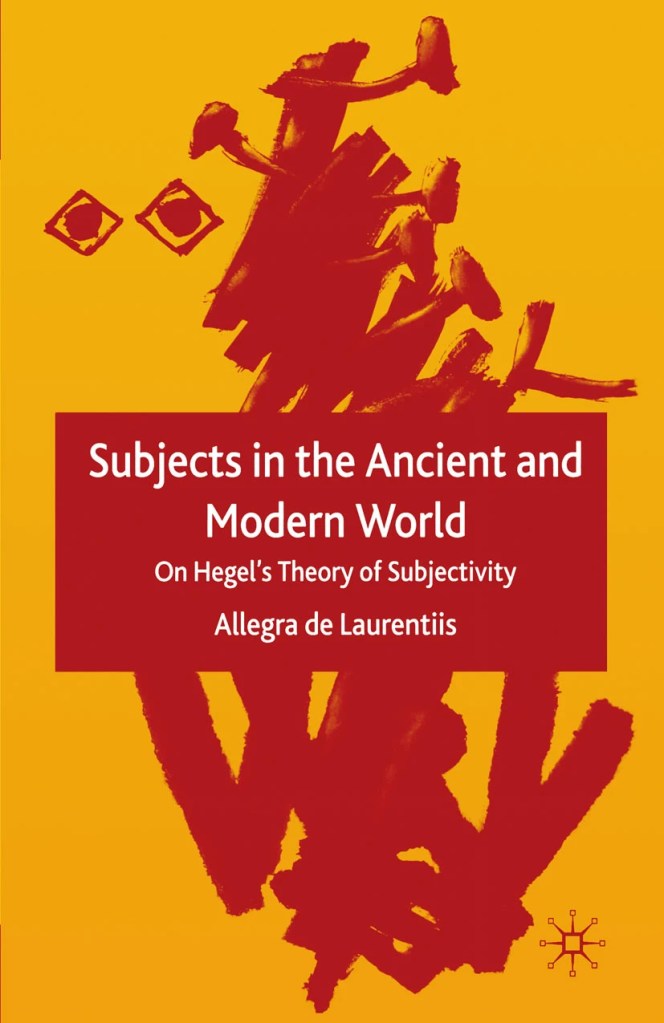
In Subjects in the Ancient and Modern World: On Hegel’s Theory of Subjectivity, Allegra de Laurentiis analyses Georg Wilhelm Friedrich Hegel’s complex conception of subjectivity, juxtaposing ancient and modern philosophical frameworks while illuminating the essential distinction between being a subject and being conscious of that status. This duality is not merely a semantic nuance but is posited by Hegel as a transformative principle that shapes individual experiences and interactions within the world. De Laurentiis adeptly navigates the landscape of philosophical thought, addressing the perennial challenge of reconciling historical philosophical insights with contemporary paradigms that often lack the rigorous metaphysical grounding characteristic of earlier traditions. The book is framed as a philosophical inquiry into how subjectivity has evolved over time, focusing particularly on how Hegel perceived the conceptualizations of individuals, persons, and moral agents differently across eras, particularly contrasting the ancient Greeks with modern thinkers.
De Laurentiis articulates the significance of examining Hegel’s reflections against the backdrop of classical Greek notions of subjectivity. She highlights the inherent difficulties contemporary scholars face when attempting to disentangle Hegel’s ideas from the prevailing assumptions of modernity, which tend to conflate subjective and objective realities in ways that obscure their nuanced distinctions. This analysis serves to remind the reader that understanding Hegel’s perspective necessitates a return to the historical and philosophical contexts that shaped the discourse surrounding subjectivity. She proposes that the rich variety of Hegel’s thought cannot be fully grasped without recognizing the historical dialectic that informs his philosophy—a dialectic that itself evolves through the ages and reveals deeper layers of meaning regarding human consciousness and individuality.
Substantial attention is dedicated to Hegel’s philosophical methodology, which she interprets as a dynamic interplay of historical consciousness and logical development. She argues that Hegel’s historical account of philosophy is a self-differentiating process that underscores the progression of human thought. This perspective invites a reconsideration of how philosophical ideas are rooted in their temporal and cultural contexts, thus fostering a dialogue between ancient philosophical concepts and contemporary notions of subjectivity. The author engages with the historical evolution of thought, demonstrating that ancient philosophical formulations were often devoid of a robust notion of subjectivity as understood in modern terms, leading to a disjunction that Hegel aims to bridge. De Laurentiis illustrates how Hegel’s critiques of Greek philosophy are not just dismissive but rather a deep engagement with the limitations and potentials inherent in earlier frameworks.
The book delves into the details of the experience of thought, emphasizing Hegel’s assertion that thought itself is an active, dynamic process rather than a passive reflection of external realities. This leads her to the concept of individual thought as an embodiment of freedom, a theme that reverberates throughout Hegel’s oeuvre. By conceptualizing thought as an experience deeply intertwined with the self, de Laurentiis elucidates Hegel’s view that consciousness evolves through interaction with the world and other subjects, culminating in a richer understanding of moral agency. Through this lens, she presents a compelling argument that the development of subjectivity is inseparable from the historical progression of ethical considerations, thus tying Hegel’s philosophical project to the lived experiences of individuals within their sociocultural contexts.
De Laurentiis’ exploration of Hegel’s reading of Plato’s Parmenides serves as a pivotal juncture in her analysis, showcasing how Hegel interprets Platonic thought as an early attempt to grapple with the nature of being and becoming. She emphasizes that Hegel perceives a fundamental shift in the conception of the subject between Plato’s time and the modern era, wherein the latter begins to privilege the individual’s self-consciousness and moral autonomy. This transition is crucial in understanding Hegel’s dialectical method, where contradictions inherent in previous philosophical systems are not merely rejected but integrated into a higher synthesis. De Laurentiis traces how this dialectical movement underpins Hegel’s conception of freedom and individuality, ultimately revealing a profound continuity in the evolution of the concept of the subject.
In her analysis of Greek moral vocabulary, de Laurentiis compellingly argues that concepts such as shame and compulsion played critical roles in shaping ancient notions of subjectivity, highlighting the socio-political implications of these moral frameworks. She suggests that Hegel’s insights into these ancient constructs illuminate the ways in which moral development informs individual subjectivity, asserting that the experience of shame, for example, catalyzes self-reflection and a recognition of one’s role within the moral community. This nuanced exploration reveals how ancient ethical considerations continue to resonate in modern discourse, encouraging readers to reassess contemporary attitudes toward individualism and moral responsibility.
de Laurentiis’ arguments find expression in her examination of dialectics, particularly as she investigates Hegel’s assertion that the dynamics of simple motion lay the groundwork for more complex interactions of spirit and consciousness. Here, she underscores the significance of recognizing both the continuity and the ruptures in the development of subjectivity throughout history. By unpacking Hegel’s dialectical approach, she illuminates the notion that subjectivity is not a static essence but rather a fluid process that evolves in response to historical and social forces. This perspective fosters a deeper appreciation for the interconnectedness of individual experiences and the broader historical narratives that shape them.
Subjects in the Ancient and Modern World offers a dense yet accessible account of Hegel’s philosophical field, navigating the complexities of subjectivity as a historical and conceptual phenomenon. Allegra de Laurentiis masterfully engages with both ancient and modern philosophical traditions, fostering a dialogue that enriches our understanding of subjectivity and its implications for individual and collective existence. By elucidating the significance of Hegel’s contributions, the book not only reaffirms the relevance of Hegelian thought in contemporary discussions but also invites readers to reflect critically on their own understanding of what it means to be a subject in a constantly evolving world.
 Simon Gros
Leave a comment