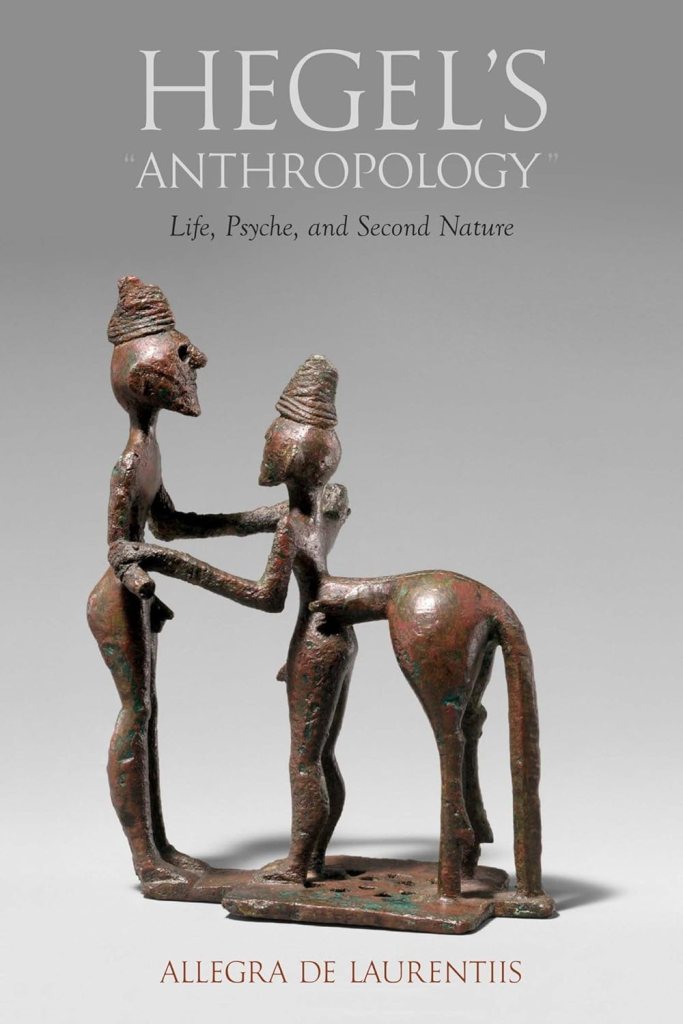
Allegra de Laurentiis’s Hegel’s Anthropology: Life, Psyche, and Second Nature offers an exhaustive and penetrating analysis of one of Hegel’s most overlooked yet philosophically potent texts, his Anthropology. Situated within the vast systematic architecture of Hegel’s Encyclopaedia of the Philosophical Sciences, this treatise addresses the “soul” (Seele) as a transitional entity between nature and spirit, bridging the material and immaterial, the physiological and the psychological, in Hegel’s theory of human development. De Laurentiis provides an erudite and precise interpretation of the Anthropology, revealing it not merely as an archaic or obsolete set of reflections but as a critical component in Hegel’s broader system of thought, integral to his conception of spirit (Geist) and its evolution from nature through subjective experience toward self-conscious rationality.
The book begins by situating Hegel’s Anthropology in its rightful place within his systematic philosophy, emphasizing its function as a critical intermediary between the Philosophy of Nature and the Philosophy of Spirit. De Laurentiis highlights that while the latter parts of Hegel’s system—dealing with objective spirit (law, ethics, and politics) and absolute spirit (art, religion, and philosophy)—have received considerable scholarly attention, the Anthropology has largely been dismissed as an embarrassing relic of outdated science and metaphysics. By recuperating this text, de Laurentiis argues that Hegel’s Anthropology is essential for understanding how he envisions the sublation (Aufhebung) of natural life into human sentience, psyche, and ultimately, spirit.
De Laurentiis guides readers through Hegel’s account of the soul as a being that, while rooted in nature, begins to transcend it. The soul, for Hegel, is not merely an ethereal or disembodied entity but is deeply intertwined with the organic life of the body, providing a metaphysical framework for understanding human beings as psychosomatic unities. Hegel’s Anthropology, as de Laurentiis outlines, traces the development of this soul from its unconscious, vegetative states (analogous to plant life) through increasingly complex forms of animal sentience, where the psyche begins to exhibit a kind of proto-consciousness, an instinctual awareness of its surroundings. This gradation of life, as discussed by Hegel, exemplifies his dialectical method, wherein each stage of life incorporates and sublates the previous one, moving toward greater complexity and reflexivity.
One of the most compelling contributions of de Laurentiis’s study is her exploration of Hegel’s treatment of the body and the psychosomatic unity of the human being. Unlike many philosophical traditions that dichotomize mind and body, Hegel’s Anthropology presents a nuanced account of their identity. De Laurentiis draws out Hegel’s non-reductive identity theory, which views the soul’s embodiment not as an accidental or mechanical attachment but as intrinsic to its nature. The soul’s activities—such as sensation, movement, and feeling—are fundamentally embodied, and it is through these activities that the psyche begins to differentiate itself from mere biological life, preparing the ground for the emergence of self-consciousness.
Hegel’s discussion of mental pathologies is another area where de Laurentiis brings fresh insight. In her detailed examination of Hegel’s views on madness, she shows how Hegel does not view insanity as a mere failure of reason but as a condition that reveals the fragility and vulnerability of the mind’s development. Madness, in Hegel’s view, is a moment where the psyche is unable to sustain its internal unity, a failure to fully sublate its natural roots. This breakdown of the self’s internal coherence, as de Laurentiis argues, reflects broader social and cultural phenomena, where the disintegration of the individual psyche is mirrored in the breakdown of communal and ethical life.
De Laurentiis also devotes significant attention to the Anthropology’s relevance for understanding Hegel’s conception of second nature—those habits, skills, and cultural norms that become ingrained in human beings through repetition and socialization. These habitualized practices form what Hegel calls “second nature,” an artificial yet essential layer of human development that mediates between raw biological drives and the more reflective, self-conscious actions of ethical life. De Laurentiis argues that Hegel’s account of second nature is crucial for grasping the full scope of his theory of spirit because it shows how freedom and rationality are not innate but are cultivated through the embodied practices of everyday life. This process of cultivation—of training the body and mind to act in accordance with reason—highlights the role of education and socialization in the formation of the individual subject, which is a central theme in Hegel’s philosophy.
What is perhaps most remarkable about de Laurentiis’s study is the way she brings Hegel into dialogue with contemporary thought, particularly in areas like psychoanalysis, cognitive science, and phenomenology. By situating Hegel’s Anthropology in relation to modern discussions of the mind-body problem, mental illness, and the nature of consciousness, de Laurentiis makes a compelling case for the enduring relevance of Hegel’s insights. She shows that Hegel’s ideas about psychosomatism, the unconscious, and the role of bodily habituation in shaping human subjectivity resonate with, and indeed anticipate, many of the concerns of contemporary philosophy and science.
Her treatment of Hegel’s sources is another highlight. De Laurentiis carefully traces Hegel’s intellectual debts to figures such as Aristotle, whose hylomorphic conception of the soul deeply influenced Hegel’s own. She also examines Hegel’s engagement with contemporaneous scientific and medical theories, such as those of Johann Friedrich Blumenbach and Xavier Bichat, whose studies of organic life and the nervous system provided important empirical material for Hegel’s reflections on the relationship between the body and the soul. By bringing these sources into the conversation, de Laurentiis shows that Hegel’s Anthropology is deeply informed by, and in dialogue with, the scientific and philosophical debates of his time.
Allegra de Laurentiis’s Hegel’s Anthropology is a groundbreaking study that restores a neglected text to its rightful place within Hegel’s philosophical system. Through rigorous historical scholarship and clear philosophical analysis, she demonstrates that the Anthropology is indispensable for understanding Hegel’s conception of spirit, particularly in its transition from nature to culture, and from unconscious life to rational self-consciousness. This book not only sheds new light on Hegel’s thought but also opens up new avenues for engaging with contemporary issues in philosophy, psychology, and the human sciences.
 Simon Gros
Leave a comment