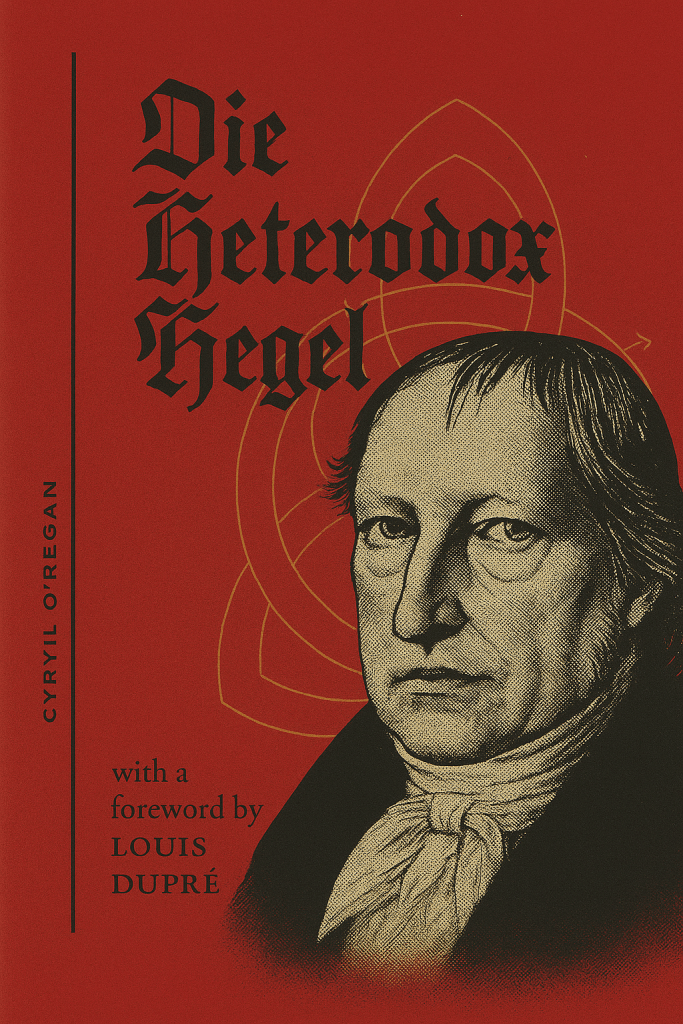
The Heterodox Hegel advances a precise and ambitious scholarly claim: that Hegel’s system is internally governed by a speculative theology whose center is a narratively articulated Holy Trinity, and that the coherence of this speculative center comes into view only when one tracks, with philological patience, Hegel’s selective allegiance to and transformation of distinct Christian and para-Christian sources—Lutheranism, speculative mysticism, Böhme, and the Gnostic dossier—across the genres of Logic, Philosophy of Religion, Phenomenology, and the encyclopedia. The book’s distinctive contribution is methodological as well as interpretive: it interweaves a trinitarian grammar with a narratological analysis of prolepsis and analepsis (folded into the pairing of anaclasis/synclasis) to show how Hegel’s God is inclusive subjectivity whose becoming is epochally structured and whose inner life anticipates, sponsors, and recollects its own manifestation.
O’Regan frames the work against the familiar interpretive volatility of Hegel reception—those “pictures” that flatten a complex object by a logic of exclusion—and situates his own reading within a more demanding practice that pursues approximation rather than verdict. The introduction draws a boundary: the object resists both antitheological reductions and the easy claim that the theological surface is dispensable rhetoric; instead, Hegel’s repeated avowals regarding the identity of the content of philosophy and religion, and the Christian determination of that content as Spirit, set constraints that any responsible interpretation must respect. The task becomes the precise specification of which Christianity Hegel philosophically translates, and how that selection governs the conversion of representation (Vorstellung) into concept (Begriff).
From this vantage, the book’s outer architecture—introduction; a first part on ontotheological foundations; a second part on the trinitarian structuration of the epochal divine; and a third part on narrative and logico-conceptual articulation—does more than organize topics; it mirrors the movement of the problem from the question of theological species to the inner grammar of Hegel’s speculative rewriting. The table of contents itself already discloses the path: an opening against negative theology, an account of narrative and the Deus revelatus, and the thesis that only a trinitarian articulation is adequate; then the three narrative “epochs” (immanent Trinity; creation/epoch of the Son; Spirit/community culminating in the inclusive Trinity) and, finally, the rules of translation between representation and concept. The sequence is not additively expository; it is compositional and argumentative, staging the systematic pressure points at which Hegel’s swerves from “normative” Christian positions become legible as symptoms of the deeper speculative species he selects.
At the foundation stands an ontotheological claim: the content-identity of theology and philosophy, the specification of that content as truth or God, and the normative status of Christianity as the adequate symbol-system for that content. O’Regan’s wager is that “ontotheology” names here neither an embarrassment to be excised nor a mere label, but the concrete site where Hegel’s triune God, understood as movement and reconciliation, sets the measure of conceptual adequacy. The introduction argues that the real work begins only when one specifies the species of Christianity that is in play, and to do this O’Regan formulates a sixfold sequence of questions that obliges the interpreter to map Hegel’s particular alignments with Luther, mysticism, Böhme, and Gnosticism, to register the points of divergence on individual theologoumena (creation, incarnation, Spirit), and only then to return to the relation of representation and concept. This circuit guards against premature abstraction and forces one to take seriously the unusually determinate decisions that mark Hegel’s procedure.
In specifying the theological field, O’Regan insists on re-describing Hegel’s trinitarianism as narratively structured. The point is sharper than the common claim that Hegel’s thought is “historical”: the divine life itself bears narrative predicates; its inner articulation is not a timeless topology but a becoming whose temporality is not simply the temporality of nature or history. To make this claim tractable, O’Regan recruits a narratological toolkit—most notably the pair prolepsis/analepsis—and then relocates it from the plane of discourse to the plane of story, and ultimately to the ontotheological stratum. In Hegelian context, prolepsis marks the anticipatory self-structuration of Spirit’s subjectivity; analepsis marks the recollective integration of the achieved moments into an inclusive subjectivity. This reorientation preserves the Hegelian refusal of a divide between language and being and allows the Trinity to appear as the form of a divine narrative whose “episodes” are creation, incarnation/passion, and Spirit/community.
The first part’s polemic “against negative theology” is not a dismissal of apophatic reserve but a judgment about adequacy. A purely apophatic grammar cannot sustain the positivity of revelation that Hegel seeks to articulate; the Deus revelatus requires a form that does justice to self-manifesting Spirit. O’Regan therefore correlates the positivity of revelation with the trinitarian form and makes this correlation itself narrative: the divine life is intrinsically “open” (anaclasis) toward its self-expression ad extra and intrinsically “closing” (synclasis) in the sense of recollective return into a higher unity that preserves difference. From the very beginning of Hegel’s public career, O’Regan shows, the value-schema opposes mere openness (dispersion, external bonding) and privileges closure as achieved inclusion; this early valuation, already visible in Faith and Knowledge and the Difference Essay, prefigures the later trinitarian grammar.
Out of these foundations O’Regan constructs the book’s central exposition: the triadic series of narrative “epochs.” The first epoch, the “immanent Trinity,” is portrayed as a speculative correction of traditional accounts of the inner life of God. The Science of Logic is read as logica divina, not as a secular detour, and the categorial genesis is treated as the narrative stringing of divine predicates and prototypes. What distinguishes this account is O’Regan’s insistence that Hegel’s rendering is only approximately aligned with Nicene orthodoxy; it places universality, pathos, and even death within the inner life, though as moments to be aufgehoben by love and life in the inclusive Trinity. The “immanent” sphere is not ultimate resting place; it is an anaclastic phase that demands continuation into creation and reconciliation.
Here O’Regan’s analysis of textual tone becomes decisive. He contrasts the deflationary note of the Phenomenology’s preface concerning “universality” with the more perspicuous narrative consciousness of the late Lectures on the Philosophy of Religion. When the latter are taken as organizing principle, “abstract universality” is repositioned as a necessary, ineliminable moment within a process whose inclusive subjectivity will subsequently exhibit pathos and the death of God as surpassable moments on the way to love, life, and Spirit. The claim is not rhetorical softening but a recalibration of genre: representation gives one angle on the divine, concept another; the inclusive Trinity binds them by a processual grammar.
The second epoch turns to creation and the “epoch of the Son.” O’Regan emphasizes that Hegel accepts the theologoumenon of creation as an approximate symbol of the first movement of the divine outward, but he also relocates creation within a trinitarian map in which the Son names the form of this manifestation. The discriminating move comes in the model of creation: surface proximity to creatio ex nihilo yields, under pressure of the system’s inclusivity, to a species of creatio ex Deo. O’Regan’s care here is philological: he tests Spinozist and Neoplatonic taxa and discards them as insufficiently specific; the proximate analogues are Jacob Böhme and Valentinian Gnosticism, since only there is creation systematically articulated under the symbols of fall and evil in a way capable of bearing the Hegelian weight.
The path from creation to evil is thus not a concession to Romantic gloom; it is the systematic consequence of a divine subjectivity that achieves itself by way of negation. O’Regan catalogues Böhme’s decisive gestures—divinity as insufficiency driven to self-transcendence, a grammar in which only one subject (the divine) persists through fundamental transformation, a lexicon of Sucht and Begierde that codifies the inner agitation of the absolute—and he brings them into proximity with Hegel’s organization of the divine process. If Hegel will ultimately criticize both Gnosticism and Böhme for failing to reach the level of Begriff, O’Regan shows that he nonetheless affirms their capacity to articulate in symbol what Hegel then rewrites at the level of concept: the necessity of negativity, the inwardness of pathos to love, and the passage through death as constitutive of life.
In the third epoch the focus is Spirit, spiritual community, and what O’Regan calls the inclusive Trinity. The discussion begins with Gemeinde as corpus mysticum and then widens to an inventory of complex mystical determinants: Eckhartian strains, Joachimite eschatology, and Böhme’s speculative inflections. These materials are not decorative; they are used to specify how Hegel’s pneumatology both exceeds and preserves inherited forms. O’Regan leverages Joachim’s threefold scheme to bring into view Hegel’s apocalyptic and theodical commitments, but he is careful to mark the difference in grammar: Hegel’s “apocalypse” is directly ontological, spans inclusive narrative space, and presupposes a radically narrative divine. This shift resets the theodicy: instead of seeking a harmonizing adjudication of historical evils from the standpoint of human interests, Hegel invites a theocentric view in which the divine process of self-constitution—precisely as inclusive Trinity—legitimates itself and thereby displaces ethical judgments framed in the register of God’s “goodness” and “justice.”
The sharpness of this claim explains both the attraction and scandal of O’Regan’s Hegel. To say that divine ontogenesis is self-legitimating and that contraries—no/yes, death/life, evil/good—are constitutive of progression is to locate reconciliation at a level prior to ethical calculus. O’Regan registers the provocation, but he treats it as the text’s own consequence once one has accepted the premises about inclusive subjectivity and narrative Trinity. The community’s attestation of Spirit is here not an earthly echo of a remote divine; it is the sphere in which the inclusive Trinity becomes explicit, where pathos is preserved and overcome.
Throughout this traversal O’Regan keeps in view the systematic relation to Luther. The book accepts that Hegel repeatedly affirms Lutheran proximity and that the theologia crucis supplies crucial emphases for the christological middle. Yet the reading is honest about the degree to which Hegel both intensifies and transposes those emphases: divine suffering becomes structural; the “death of God” becomes a narratively necessary moment; and the locus of reconciliation is the Spirit-community whose testimony functions as the resolution of abandonment. To account for this complex agreement-and-swerve, O’Regan brings Böhme and the Valentinian tradition back into the frame, suggesting that within the Lutheran field itself Böhme had already supplied a precedent for a chain of transformations that could bear the Hegelian weight.
What results of this triangulation is an image of Hegel’s christology that neither collapses into classical ontological disputes nor evades doctrinal content. The incarnation and passion occupy, within LPR and PS (though less so in the Encyclopedia), the second moment of the Son. The passion is read as the speculative extreme of divine narrative: the point where pathos and death enter explicitly into the divine life, not as alien accidents but as moments to be taken up. The book’s claim here is cautious yet firm: it is not that Hegel relativizes dogma, but that he reconfigures it through a grammar of process in which analeptic recollection comprehends the negative, and the community’s Spirit-life secures the closure (synclasis) that the Son’s pathos demands.
With the three epochs in place, O’Regan returns to the inner mechanics of representation and concept. The final part’s thesis is that “speculative rewriting” neither abolishes nor simply supersedes representation; it preserves it within a higher unity in which narrative perdurance remains operative. Representation names the indispensable symbolic mediation by which determinate content is available to community and thought; concept names the form in which that content is secured against entitative deformation and articulated as process. Hegel levies criticisms against symbolic systems—Gnosticism among them—for their “thingly” picturing of the divine, yet O’Regan notes that the same symbolic repertoires furnish the necessary predicates that the concept will later gather, transfigure, and retain.
This dialectic of retention and transfiguration is not merely formal. O’Regan tracks it back into the sources to show why the choice of “heterodox” lines of tradition is intrinsic to Hegel’s project. Böhme’s grammar of divine lack and drive, Eckhart’s radicalization of interiority, Joachim’s historical triads: each offers a resource that can be criticized at the level of representation and yet conserved in the speculative ascent. Crucially, O’Regan shows Hegel’s dependence on historically specific conduits—for example, Neander’s presentations of Gnosticism, with their loose bundling of Neoplatonic and Hermetic elements—and explains how such inherited categorizations help to set the horizon within which Hegel aligns and opposes himself. The point is not antiquarian; it is to demonstrate how conceptual decisions are choreographed by the materials of representation that Hegel both uses and rewrites.
One of the strongest features of O’Regan’s method is that he refuses to reduce “narrative” to a rhetoric of edification or a mere heuristic. By pressing prolepsis and analepsis into ontological service, he can claim that the divine life “anticipates” its economy and “recollects” it into an achieved subjectivity; by pairing anaclasis and synclasis he can mark the constant tension between openness to manifestation and the pressure toward inclusive closure. Because these pairs are made to operate at the level of the divine story, they yield an interpretive advantage: they allow one to speak of an “immanent Trinity” that is itself a narrative phase, identifiable in the logical text as a sphere of universality that does not end the story; they also allow one to place creation and passion without either extrinsically appending them or dissolving them into timelessness.
The same advantage clarifies the work’s treatment of apocalypse and theodicy. If the divine process itself is narrative and inclusive, then “apocalypse” cannot remain an external chronological end; it names instead the genre in which the divine subject comes to explicitness as inclusive Trinity. The theodicy that corresponds is not a ledger of compensations but a theocentric reassignment of measure: the process of self-constitution becomes the criterion of value and truth. O’Regan is alive to the offense this poses to moral reason; he nonetheless shows that the offense is integral to Hegel’s speculative claim and is inseparable from the reconciliation Hegel announces.
Because the project is comprehensive, O’Regan also invests in a historiography of reception. He acknowledges the voices that attempt to exdenominate theology from Hegel by positing a hidden “depth grammar” at odds with the surface, and he registers equally those that declaratively baptize Hegel as orthodox. Against both, he argues that the text’s own pattern—the triune, narrative, inclusive God who binds universality and pathos—dictates a different taxonomy than “orthodox/secular,” and the detailed dossiers on Luther, mysticism, Böhme, and Gnosticism provide the evidentiary grain. The wager is that only a network of interlocking questions and intertextually disciplined answers can rise to the systematicity that the object demands.
The cumulative picture that emerges is deliberately problem-laden. Hegel’s explicit Lutheran confessions are honored, yet the book dwells precisely where Hegel exceeds Lutheran limits—placing Trinity at the system’s center in a manner Luther’s texts do not, universalizing the theologia crucis into a constitutive divine pathos, and finding in community the site of reconciliation’s explicitness. Hegel’s critiques of symbols remain, yet the same symbols—Böhme’s drama of exile and pain, Valentinian motifs of fall—are internal to the speculative content once rewritten. Creational language is preserved, yet the model that fits the system’s inclusivity takes the form of ex Deo. The logic remains God’s logic; the history remains Spirit’s history; the genres remain porous. The result is a Hegel for whom “heterodox” is not an accusation but a descriptive marker of the sources he privileges and the grammar he constructs.
In closing, the book’s framing returns: the foreword already intimated that O’Regan’s Hegel both preserves theological seriousness and transforms interpretation so thoroughly that the old camps cannot contain it. What the long argument establishes is the mechanism of that transformation. The Deus revelatus is narrated and trinitarian; the immanent life is phase, not terminus; creation, fall, and evil are not alien to God’s life but moments to be preserved and overcome; the passion is the speculative extreme of divine narrative; Spirit is community and inclusive Trinity; apocalypse and theodicy are recoded by theocentric measure; representation is neither discarded nor sovereign, because only concept can protect the process from entitative distortion, and only representation supplies the symbolic repertory that concept transforms and retains. The composition sequence—foundations, epochs, speculative rewriting—enacts this thesis. The outer frame—introduction, parts, and chapters—keeps the interpreter honest, because it binds claims to dossiers and method rather than slogans. The achievement, finally, lies in the way these parts merge into, and are displaced by, the claim that Hegel’s God is inclusive subjectivity whose story is the measure of doctrinal truth and conceptual adequacy alike.
 Simon Gros
Leave a comment