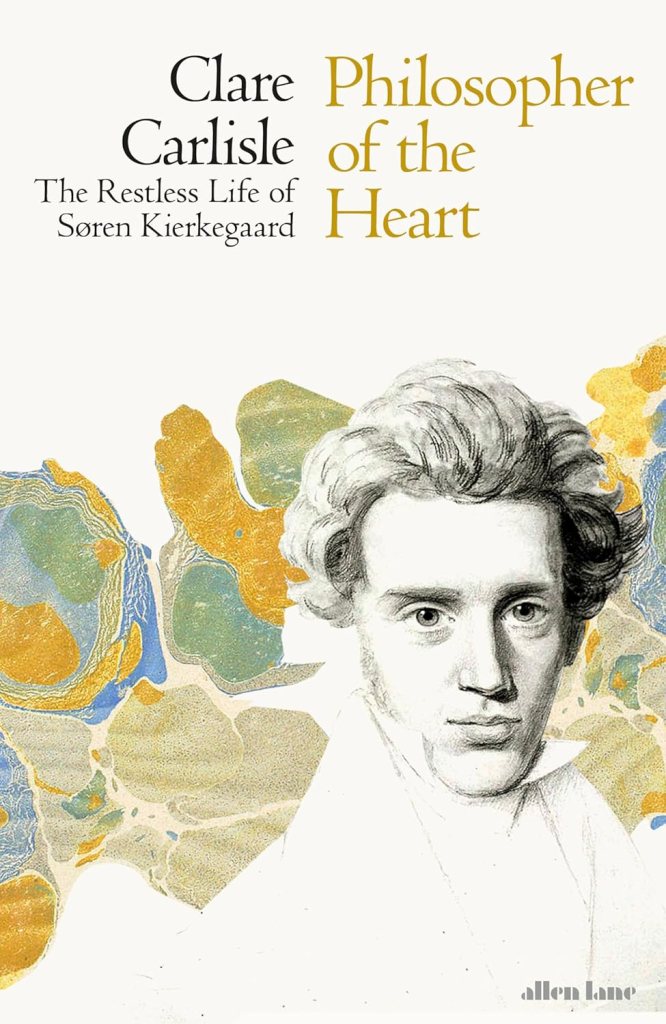
In Philosopher of the Heart: The Restless Life of Søren Kierkegaard, Clare Carlisle invites readers into the tumultuous life of one of the most significant figures in modern philosophy. Often heralded as the father of Existentialism, Kierkegaard’s work was characterized by an unwavering inquiry into the nature of existence, delving deeply into what it means to be a human being in a complex and often confusing world. Carlisle masterfully navigates the relationship between Kierkegaard’s life and his philosophy, creating a narrative that eschews conventional chronology to adopt a more fluid and dynamic approach, echoing Kierkegaard’s own assertion that while life must be lived forwards, it can only be understood backwards. This innovative biography offers an intimate portrayal of Kierkegaard’s existential struggles, framed by the personal experiences that shaped his philosophical outlook, particularly his relationship with Regine Olsen, his only fiancée, whose impact on his life cannot be overstated.
At the heart of Kierkegaard’s philosophy lies a passionate exploration of the human condition, a pursuit that unfolded during the intense and prolific decade of the 1840s and 1850s, when he produced a remarkable body of work that examined not only the possibilities of authentic existence but also the failures and limitations of contemporary Christianity. Kierkegaard’s critique of the established Church was scathing; he believed that its institutional manifestation often fell short of the radical, personal faith espoused by Jesus Christ. His writings grappled with the concept of faith itself, exemplified in his interpretation of the biblical story of Abraham, whose willingness to sacrifice his son Isaac epitomized the tension between ethical duty and divine command. Kierkegaard provocatively posited that true religious belief transcends ethical considerations, a notion that raised eyebrows and incited criticism from both religious and philosophical communities of his time. Carlisle skillfully illustrates this central theme, emphasizing how Kierkegaard’s existential struggles informed his theological inquiries, revealing a profound engagement with the paradoxes of faith and the nature of suffering, which he viewed as integral to a deeper understanding of human existence.
Carlisle’s biographical approach is deeply engaging; she attempts to inhabit Kierkegaard’s consciousness and experience his life as he lived it. By opening the narrative in May 1843, as Kierkegaard returns to Copenhagen from Berlin, readers are immediately immersed in his world—a vibrant and rapidly modernizing city, alive with the intellectual currents of the time, particularly the influence of Hegelian philosophy. Kierkegaard’s own relationship with the city is complex and multifaceted; at times, he expresses an almost romantic attachment to Copenhagen, while at other moments, he feels alienated and overwhelmed by its banality. This duality reflects his inner turmoil, his struggle to reconcile his lofty philosophical aspirations with the mundane realities of daily life, and his fear of ridicule. Throughout the biography, Carlisle captures the essence of Kierkegaard’s character, portraying him as a man profoundly aware of his own vulnerabilities, whose keen intellect was often overshadowed by a pervasive sense of melancholy and existential anxiety.
The biography combines Kierkegaard’s intellectual evolution with the emotional landscape of his life, highlighting the formative experiences that informed his philosophical ideas. One pivotal moment in his life was his engagement to Regine Olsen, which he famously terminated, a decision that haunted him for the rest of his life. Carlisle reflects on the implications of this choice, suggesting that Kierkegaard’s refusal to marry stemmed not from disdain for marital conventions but from a deep-seated fear of the intimacy and responsibility that marriage entails. He grappled with his own capacity for love and commitment, often pondering whether his melancholic disposition and spiritual aspirations could coexist with the demands of a conventional domestic life. This tension serves as a recurring motif throughout his work, manifesting in his exploration of concepts such as despair, anxiety, and the quest for authentic selfhood.
In presenting Kierkegaard’s philosophy, Carlisle deftly navigates the labyrinth of his thoughts, demonstrating how his writings reflect an unrelenting quest for understanding amidst the chaos of existence. Kierkegaard’s existential framework underscores the importance of individual choice and personal responsibility, challenging readers to confront their own fears and uncertainties. His insistence that despair is the result of failing to engage fully with one’s existence compels a reexamination of contemporary understandings of happiness and fulfillment. As Carlisle articulates, Kierkegaard’s philosophy does not shy away from the discomfort of suffering; rather, it embraces it as a vital aspect of the human experience, advocating for a life lived with passion and authenticity, despite the inherent risks of despair.
Carlisle emphasizes Kierkegaard’s engagement with the Christian faith, portraying him as both a critic of and a seeker within this tradition. His writings reflect a deep longing for a relationship with God that is intensely personal and marked by struggle rather than certainty. The tension between faith and doubt permeates his work, leading to a nuanced understanding of what it means to believe in a world rife with ambiguity. Kierkegaard’s insights challenge the reader to grapple with the complexities of belief, urging them to consider how faith intersects with personal experience, ethical dilemmas, and existential angst.
As the biography progresses, Carlisle brings to life the various contexts that influenced Kierkegaard’s thought, including the socio-political climate of 19th-century Denmark, the intellectual milieu dominated by Hegelian philosophy, and the vibrant cultural life of Copenhagen, where Kierkegaard walked the streets, often observed and critiqued by contemporaries. She paints a vivid picture of a man who, despite his significant intellectual accomplishments, remained acutely aware of his isolation and the specter of ridicule that loomed over him. This element of vulnerability is crucial in understanding Kierkegaard; his work resonates not only as a philosophical treatise but as an intimate exploration of the human heart, replete with its joys and sorrows, fears and aspirations.
Carlisle’s biography culminates in a poignant reflection on Kierkegaard’s legacy, both in his own time and in contemporary thought. She posits that Kierkegaard’s existential inquiries continue to resonate today, particularly in a world characterized by rapid change and uncertainty, where individuals often grapple with the question of what it means to live authentically. Kierkegaard’s insistence on the necessity of confronting one’s own despair and the urgency of making meaningful choices speaks to the modern human experience, encouraging readers to embrace the complexity of their existence. His philosophical journey, marked by an unyielding pursuit of truth and a deep understanding of the heart, challenges individuals to embark on their own quests for meaning and self-discovery.
Philosopher of the Heart is not only a biography of Søren Kierkegaard, but an invitation to engage with the questions that shaped his life and work. Clare Carlisle combines the personal and the philosophical, illuminating Kierkegaard’s enduring relevance in a world that often seeks comfort over truth. By situating Kierkegaard within the context of his time while presenting his emotional landscape, Carlisle paints a compelling portrait of a thinker who dared to confront the most profound challenges of existence, offering readers a path towards their own understanding of what it means to be human in an increasingly complex world. The biography resonates as a powerful testament to the restless spirit of Kierkegaard—a spirit that continues to inspire and provoke reflection on the intricacies of the heart and the existential dilemmas of life.
 Simon Gros
Leave a comment