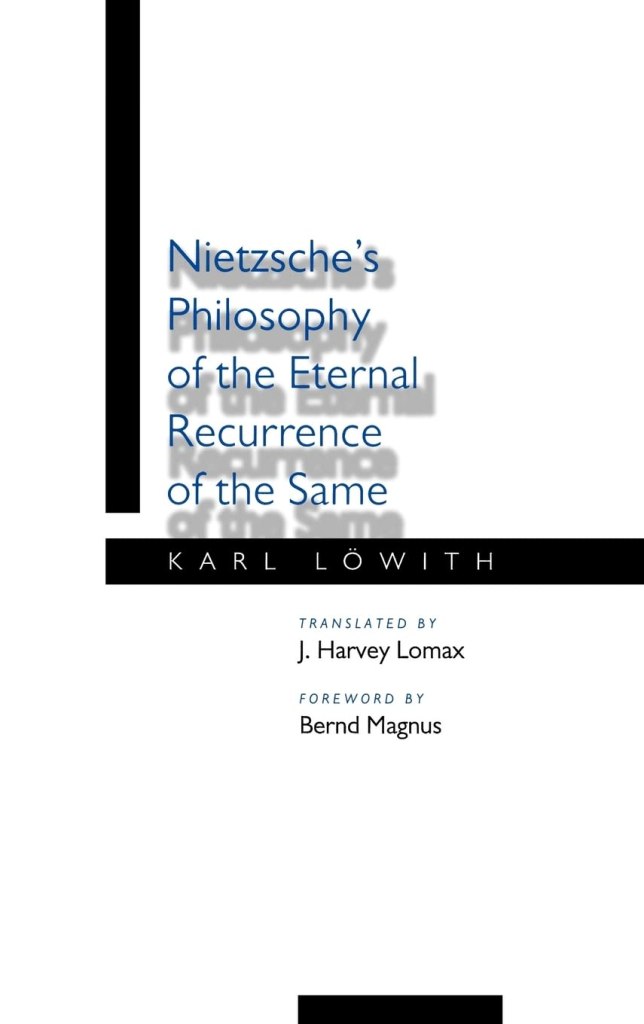
Karl Löwith’s Nietzsche’s Philosophy of the Eternal Recurrence of the Same is a monumental contribution to the scholarly understanding of Friedrich Nietzsche’s thought, offering a rigorous and critical exploration of one of Nietzsche’s most enigmatic and contested doctrines: the eternal recurrence. Löwith’s work, originally published in 1935 in the perilous intellectual and political climate of Nazi Germany, represents a courageous and incisive effort to reclaim Nietzsche’s philosophy from the clutches of ideological distortion. The book has been celebrated as a pivotal text in the interpretation of Nietzsche, influencing generations of scholars, particularly within the German-speaking world, and now finally accessible to a broader audience.
At the heart of Löwith’s analysis lies a thorough examination of Nietzsche’s concept of eternal recurrence, a doctrine that Nietzsche himself regarded as the “highest formula of affirmation” and central to his philosophical project. Löwith approaches this doctrine not merely as an abstract metaphysical proposition but as a critical juncture where Nietzsche’s thought grapples with the profound implications of human existence, freedom, and fate. His analysis is distinguished by a careful disentanglement of the eternal recurrence from the will to power, two concepts that Heidegger, Nietzsche’s most formidable interpreter, sought to interweave into a unified metaphysical system.
Löwith’s study underscores the fundamental incompatibility between the eternal recurrence and the will to power, positing that the former represents a cosmological vision that stands in stark opposition to the latter’s dynamic and forward-looking energy. The eternal recurrence, as Löwith painstakingly elucidates, suggests a world governed by the infinite repetition of a finite number of states, a notion deeply rooted in ancient philosophical traditions, particularly those of Heraclitus and the Stoics. This cyclical view of time and existence implies a universe where every moment, every event, and every decision is destined to recur endlessly, raising significant questions about the nature of human freedom and the possibility of meaningful action within such a deterministic framework.
Löwith confronts the paradox inherent in Nietzsche’s challenge to “will the eternal recurrence” of each moment of life—a challenge that seems to simultaneously affirm and negate the very notion of individual agency. How, Löwith asks, can one genuinely will what is, by necessity, predetermined? This paradox, he argues, fractures Nietzsche’s doctrine into “incommensurable shards,” exposing a tension between the ethical imperative to embrace life in its entirety and the fatalistic undercurrent that seems to strip this imperative of its efficacy. The result is a philosophy that oscillates between the poles of radical affirmation and existential resignation, a tension Löwith characterizes as the collision of a “physical metaphysics” with an “atheistic religion.”
In positioning the eternal recurrence as the linchpin of Nietzsche’s thought, Löwith departs from other prominent interpretations, particularly those of Heidegger and Jaspers. Heidegger, who famously portrayed Nietzsche as the last great metaphysician of the West, sought to integrate the eternal recurrence into a broader narrative of the will to power as the underlying force of all existence. Löwith, however, rejects this synthesis, arguing that Nietzsche’s aphoristic style and the fragmented nature of his writings resist such totalizing interpretations. Instead, Löwith emphasizes the discontinuities and contradictions within Nietzsche’s work, suggesting that the philosopher’s true insight lies not in the coherence of a system but in the relentless questioning and overturning of all certainties.
Löwith’s critique of Heidegger extends beyond their divergent readings of Nietzsche. His work can also be seen as an implicit rebuttal to Heidegger’s own entanglement with National Socialism, a connection that Löwith, a Jewish scholar in exile, did not overlook. By reasserting the philosophical rigor and depth of Nietzsche’s thought, Löwith implicitly challenges the politicized and reductive appropriations of Nietzsche by both Heidegger and the Nazi ideologues who sought to co-opt Nietzsche’s legacy for their own purposes. This context imbues Löwith’s work with a political significance that resonates far beyond the confines of academic debate.
The publication of Löwith’s book during the rise of National Socialism was itself an act of intellectual defiance. In a time when Nietzsche’s works were being manipulated to serve the propaganda needs of the Nazi regime, Löwith’s critical engagement with Nietzsche’s philosophy represented a bold assertion of scholarly integrity and philosophical truth. His critique of contemporaneous interpreters, including the Nazi-affiliated Alfred Baeumler, further underscores the courage and clarity of Löwith’s scholarship.
Löwith’s Nietzsche’s Philosophy of the Eternal Recurrence of the Same is a key philosophical investigation that remains relevant to contemporary debates about Nietzsche’s legacy. The book’s influence, though long overshadowed by the dominance of Heideggerian interpretations, has been gradually recognized, especially in Anglophone scholarship, where it has inspired a more nuanced and critical approach to Nietzsche. Scholars such as Arthur C. Danto, Maudemarie Clark, and Alexander Nehamas, among others, have drawn on Löwith’s insights to explore the complexities and contradictions in Nietzsche’s work, contributing to a more comprehensive understanding of the philosopher who continues to challenge and provoke.
This English translation offers readers the opportunity to engage with Löwith’s rigorous analysis and to appreciate the depth of his philosophical inquiry. Löwith’s work invites readers to reconsider the place of the eternal recurrence within Nietzsche’s thought and to reflect on the broader implications of this doctrine for questions of time, existence, and the human condition. It is a book that demands careful study and thoughtful reflection, offering no easy answers but instead challenging us to grapple with the enduring questions at the heart of Nietzsche’s philosophy. Through Löwith’s penetrating critique, Nietzsche is seen not as a prophet of nihilism or a harbinger of political ideologies, but as a philosopher of unsettling insight, whose thought continues to resonate in the philosophical explorations of our time.
 Simon Gros
Leave a comment