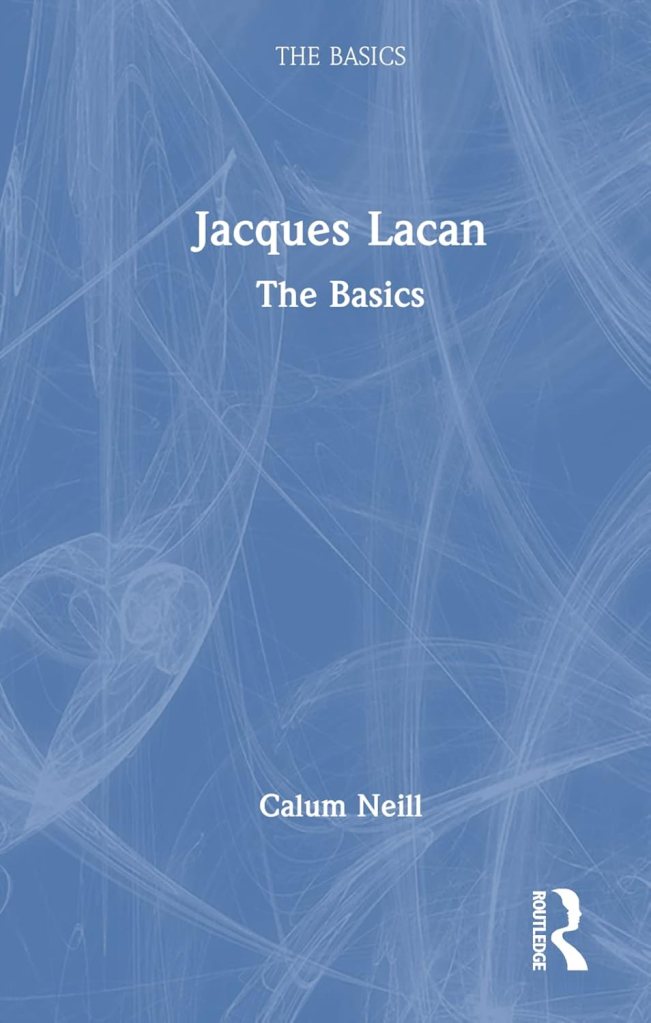
Jacques Lacan: The Basics by Calum Neill serves as an invaluable key to unlock the complexities of Jacques Lacan’s thought, a task both Herculean and necessary, given Lacan’s profound impact on 20th-century intellectual landscape. More than just introduce Lacan, the book wrestles with his dense, often impenetrable writings, which have shaped and challenged fields as diverse as psychoanalysis, literature, politics, cultural studies, and beyond. Lacan’s work, replete with theoretical innovations, remains essential yet daunting for anyone wishing to understand the interplay of language, desire, and the unconscious in the formation of subjectivity.
Neill’s book stands as a companion for those who find themselves adrift in Lacan’s theoretical waters, guiding readers through the core concepts that define Lacanian psychoanalysis. Lacan’s ideas, from the mirror stage to the symbolic order, are notoriously elusive, their meanings often buried beneath layers of linguistic complexity and theoretical abstraction. Neill’s achievement lies in his ability to distill these ideas into their fundamental components without stripping them of their inherent richness. This is no small feat; Lacan himself was known for his cryptic style, a deliberate obfuscation intended to provoke deeper engagement and to resist the complacent assimilation of his ideas into conventional thought patterns.
What makes Jacques Lacan: The Basics particularly noteworthy is its refusal to simplify Lacan’s ideas to the point of triviality. Neill understands that to truly grasp Lacan, one must embrace the difficulty, the discomfort, and the disorientation that his work invariably provokes. Yet, Neill does not leave the reader stranded in a sea of confusion. Instead, he offers a map, carefully charted, that enables a journey through Lacan’s thought, highlighting key landmarks—such as the real, the imaginary, and the symbolic—while also providing the necessary tools for further exploration.
The book’s accessibility is enhanced by Neill’s use of examples from popular culture, which serve to illuminate the often-abstract concepts at the heart of Lacanian theory. By anchoring these concepts in familiar cultural narratives, Neill bridges the gap between the esoteric and the everyday, demonstrating that Lacan’s ideas, while complex, are deeply relevant to contemporary life. This approach not only demystifies Lacan but also reveals the profound ways in which his thought can enhance our understanding of the world around us, from the workings of desire in cinema to the unconscious dynamics of political discourse.
Moreover, Neill’s work is suffused with a deep respect for Lacan’s intellectual rigor. He recognizes that any attempt to introduce Lacan must grapple with the inherent paradox of making accessible what was deliberately made difficult. Lacan’s writing, often characterized by its spiral structure and incessant play on language, resists easy summary or reductive explanation. Neill does not shy away from this challenge, but rather confronts it head-on, acknowledging that any introduction to Lacan is necessarily incomplete and that true understanding requires ongoing engagement with Lacan’s original texts.
This recognition of the limits of any introductory text is one of the strengths of Neill’s book. He does not pretend to offer a final or definitive reading of Lacan but rather a starting point—a way in. The included glossary and list of further readings are not mere appendices but essential components of a broader educational project that encourages readers to delve deeper into Lacan’s oeuvre. Neill’s book is, in this sense, not an endpoint but a gateway, opening up pathways for future study and contemplation.
The influence of Lacan on contemporary thought cannot be overstated, and this work is positioned as a critical resource for those seeking to engage with this influence in a meaningful way. Lacan’s theories of language, subjectivity, and the unconscious have permeated disciplines as varied as film studies, political theory, and cultural analysis, and understanding these theories is crucial for any serious scholar in these fields. Neill’s book outlines Lacan’s ideas and situates them within the broader intellectual currents of the 20th and 21st centuries, demonstrating their continued relevance and vitality.
What emerges from Neill’s work is not just a clearer understanding of Lacan, but an appreciation of the necessity of Lacanian thought in contemporary debates. Whether in the analysis of ideology, the critique of capitalism, or the exploration of identity, Lacan’s ideas provide critical tools for interrogating the structures that shape our lives. Neill’s book makes these tools accessible, without dulling their edge. It invites readers to engage with Lacan as active participants in a conversation that challenges our deepest assumptions and compels us to rethink the very foundations of our understanding.
Jacques Lacan: The Basics by Calum Neill is more than just an introduction to Lacan; it is a rigorous yet accessible entry point into the complex world of Lacanian theory. It offers readers the necessary groundwork to begin their journey into Lacan’s thought while maintaining the depth and nuance that his work demands. Neill’s book is a vital resource for students and scholars alike, providing the tools to navigate Lacan’s challenging ideas and demonstrating their significance for a wide range of academic and practical pursuits. As such, it is an indispensable text for anyone serious about engaging with one of the most important and challenging thinkers of the modern era.
 Simon Gros
Leave a comment