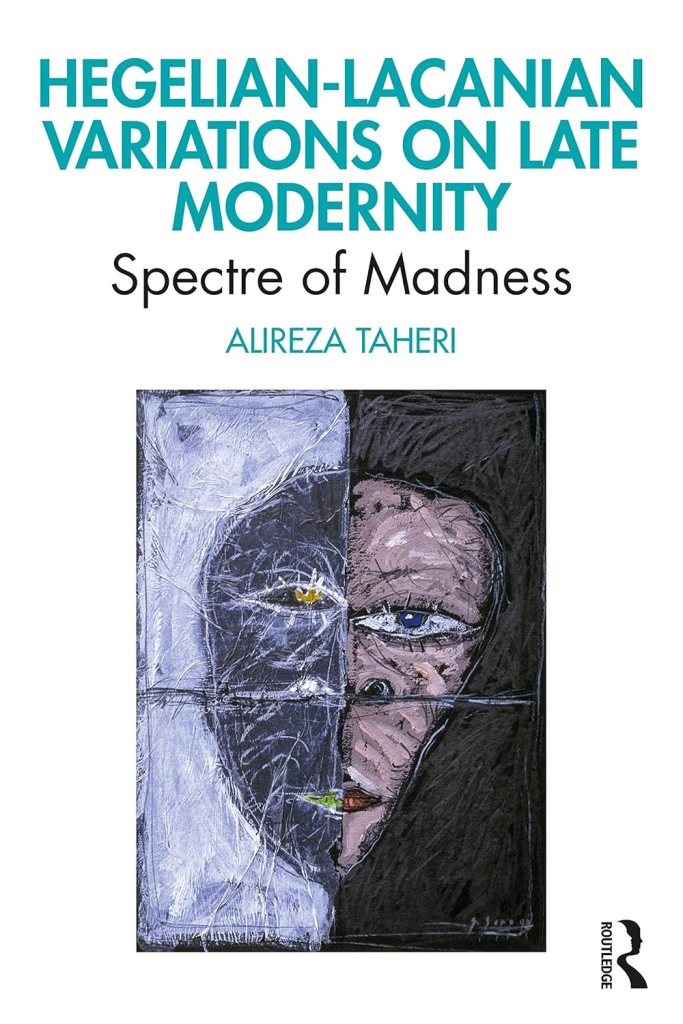
Alireza Taheri’s Hegelian-Lacanian Variations on Late Modernity: Spectre of Madness is a bold, unapologetically rigorous irruption into the complex dynamical exchange between Hegelian dialectics and Lacanian psychoanalysis, targeting the very heart of contemporary philosophical discourse. More than traversing familiar terrain it seeks to overturn the very paradigms that dominate the post-secular intellectual climate of our age. With an acute awareness of the rising tide of New Ageism and the associated surge in anti-philosophical sentiment, Taheri’s treatise stands as a defiant championing of the reassertion of philosophical and psychoanalytic reason in an era increasingly dominated by what he identifies as the spurious triumph of spiritualism over critical thought.
The work is built on the premise that our current intellectual and cultural milieu is marked by an endemic failure to reckon with the nuanced complexities inherent in philosophical and psychoanalytic traditions. This failure manifests most notably in the tendency to misrecognize and oversimplify conceptual oppositions, a process Taheri, following Hegel, terms diremption. It is through this operation of diremption—where conceptual pairs like truth and lie, good and evil, religiosity and atheism are artificially set against each other—that the contemporary subject finds itself ensnared in contradictions that are increasingly vicious and untenable. These contradictions, Taheri argues, are not simply intellectual puzzles but are symptomatic of deeper, structural conditions that define the psychic and social realities of late modernity.
Taheri’s analysis insists on the need for a renewed engagement with dialectical thinking, an engagement that moves beyond the superficial reconciliations and easy answers offered by what he terms “common understanding.” In this sense, Hegelian-Lacanian Variations on Late Modernity is as much a methodological manifesto as it is a substantive philosophical argument. Taheri, drawing heavily on the works of Hegel and Lacan, as well as the contemporary interpretations by thinkers like Slavoj Žižek, positions dialectical thought as the only viable path forward in confronting the deadlocks of our time. It is through this path—a path Taheri aptly identifies with Hegel’s “path of despair“—that we might hope to arrive at a form of “joyful wisdom” that is, in a Nietzschean sense, both tragic and life-affirming.
Taheri’s treatment of diremption as a central theme in the book is not a mere theoretical abstraction but is tied to a critical examination of the way this operation plays out across various domains of human experience. Each “variation” in the book’s structure serves as a meditation on a specific instance of diremption, from the paradoxes of love and the dynamics of power between analysand and analyst, to the conflicts inherent in sexual difference and the generational tensions between parent and child. In each of these variations, Taheri deftly illustrates how the failure to recognize identities-in-difference—where opposites are seen as merely opposed rather than dialectically interrelated—leads to a more deep entrapment in contradiction. This is particularly evident in his analysis of religious belief and atheism, where the diremptive split is shown to conceal a deeper, underlying unity that common understanding fails to grasp.
One of the most striking aspects of Taheri’s approach is his reconfiguration of negativity as a central concept at the intersection of German Idealism and psychoanalysis. By recasting the Hegelian notion of contradiction through a Lacanian lens, Taheri is able to explore the ways in which certain irresolvable antinomies are not only constitutive of human subjectivity but are also the very conditions that make subjectivity possible. This is evident in his discussion of symbolic castration, where the impossibility of full enjoyment is shown to be not merely a limit imposed from without but an intrinsic feature of the symbolic order itself. Here, the structural impossibility that Lacan identifies is interpreted as a reflection of the same dialectical logic that Hegel attributes to the contradictions inherent in nature.
Taheri’s engagement with these themes is not confined to abstract theorization but is instead intricately connected to the lived realities of late modernity. The book argues persuasively that the “madness” of our contemporary world—manifest in everything from the resurgence of authoritarian politics to the disorienting effects of late capitalist culture—is, at its root, a consequence of our collective inability to navigate the diremptive splits that define our epoch. This madness, far from being an aberration, is revealed as the logical outcome of a world that has forsaken dialectical reason in favor of simplistic binaries and facile resolutions.
Yet, Hegelian-Lacanian Variations on Late Modernity is not a work of despair. Despite its unflinching analysis of the contradictions and deadlocks of our time, the book ultimately gestures towards the possibility of a new mode of thought—one that embraces the paradoxical nature of reality and seeks to transcend the impasses of ordinary understanding. This is the “joyful wisdom” that Taheri alludes to, a wisdom that is born not out of denial or escape, but out of a deeper engagement with the contradictions that define our existence.
Taheri’s work is a formidable contribution to both philosophy and psychoanalysis, demanding a rethinking of the relationship between these two fields and their relevance to the challenges of contemporary life. In its unrelenting commitment to the principles of dialectical reasoning, Hegelian-Lacanian Variations on Late Modernity stands as a critical intervention in the ongoing debates about the future of thought in a post-secular world.
In sum, this book is a key philosophical statement, a plea to return to the speculative rigor that Hegel and Lacan represent, as a means of confronting the specters that haunt our age. Through its challenging, and ultimately rewarding exploration of diremption and contradiction, Taheri’s Hegelian-Lacanian Variations on Late Modernity offers a compelling vision of what it might mean to think dialectically in an era increasingly defined by its resistance to such thinking. It is a book that demands to be read, grappled with, and ultimately, understood as a necessary guide for navigating the complexities of our late modern condition.
 Simon Gros
Leave a comment