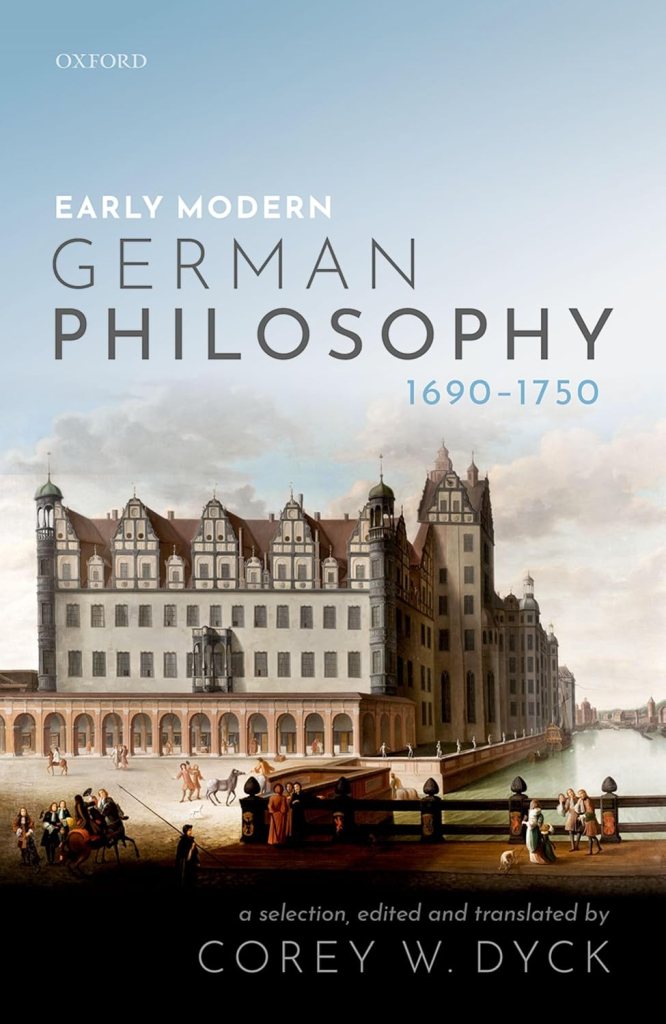
Corey W. Dyck’s Early Modern German Philosophy (1690-1750) is an erudite curated collection that serves as a crucial work for English-speaking scholars and students to get a glimpse into the rich, yet often overlooked, philosophical landscape of early modern Germany. This period, commonly bracketed between the towering figures of Leibniz and Kant, is frequently reduced to a transitional phase or an intellectual backdrop against which these giants stand in stark relief. However, Dyck’s anthology challenges this reductive view by presenting a diverse array of texts that reveal a dynamic and complex tradition in its own right. Through careful selection and translation, Dyck brings to light the intellectual ferment of late seventeenth and early eighteenth-century German thought, demonstrating that this era was far from a mere prelude to the critical philosophy of Kant, but was instead a period of vibrant and significant philosophical innovation.
The anthology includes key texts from well-known figures such as Christian Thomasius, Christian Wolff, Christian August Crusius, and Georg Friedrich Meier, alongside works by lesser-known but equally important thinkers like Dorothea Christiane Erxleben, Theodor Ludwig Lau, Friedrich Wilhelm Stosch, and Joachim Lange. These texts collectively explore a wide range of topics across metaphysics, epistemology, logic, and ethics, providing a comprehensive view of the philosophical concerns that preoccupied German thinkers in this era. Dyck’s translations, many of which make these works accessible in English for the first time, are both faithful and readable, capturing the nuances of the original German while ensuring that the ideas are communicated clearly to a modern audience.
One of the most remarkable features of this collection is how it situates these German thinkers within a broader European context. Dyck underscores that early modern German philosophy was deeply interconnected with, yet distinct from, the intellectual movements in England, France, and the Netherlands. German philosophers engaged rigorously with the ideas circulating in Europe at the time, from Cartesian dualism to Spinozist monism, from Hobbesian materialism to the rationalism of Leibniz. But they did so in ways that reflected the unique religious, political, and cultural milieu of the Holy Roman Empire. The Thirty Years’ War, the enduring religious divisions between Catholics, Lutherans, and Calvinists, and the slow emergence of the German language as a medium for philosophical discourse all shaped the trajectory of German thought in this period.
Thomasius, for example, was not merely as a critic of scholasticism and an advocate for the vernacular in academic discourse but as a philosopher who fundamentally redefined the role of logic and reason in everyday life. His work on prejudices, as presented in this collection, moves beyond a simple Cartesian rejection of sensory deception, proposing instead a nuanced account of how social and cultural forces shape human cognition. Similarly, Wolff’s systematic philosophy, often seen as a dry and overly technical elaboration of Leibnizian ideas, is revealed in Dyck’s selections to be a robust and versatile framework for addressing a wide range of metaphysical and ethical questions. Wolff’s debates with the Pietists, documented in detail within this collection, illustrate the high stakes of philosophical inquiry in early modern Germany, where questions of free will, divine foreknowledge, and the immortality of the soul were seen as having profound implications for faith and morality.
The inclusion of texts by figures like Erxleben and Lau further broadens our understanding of the period by highlighting voices that have often been marginalized in the historical narrative. Erxleben’s work, in particular, is groundbreaking in its feminist critique of the educational and intellectual barriers faced by women. Her rigorous analysis of the prejudices that prevented women from accessing education not only contributes to the history of feminist thought but also engages deeply with the broader epistemological concerns of the time. Lau’s pantheistic and materialistic philosophy, on the other hand, represents the radical undercurrents of early modern German thought, drawing connections between metaphysical speculation and political critique in ways that anticipate later Enlightenment and Romantic movements.
Dyck’s scholarly apparatus, including detailed introductions and bibliographies for each text, further enhances the value of this collection. These introductions not only provide essential historical and philosophical context but also engage critically with the secondary literature, offering readers a comprehensive overview of the current state of research in the field. The bibliographies, which include both primary sources and the most relevant English-language scholarship, serve as invaluable guides for further study, making this anthology an essential resource for both newcomers and seasoned scholars of early modern philosophy.
In presenting these texts, Dyck challenges the prevailing narrative that early modern German philosophy was merely a bridge between the innovations of the seventeenth century and the critical turn of the late eighteenth century. Instead, he argues for a reevaluation of this period as one of substantial philosophical achievement in its own right. The thinkers represented in this collection were not merely commentators on the works of Descartes, Leibniz, or Spinoza, nor were they simply forerunners of Kant. They were original and often daring philosophers who addressed the pressing intellectual and cultural issues of their time with creativity and rigor.
Through this collection, Dyck offers a more nuanced and comprehensive understanding of the philosophical landscape of early modern Germany. He shows that this period was characterized by a rich diversity of thought, where debates about the nature of reality, the limits of human knowledge, the foundations of morality, and the role of religion in public life were conducted with a level of sophistication that has often been underappreciated. The texts included in Early Modern German Philosophy (1690-1750) demonstrate that this was a time of significant intellectual formation, where the seeds of many later developments in German philosophy were planted.
Ultimately, Dyck’s work invites readers to reconsider the early modern German tradition not as a footnote to the history of philosophy but as a formative period that laid the groundwork for many of the ideas that would come to define modernity. This anthology, with its careful translations and insightful commentary, will undoubtedly become a standard reference for anyone interested in the history of German philosophy, offering fresh perspectives on a period that is ripe for rediscovery and reevaluation.
 Simon Gros
Leave a comment