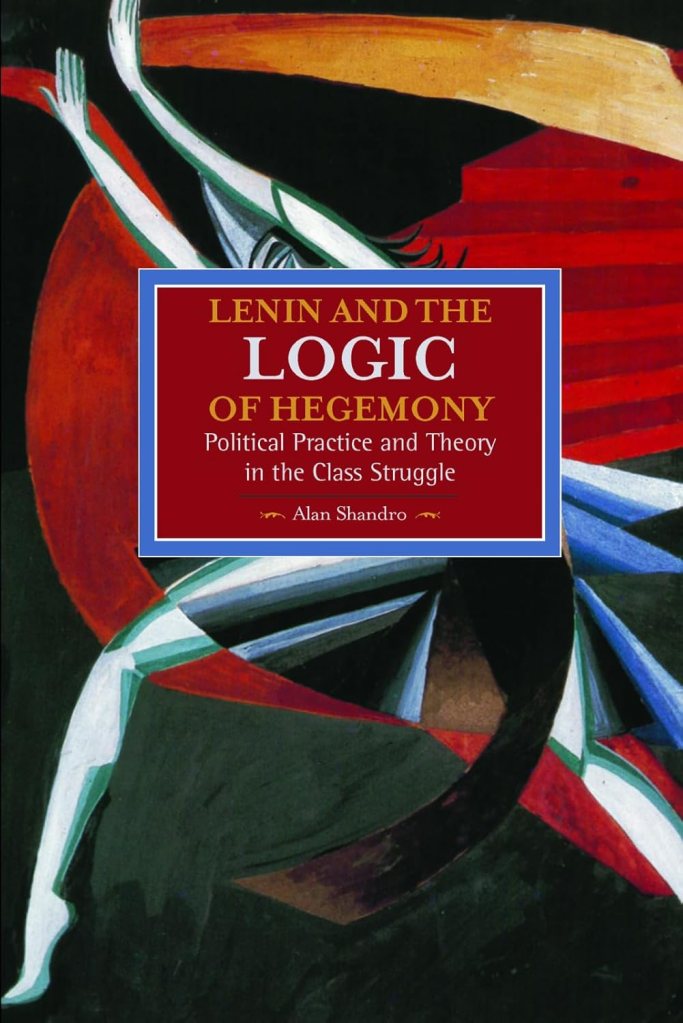
Alan Shandro’s Lenin and the Logic of Hegemony is a work of great philosophical and historical significance, boldly reinterpreting Lenin’s contributions to Marxist thought through the lens of Gramsci’s concept of hegemony. In this ambitious study, Shandro confronts the entrenched caricatures of Lenin as a mere political tactician or authoritarian figurehead, proposing instead a reading that positions Lenin as a theorist deeply engaged with the dynamics of class struggle. By analyzing Lenin’s writings and the broader socio-political context in which they were produced, Shandro traces the evolution of Lenin’s thought, culminating in the ‘philosophical fact’ of hegemony—a concept that Shandro argues is pivotal not only to understanding Lenin’s political praxis but also to the broader trajectory of Marxist theory.
Shandro’s work is distinguished by its rigorous approach to Lenin’s texts, rejecting the simplistic dichotomies often drawn between theory and practice. He presents Lenin as a thinker whose theoretical innovations were inextricably linked to the exigencies of the revolutionary movement. In this way, Shandro navigates the tension between close textual analysis and broader conceptual interpretation, a tension that has bedeviled many previous studies of Lenin. By grounding his analysis in the historical and political conditions of early 20th century Russia, Shandro demonstrates how Lenin’s approach to leadership and strategy was informed by a complex understanding of hegemony—an understanding that prefigured and informed Gramsci’s later elaborations on the subject.
Central to Shandro’s thesis is the argument that Lenin’s theory of hegemony represents a decisive break from the deterministic and mechanical interpretations of Marxism that dominated the Second International. In contrast to the unilinear logic of Kautsky and others, who viewed the path to socialism as a gradual, almost inevitable process, Lenin recognized the contingent and conflictual nature of the revolutionary struggle. For Lenin, the role of the revolutionary party was not simply to reflect the spontaneous consciousness of the working class but to actively shape and direct it, to forge a hegemonic bloc capable of leading the entire oppressed masses in the struggle against both autocratic and capitalist domination. This conception of hegemony, as Shandro elaborates, was not just a tactical consideration for Lenin but was rooted in a deep understanding of the dialectical interplay between structure and agency, between the objective conditions of the class struggle and the subjective interventions of the revolutionary vanguard.
Shandro’s analysis sheds new light on the historic split between the Bolsheviks and Mensheviks, situating it within the context of competing visions of proletarian hegemony. While the Mensheviks adhered to a more economistic and spontaneous model of class consciousness—one that assumed a natural, evolutionary development of socialist awareness through economic struggle—Lenin insisted on the necessity of political leadership and the primacy of revolutionary theory in guiding the proletariat towards hegemonic leadership of the broader democratic revolution. This strategic orientation, Shandro argues, was crucial in differentiating Lenin from his contemporaries and in positioning the Bolshevik Party as the driving force behind the October Revolution.
In advancing this argument, Shandro also engages critically with the post-Marxist appropriations of Gramsci, particularly those that have sought to divorce Gramsci’s concept of hegemony from its Leninist roots. He contends that these postmodern interpretations, in their efforts to sanitize Gramsci for contemporary liberal and democratic sensibilities, have obscured the revolutionary implications of his thought. By reclaiming the Leninist dimension of hegemony, Shandro not only restores a vital link in the history of Marxist theory but also offers a powerful critique of the depoliticized readings that have dominated recent scholarship.
The implications of Shandro’s work extend beyond the realm of historical analysis. By reasserting the centrality of hegemony in Lenin’s thought, Shandro provides contemporary Marxists with a theoretical framework that is both historically grounded and adaptable to the complexities of modern class struggle. In a period marked by the fragmentation of the global left and the rise of new forms of capitalist hegemony, Shandro’s Lenin offers a model of political leadership that is at once responsive to the concrete conditions of struggle and committed to the revolutionary transformation of society.
Shandro also addresses the perennial question of leadership and agency in the class struggle, a question that remains as relevant today as it was in Lenin’s time. He challenges the notion that Lenin’s approach necessarily leads to an elitist or authoritarian model of leadership, arguing instead that Lenin’s conception of hegemony is fundamentally democratic in its orientation—aimed not at perpetuating the division between rulers and ruled but at overcoming it through the conscious organization and empowerment of the proletariat. This, Shandro suggests, is the ultimate goal of Lenin’s political practice: to create the conditions for a society in which the need for hegemonic leadership is transcended, where the masses are no longer subjects of domination but active agents in the construction of a socialist order.
Lenin and the Logic of Hegemony is a significant contribution to Marxist political theory, offering a fresh perspective on Lenin’s legacy that is both intellectually rigorous and politically urgent. It challenges readers to rethink their assumptions about the nature of revolutionary leadership, the role of theory in political practice, and the possibilities for building hegemony in the contemporary world. By re-centering Lenin in the discourse on hegemony, Shandro not only deepens our understanding of one of the most influential figures in Marxist thought but also reaffirms the relevance of Leninist strategy for the struggles of the 21st century. This is a book that demands serious engagement from anyone interested in the theory and practice of revolutionary politics.
 Simon Gros
Leave a comment