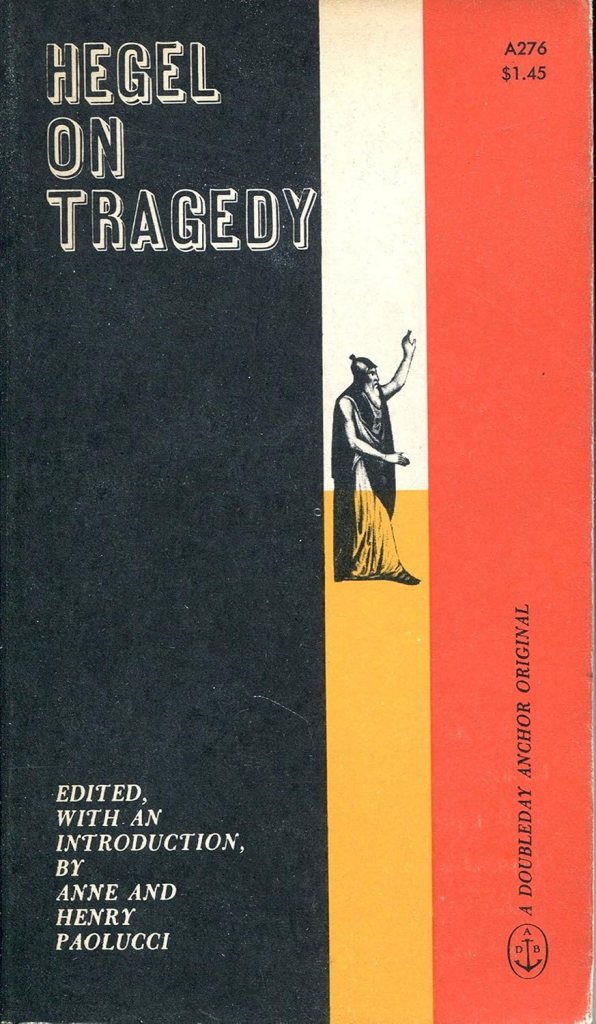
Hegel on Tragedy, an anthology edited by Anne and Henry Paolucci, is a compilation of some of the most challenging thoughts ever penned by one of the most formidable philosophers in the Western canon—Georg Wilhelm Friedrich Hegel. This 1962 collection is not merely an assembly of Hegel’s musings on tragedy, it’s an entrance to the complex ideas of his philosophical thought, combining together excerpts from across his expansive oeuvre, bringing us onto the field of Hegel’s aesthetics. The Paoluccis have curated these excerpts with an astute awareness of the necessity of contextualizing Hegel’s ideas, recognizing that his theories on art, and specifically tragedy, cannot be disentangled from the larger philosophical system to which they belong.
Central to this volume are selections from Hegel’s Lectures on Aesthetics, a posthumously published work that itself was an attempt by Hegel’s student to preserve and systematize the master’s thoughts from his extensive university lectures. These lectures form the backbone of Hegel’s philosophy of art and offer the most accessible pathway into his otherwise notoriously abstruse philosophy. Yet, despite the relative accessibility of the Aesthetics compared to his denser writings like The Phenomenology of Spirit, the Paoluccis do not shy away from challenging us as readers, and include a substantial excerpt from this latter work, Hegel’s acknowledged magnum opus, which demands from its readers nothing short of a full intellectual commitment.
To approach Hegel’s thoughts on tragedy, one must first grapple with his larger philosophical system—a system in which aesthetics is inextricably linked with metaphysics, ethics, and politics. Hegel posits that human history is the progressive realization of reason, a dialectical unfolding in which the spirit gradually becomes conscious of itself as freedom. This grand narrative, wherein each epoch of human history is a stage in the self-revelation of spirit, places art in a pivotal role. For Hegel, art is not just an external manifestation of cultural values, but a necessary stage in the self-expression of spirit, a moment where the absolute becomes visible and tangible.
Within this framework, Hegel identifies three major stages in the development of art, each corresponding to different cultural epochs: symbolic, classical, and romantic. These stages are not solely meant as chronological but represent an ascending movement toward the freedom of the spirit itself. Symbolic art, which Hegel associates with the ancient cultures of the East, struggles to find an adequate expression of the divine within nature, resulting in forms that are rich in spiritual content but still obscure and unfree. The symbolic stage is dominated by architecture, which, while grand and awe-inspiring, remains bound to the earth and to nature.
The classical stage, epitomized by ancient Greek sculpture, marks a significant advance. Here, art achieves a balance between form and content, presenting the ideal human form as the embodiment of divine beauty. In classical art, the spirit appears in its most perfect material manifestation, achieving a unity that seems almost complete. However, this unity is too static, too perfect—it lacks the inner depth and contradiction necessary for further development. It is this very sense of completion that, paradoxically, reveals the limitations of classical art. The spirit must move beyond the static perfection of classical beauty toward a higher, more self-conscious form of expression.
This movement brings us to romantic art, which Hegel associates with the modern Christian world. Romantic art, particularly in its highest form—poetry—represents a deeper, more interiorized expression of spirit. Unlike the earlier stages, romantic art is characterized by its self-consciousness and its focus on the inner life of the individual. Poetry, as the most immaterial of the arts, best captures this inwardness, expressing the infinite subjectivity of the spirit. It is in romantic art that tragedy finds its highest and most complete expression.
In Hegel’s view, tragedy is the highest form of poetry, the culmination of the spirit’s artistic self-expression. Tragedy enacts the conflict of ethical forces, each of which represents a partial embodiment of the universal spirit. The tragic hero is not simply a character caught in unfortunate circumstances; they are the site of a deep ethical conflict, embodying competing values that cannot be reconciled. In Antigone by Sophocles, which Hegel considers the paradigmatic tragedy, the heroine is caught between the duties to her family and the demands of the state—each a legitimate ethical force in its own right. The tragic resolution, in which the hero’s destruction becomes necessary, is not merely a sad or unfortunate ending but a dialectical necessity, revealing the limitations of the hero’s one-sided adherence to a particular ethical stance.
The progression of tragedy from the ancient Greeks to the modern era, especially in the works of Shakespeare, illustrates the evolution of the spirit’s self-awareness. In Shakespearean tragedy, the characters are often more complex and self-conscious than their Greek predecessors. They embody not just specific ethical principles but the very freedom of the spirit itself. Shakespeare’s heroes, such as Hamlet and Macbeth, are more than ethical actors and represent figures of existential depth, whose inner conflicts reflect the spirit’s struggle for self-realization in a world where the old certainties have broken down.
Yet, even as Hegel elevates tragedy to the pinnacle of art, he also signals its historical demise. The romantic period marks the end of art’s highest development, not because art ceases to exist, but because the spirit moves beyond art to find its fullest expression in philosophy. In Hegel’s dialectical system, art, religion, and philosophy are three stages of the spirit’s self-realization, with philosophy ultimately subsuming the insights of art and religion into a more complete and self-conscious understanding of the absolute.
The Paoluccis’ anthology introduces readers to these intricate philosophical ideas and situates them within the broader context of Hegel’s work and its reception. They offer insights into the development of Hegel’s thought over time, showing how his early works laid the groundwork for his later, more systematic philosophy. They also provide a glimpse into the reception of Hegel’s ideas in various intellectual traditions, from Marxism to Existentialism, highlighting the enduring influence of Hegel’s thought on modern philosophy and literature.
However, the anthology does not shy away from the challenges posed by Hegel’s thought. The editors acknowledge the difficulty of Hegel’s prose, the notorious density and abstraction that have led many to regard his work as impenetrable. Yet, they also argue that the effort to engage with Hegel is profoundly rewarding, offering insights into the nature of art, history, and human existence that are as relevant today as they were in the 19th century.
Hegel on Tragedy is both a book for scholars of philosophy or students of literature and a work that demands the attention of anyone interested in the deepest questions of human existence. It challenges readers to think beyond the surface of things, to engage with ideas that are difficult but ultimately transformative. The Paoluccis have done a great service in bringing together these key texts, making Hegel’s complex and often elusive ideas more accessible to a wider audience. Yet, they also remind us that Hegel’s work remains a profound and challenging terrain, one that requires patience, dedication, and a willingness to confront the deepest contradictions of human life.
 Simon Gros
Leave a comment