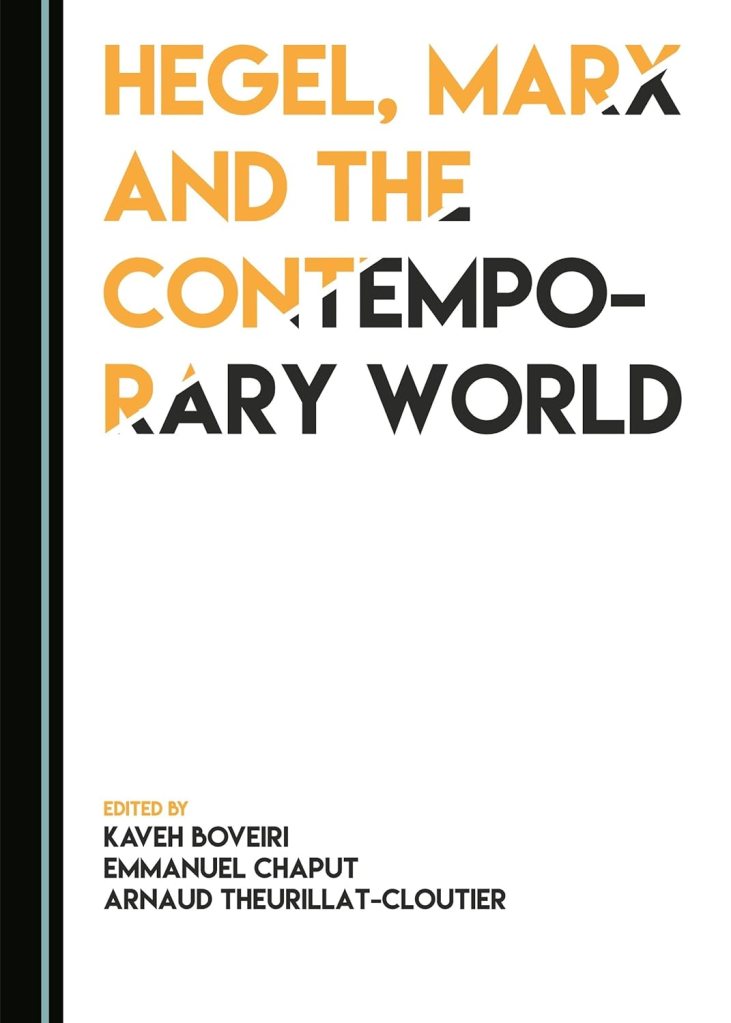
Hegel, Marx, and the Contemporary World, edited by Kaveh Boiveiri and Emmanuel Chaput, is a significant scholarly contribution to the ongoing discourse surrounding the philosophical legacies of Hegel and Marx, particularly in relation to the pressing crises of the twenty-first century. Originating from a three-day conference held at the University of Montreal in April 2014, the book presents various perspectives and insights, articulating the relevance of Hegelian and Marxian thought in addressing contemporary ecological, economic, political, and anthropological dilemmas that shape human existence today. The editors and contributors navigate the relationships between critique and the historical underpinnings of philosophical thought, emphasizing that the very frameworks through which we seek to understand and critique modern capitalism are themselves potentially in a state of crisis.
The book’s fundamental premise is that a proper critique of our current conditions—an endeavor the authors term Kritikos—is intimately connected to the historical and intellectual crises (Krisis) we confront. This alignment posits that to engage effectively with our current socio-economic and ecological challenges, we must first grapple with the theoretical crises arising within critical traditions. Herein lies a paradox: while numerous critical perspectives have emerged to oppose contemporary capitalism, many are hindered by a lack of coherent theoretical frameworks that can provide a substantive diagnosis of the prevailing crises. This conceptual inadequacy, the book suggests, stymies effective action plans aimed at transformation. Thus, a reevaluation of Hegel and Marx offers not merely a retrospective glance but a forward-looking framework for understanding the modern condition.
The exploration within this volume does not only recover the philosophical positions of Hegel and Marx, it reframes their insights as necessary tools for grappling with present-day realities. Hegel’s approach, marked by a desire to comprehend the world as a totality, and Marx’s critique of capitalist modes of production, both serve as lenses through which to interrogate the alienation and exploitation prevalent in contemporary societies. In this light, the book analyses the intellectual enterprises of both figures, each of whom was acutely aware of the crises of their time—Hegel confronting the spiritual dislocation wrought by modernity and Marx contending with the socio-economic upheavals of industrial capitalism.
One key aspect of the book is its focus on the mutual influences of Hegel and Marx, revealing how the latter’s philosophical innovations cannot be fully understood without considering his engagement with Hegelian dialectics. This relationship is not simply adversarial; rather, it reflects a complex dialogue that shapes the trajectory of modern critical thought. Contributions from various scholars articulate the need to reassess Marx’s philosophical underpinnings, advocating for a rediscovery of the philosophical core of his critique of capitalism, which has often been obscured by overly doctrinaire interpretations. This reassessment invites readers to engage with Marx not just as a social theorist but as a thinker whose philosophical legacy remains vital for contemporary discussions on social justice, economic equity, and the possibility of transformative action.
The book investigates how contemporary thinkers have wrestled with the legacies of Hegel and Marx in light of the failures and limitations of “orthodox” Marxism. The decline of traditional Marxist doctrines has prompted a resurgence of interest in a philosophical Marx, one who is deeply seated within the debates that shaped his intellectual environment. This renewed focus highlights the necessity of understanding Marx’s critiques through a philosophical lens, challenging the simplistic binaries that often characterize interpretations of his work. As the contributors reflect on the historical context of Marx’s thought, they elucidate how his relationship with Hegel was not only formative but also fundamentally shaped his approach to questions of praxis and theory. This historical grounding allows for an analysis of the dynamics between theory and practice, a theme that resonates throughout the discussions in the book.
The essays analyse the multifaceted dimensions of alienation, a concept central to Marxian thought. Through a critical examination of alienation, the authors unravel the implications of objectification within capitalist societies, exploring how Marx articulated the conditions under which individuals experience disconnection from their labor, community, and self. This focus on alienation serves as a crucial touchstone for understanding the socio-political landscape of the contemporary world, illustrating how theoretical insights can illuminate lived experiences of crisis and oppression.
In addressing the dialectical methods employed by both Hegel and Marx, the contributors question traditional interpretations that often conflate their methodologies. They investigate the fundamental differences between Hegelian and Marxian dialectics, emphasizing that Marx’s critique of Hegel does not merely invert Hegelian thought but rather seeks to establish a distinct methodological approach rooted in material conditions and socio-historical contexts. The debates surrounding dialectics extend into contemporary political philosophy, where the legacy of both thinkers continues to inform discussions on the nature of political action, agency, and the possibilities for collective transformation in an increasingly fragmented world.
The discourse within the book underscores the urgency of grappling with the philosophical dimensions of crisis, recognizing that the tools we develop for critique must evolve in tandem with our understanding of the crises we face. This is underscored by the need for a comprehensive rethinking of how we articulate critiques of capitalism and envision alternative futures. By returning to the foundational questions posed by Hegel and Marx, the contributors advocate for a revitalization of critical theory that can address the complexities of modern life while remaining attuned to the historical legacies that inform our current challenges.
Hegel, Marx, and the Contemporary World is a crucial intervention in contemporary philosophical debates, providing a variety of reflections that invite readers to reconsider the relevance of Hegelian and Marxian thought in navigating the crises of our time. The book’s integrative approach combines historical analysis, theoretical inquiry, and contemporary relevance, creating a platform for interdisciplinary dialogue that spans the fields of philosophy, political theory, sociology, and environmental studies. It serves not only as proof of the vitality of Hegelian and Marxian critique but also as a plea to engage with their ideas in the pursuit of transformative action within a world increasingly characterized by crisis and uncertainty. By situating Hegel and Marx at the heart of contemporary discourse, the editors and contributors illuminate pathways toward understanding the complexities of human existence and the potential for meaningful change amidst the challenges we face today.
 Simon Gros
Leave a comment