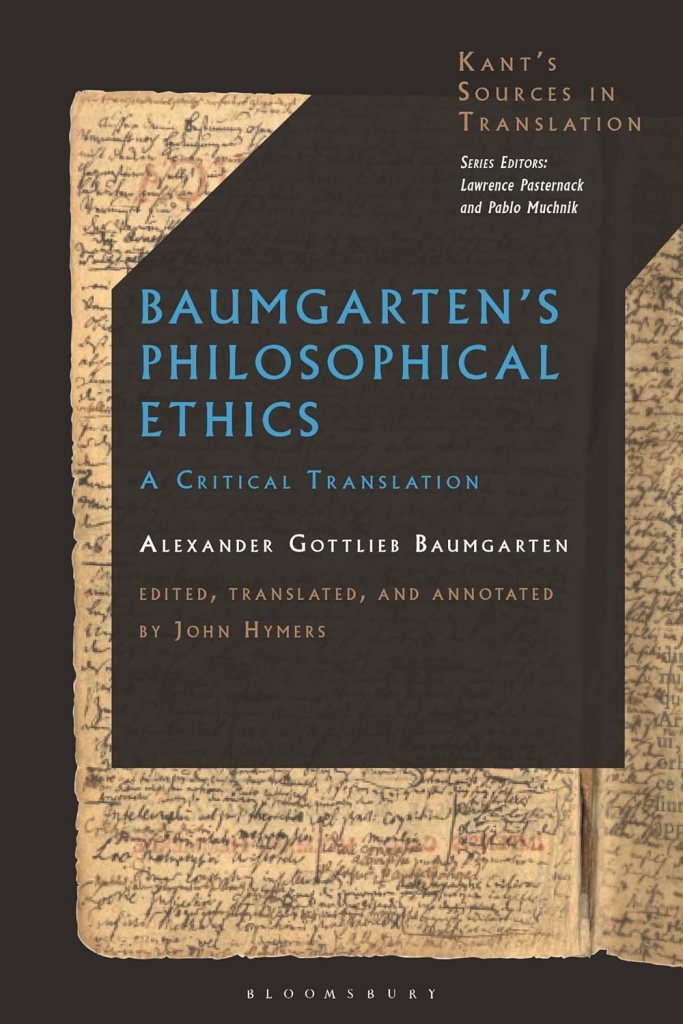
Baumgarten’s Philosophical Ethics: A Critical Translation by John Hymers is an essential contribution to the understanding of the intellectual genesis and development of German moral philosophy in the eighteenth century. It’s is a presentation of the influence that Alexander Gottlieb Baumgarten’s Ethica Philosophica had on his contemporaries and, most significantly, on Immanuel Kant. Hymers’ work is an invaluable resource for scholars of modern philosophy, offering the first English translation of a text that was instrumental in shaping the ethical thought of an era, especially within the context of German academic instruction.
Baumgarten’s Ethica Philosophica (1740), long considered a pivotal text in the canon of modern philosophy, served as a foundational textbook in German universities for several decades. Its role as a primary reference for moral philosophy is underscored by the fact that it was the textbook used by Immanuel Kant during his lectures on ethics from 1759 to 1794. Baumgarten’s influence on Kant is profound, yet it is a relationship that has often been overlooked or misunderstood due to the lack of accessible translations of Baumgarten’s works. Hymers rectifies this gap by providing a clear and faithful translation that is enriched by his scholarly introduction and meticulous annotations.
Hymers’ translation does more than make Baumgarten’s Ethica Philosophica available to an Anglophone audience; it illuminates the complex relationship between Baumgarten’s ideas and Kant’s moral philosophy. Kant’s use of Baumgarten’s text in his lectures was not merely a matter of convenience or adherence to academic norms. Rather, as Hymers demonstrates, Kant engaged deeply with Baumgarten’s ideas, sometimes adopting them, sometimes modifying them, and often challenging them. This dynamic interaction is crucial for understanding the evolution of Kant’s own ethical thought, particularly his development of the concepts that would later form the foundation of his Groundwork of the Metaphysics of Morals (1785) and the Critique of Practical Reason (1788).
Baumgarten’s Ethica Philosophica is firmly rooted in the rationalist tradition of Christian Wolff, whose influence is evident throughout the text. However, as Hymers points out, Baumgarten was not only a disciple of Wolff, but a thinker of considerable originality. His ethical system is characterized by a rigorous commitment to the principle of perfection, a concept that Baumgarten develops with a complexity and nuance that goes beyond Wolff’s formulations. For Baumgarten, perfection is not merely a metaphysical concept but the central organizing principle of ethics. The moral imperative to “perfect yourself” (Ethica Philosophica §10) is presented as the fundamental law of practical philosophy, a law that governs both individual conduct and the ethical life of the community.
Hymers’ translation captures the precision and clarity of Baumgarten’s Latin, while his annotations provide essential context for understanding the subtleties of Baumgarten’s thought. The translation is based on the third edition of the Ethica Philosophica (1763), which is notable for its inclusion of German glosses and the systematic organization of the text into 500 numbered paragraphs. Hymers carefully preserves the structure and terminology of the original, making the translation a reliable guide for readers seeking to understand both the letter and the spirit of Baumgarten’s work.
One of the most significant contributions of this translation is its elucidation of the ways in which Baumgarten’s Ethica Philosophica anticipates and informs Kant’s moral philosophy. For instance, Baumgarten’s introduction of the term “imperative” in the context of ethical obligation is a clear precursor to Kant’s concept of the categorical imperative. Moreover, Baumgarten’s distinction between different types of ethical deficiencies and his critique of the notion of happiness as a component of moral philosophy are themes that Kant would later develop in his own work. Hymers’ careful cross-referencing of Kant’s lecture notes and Reflexionen with Baumgarten’s text allows readers to see these connections with unprecedented clarity.
The translation is also accompanied by selections from the writings of Christian Wolff, G.F. Meier, and Heinrich Köhler, as well as relevant transcriptions from Kant’s lectures on ethics. These supplementary texts provide a broader intellectual context for understanding Baumgarten’s Ethica Philosophica and its reception in the German philosophical tradition. They also serve to highlight the dialogical nature of Kant’s engagement with Baumgarten, as Kant’s marginal notes and lecture comments reveal a continuous process of interpretation, critique, and adaptation.
Hymers’ introduction provides a comprehensive overview of Baumgarten’s life and intellectual development, tracing his education in the Pietist environment of Halle, his critical engagement with Wolff’s philosophy, and his eventual establishment as a leading figure in the German Enlightenment. This biographical sketch is essential for understanding the philosophical and theological concerns that underpin Baumgarten’s ethics, particularly his efforts to reconcile the rationalist tradition with the moral demands of Christian theology.
The central themes of Baumgarten’s Ethica Philosophica are expounded with a level of detail that reflects Hymers’ deep understanding of the text. Baumgarten’s conception of ethics as a science of perfecting the will through rational principles is explored in relation to his broader metaphysical and aesthetic theories. The notion of perfection as the agreement of multiple realities in a single unified entity is shown to be the foundation of Baumgarten’s ethical system, with the concept of obligation emerging as the practical expression of this metaphysical principle.
Hymers also addresses the stylistic and rhetorical elements of Baumgarten’s work, noting the influence of classical authors such as Cicero, Horace, and Virgil. Baumgarten’s use of allusion and his preference for a concise, aphoristic style are examined in relation to his broader philosophical project. Hymers’ annotations often reveal the subtle ways in which Baumgarten engages with his classical predecessors, using their insights to enrich his own ethical reflections.
Baumgarten’s Philosophical Ethics is an indispensable resource for anyone interested in the history of modern philosophy, Kantian ethics, or the intellectual heritage of the German Enlightenment. John Hymers’ translation and commentary bring Baumgarten’s Ethica Philosophica to life for a new generation of readers, offering a window into the philosophical debates that shaped one of the most significant periods in Western thought. This volume is not only a critical edition of a key philosophical text but also a profound meditation on the nature of moral philosophy itself, as seen through the lens of one of its most important, yet often overlooked, figures.
 Simon Gros
Leave a comment