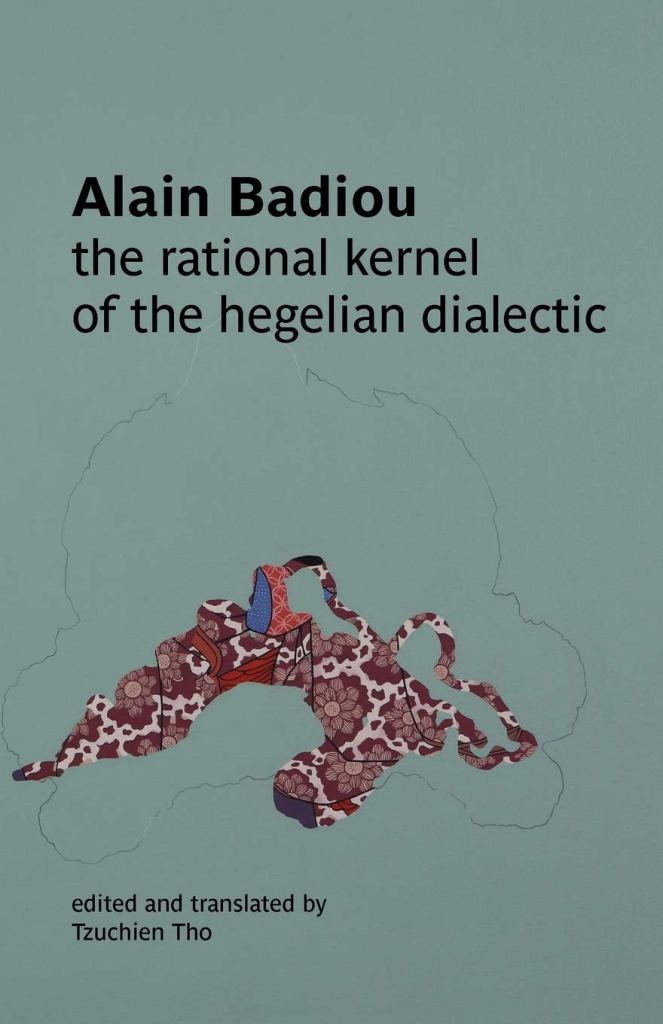
Alain Badiou’s The Rational Kernel of the Hegelian Dialectic is a text of deep historical and philosophical significance, a dense work situated within the turbulent intellectual landscape of the late 1970s. As the concluding piece of a trilogy that includes Theory of Contradiction and On Ideology, this work captures the essence of Badiou’s engagement with Marxism, Hegelian dialectics, and the revolutionary fervor that followed the events of May ’68. It represents both a culmination and a transformation of Badiou’s early political-philosophical thought, crystallizing his commitment to a radical, non-teleological interpretation of Hegel and Marx, filtered through Maoist ideology.
The book’s format is itself an exercise in dialectical thinking, with Badiou and his collaborators, including the translator and commentator Tzuchien Tho, engaging in a layered dialogue with the work of the Chinese Hegelian philosopher Zhang Shi Ying. Zhang’s original text, written in 1972, serves as the focal point around which Badiou constructs his own analysis, offering both an exposition and a critique of Hegelian dialectics as interpreted through the lens of Chinese Marxism. This approach reflects Badiou’s broader philosophical project of fusing different strands of thought to produce new theoretical syntheses. The decision to center Zhang’s work highlights Badiou’s interest in the global dimension of Marxist theory and his recognition of the importance of the Chinese experience in the development of a revolutionary dialectic.
Badiou’s engagement with Hegel in this text is characterized by a deliberate and strategic departure from the dominant French interpretations of Hegel that had been prevalent since the post-war period. He criticizes the emphasis on the Phenomenology of Spirit, particularly the master-slave dialectic, which had been central to the existentialist and psychoanalytic readings of Hegel by figures like Sartre and Lacan. For Badiou, this focus on the subjective dimensions of consciousness and recognition leads to a form of romantic individualism that ultimately weakens the revolutionary potential of Hegelian thought. Instead, Badiou seeks to recover what he terms the “rational kernel” of the Hegelian dialectic, which he locates not in the Phenomenology but in the Science of Logic.
In Badiou’s reading, the Science of Logic provides the most rigorous formulation of dialectical thought, one that is capable of sustaining a truly revolutionary Marxism. The Logic’s emphasis on contradiction as the driving force of development is central to Badiou’s argument. He contends that it is this aspect of Hegel’s thought that was most influential for Marx and Lenin, and that it remains essential for any contemporary revolutionary theory. The power of the dialectic, as Badiou presents it, lies in its ability to reveal the inherent instability of any given order, its “universal and irresistible power” to dissolve even the most secure and stable structures. This understanding of the dialectic as a force of continuous negation and division is crucial to Badiou’s critique of both Stalinism and the so-called “new philosophers” who, in his view, had abandoned the revolutionary project by retreating into a caricatured anti-totalitarianism.
Badiou’s text also grapples with the political and intellectual challenges of the late 1970s, a period he identifies as a time of “triumphant restoration” following the revolutionary hopes of the 1960s. This restoration is marked by the rise of neoliberalism and the retreat of the left across Europe, China, and the United States. In this context, Badiou’s return to Hegel is a strategic intervention aimed at reaffirming the viability of Marxist theory in the face of this reactionary turn. By engaging with Zhang Shi Ying’s work, Badiou also seeks to bridge the geographical and cultural divide between the European and Chinese experiences of Marxism, emphasizing the global nature of the revolutionary struggle.
The inclusion of a recent interview with Badiou in the volume adds another layer to the text, as it allows Badiou to reflect on the development of his thought over the intervening decades. In this interview, Badiou addresses the apparent discrepancies between his earlier Maoist-influenced writings and his later work on ontology and the “communist hypothesis.” He discusses the evolution of his understanding of dialectics, negativity, and modality, as well as the implications of these concepts for contemporary political practice. This retrospective reflection provides valuable insights into the continuity and change in Badiou’s philosophical project, highlighting the ways in which his early engagement with Hegel and Marx continues to inform his current work.
The Rational Kernel of the Hegelian Dialectic is a work of exceptional depth and complexity, offering a critical examination of the Hegelian dialectic through the lens of Marxism and Maoism. It serves as both a historical document of Badiou’s intellectual development and a philosophical treatise on the nature of dialectical thought. For readers of Badiou’s more recent work, this text provides a crucial context for understanding the roots of his later theories and the enduring influence of Hegelian and Marxist thought on his philosophy. The book’s unique format, which weaves together the voices of Badiou, Zhang Shi Ying, and Tzuchien Tho, challenges the reader to engage with the dialectic not as a static doctrine but as a living, evolving process of thought and action. As such, it stands as a testament to Badiou’s commitment to the revolutionary potential of philosophy and his ongoing struggle to articulate a coherent and compelling vision of a radical future.
 Simon Gros
Leave a comment