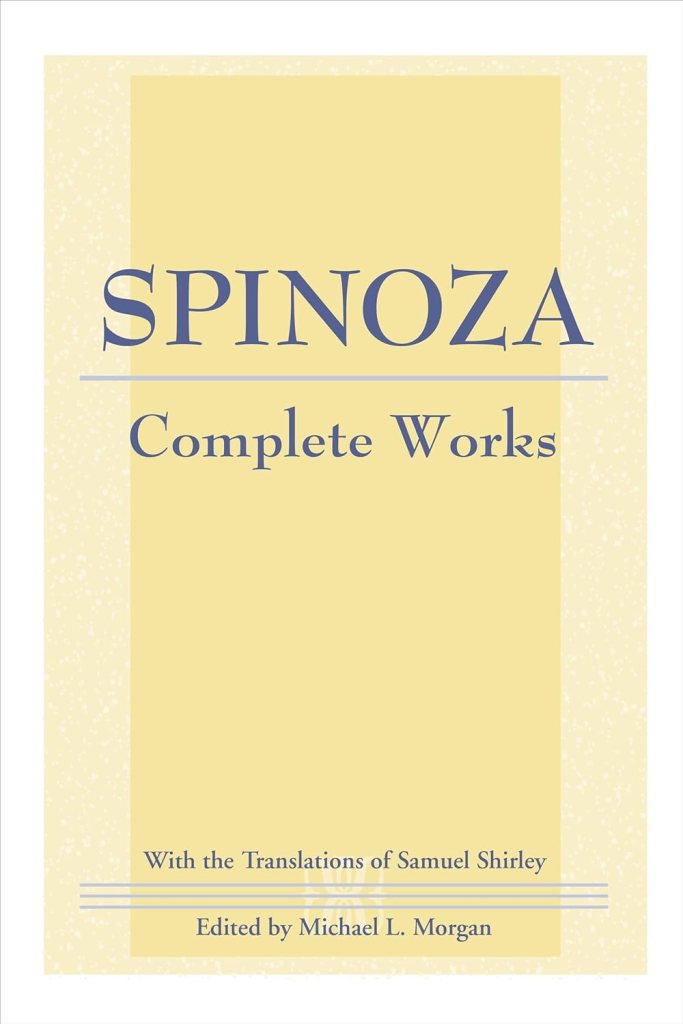
The collection of Spinoza: Complete Works is an unparalleled achievement in the landscape of Western philosophy, presenting the full corpus of Baruch Spinoza’s writings in a single translated volume. This book is an intellectual edifice, one that demands a profound engagement with the foundational ideas of metaphysics, ethics, politics, and religion. Edited by Michael L. Morgan and translated by Samuel Shirley, this edition provides English-speaking readers with the most authoritative and accessible version of Spinoza’s works, capturing the precision, clarity, and philosophical rigor that characterize Spinoza’s thought.
Spinoza’s philosophy, which emerges with singular intensity from these pages, is a synthesis of the philosophical traditions that preceded him—primarily the rationalism of Descartes, the scholasticism of medieval thinkers, and the naturalism of ancient Stoicism—yet it is also a radical departure from them. Spinoza’s system is rooted in the concept of substance, a concept he redefines in such a way that it becomes the linchpin of a metaphysical vision that encompasses everything that exists. For Spinoza, there is only one substance, which he equates with God or Nature, and this substance is the foundation of all reality. Every entity, every thought, every phenomenon is a mode of this single substance, and understanding the nature of substance and its attributes—chiefly thought and extension—is crucial to understanding the nature of reality itself.
Morgan’s editorial contributions, which include an overarching introduction as well as specific prefaces to each of Spinoza’s works, are invaluable. They provide context and clarity, offering readers both a historical framework and a philosophical lens through which to approach Spinoza’s writings. Morgan situates Spinoza within the broader currents of seventeenth-century thought, highlighting the ways in which his work responds to and diverges from the intellectual milieu of his time. This is particularly important given the ways Spinoza’s thought was both a product of his environment and a radical critique of it, challenging the religious, political, and philosophical orthodoxies of his day.
The central text of this volume, the Ethics, is Spinoza’s magnum opus, a work that has influenced countless philosophers, theologians, and scientists since its posthumous publication. Written in a geometrical style, the Ethics is a bold attempt to apply the principles of logic and mathematics to the understanding of human existence and the nature of the universe. Spinoza’s propositions, proofs, and corollaries lead the reader through a complexly structured argument that culminates in the vision of a universe governed by necessity and reason. For Spinoza, true freedom lies not in the ability to act against the constraints of nature but in the understanding and acceptance of these constraints as expressions of the divine order.
This volume also includes Spinoza’s other major works, such as the Tractatus Theologico-Politicus, where he argues for the separation of philosophy from theology and makes a case for the freedom of thought and expression. Here, Spinoza’s political philosophy intersects with his metaphysics, as he contends that a rational understanding of the world leads to a more just and equitable society. His arguments for religious tolerance and the critique of superstition are as relevant today as they were in his own time, reflecting Spinoza’s commitment to intellectual freedom and his belief in the power of reason to dispel the darkness of ignorance and prejudice.
The Tractatus de Intellectus Emendatione and the Short Treatise on God, Man, and His Well-Being, both included in this volume, offer glimpses into the development of Spinoza’s thought. These works show a philosopher deeply engaged with the problems of knowledge, striving to understand how the human mind can achieve a clear and distinct understanding of the world. Spinoza’s epistemology is intimately connected with his ethics; for him, knowledge is not merely an intellectual pursuit but a path to the good life. The more we understand the world, the more we align ourselves with the rational order of nature, and the more we achieve a state of beatitudo, or blessedness.
Shirley’s translations are celebrated for their accuracy and elegance, qualities that are essential in rendering Spinoza’s complex and often challenging ideas into English. His translation does not merely convey the meaning of Spinoza’s Latin but captures the cadence and clarity of the original, making Spinoza’s thought accessible to both newcomers and seasoned scholars. Shirley’s approach is notably non-intrusive; he resists the temptation to interpret or editorialize, allowing Spinoza’s ideas to speak for themselves. This fidelity to the text is crucial, given the dense and often technical nature of Spinoza’s writing, where every word is laden with philosophical significance.
Spinoza’s impact on the subsequent history of philosophy cannot be overstated. His ideas prefigure many of the debates that would come to dominate modern and contemporary thought, from the nature of freedom and determinism to the relationship between mind and body, the foundations of political authority, and the role of religion in public life. Yet, as Morgan’s introduction suggests, Spinoza is not just a precursor to later thinkers; he is a philosopher of the highest order, whose work continues to offer profound insights into the human condition.
Spinoza: Complete Works is a pathway to the mind of one of the most original and influential thinkers in the Western tradition. It offers readers the opportunity to engage with Spinoza’s thought in its entirety, to explore the depths of his metaphysics, the rigor of his ethics, the boldness of his political philosophy, and the subtlety of his religious reflections. This volume is an indispensable resource for anyone seeking to understand Spinoza, whether as a historical figure or as a living voice in the ongoing conversation of philosophy. It invites readers not only to study Spinoza but to think with him, to challenge their assumptions, and to see the world anew through the lens of his radical and enduring vision.
 Simon Gros
Leave a comment