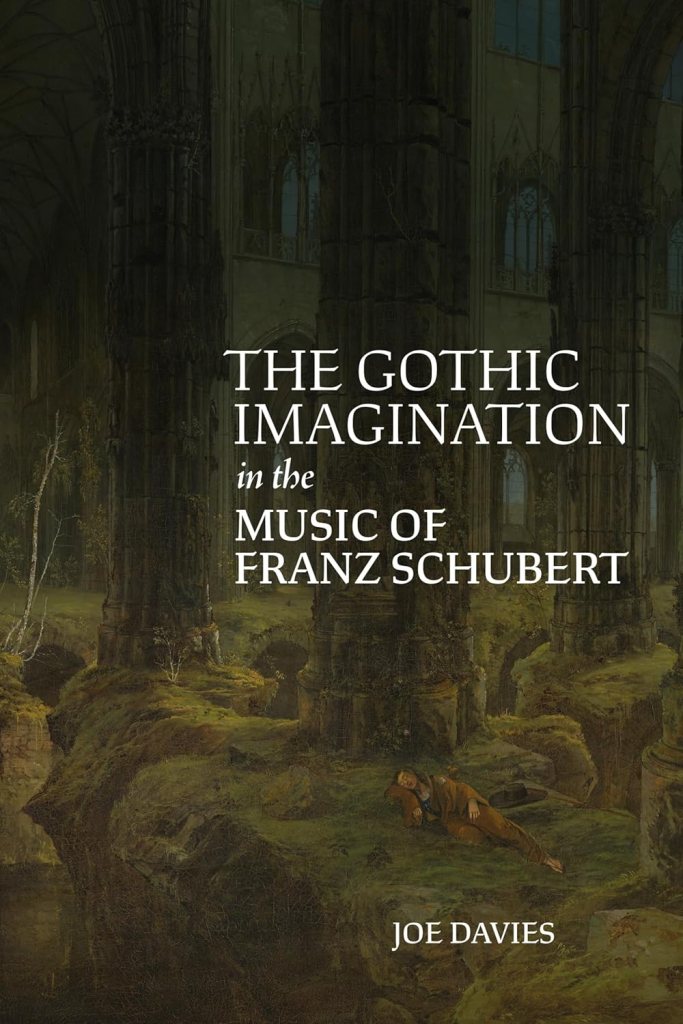
Joe Davies’s The Gothic Imagination in the Music of Franz Schubert offers an unprecedented and comprehensive examination of the deep and often unsettling ways in which the gothic permeates the music of one of the most beloved composers of the Romantic era. This work is a tour de force of interdisciplinary scholarship, shedding light on how Schubert’s compositions are infused with the elements of the gothic—a cultural and artistic movement that thrived on the dark, the eerie, and the supernatural. Through Davies’s exploration, we see Schubert not just as a composer of songs and symphonies but as an architect of a musical landscape where the boundaries between life and death, reality and fantasy, are persistently blurred.
Davies delves into Schubert’s engagement with gothic themes by tracing their presence from Schubert’s early songs through to the instrumental masterpieces of his later years. He situates Schubert’s work within a broader context of gothic art, literature, and aesthetic discourse, thus allowing for a richer understanding of the cross-pollination of ideas across different artistic domains. Schubert’s music, in Davies’s analysis, emerges as a site of gothic haunting, where the past looms ever-present, and death is a constant companion. The composer’s ability to evoke a sense of eerie unease, whether through a sudden rhythmic disjuncture or a ghostly tremolo, is not merely an incidental effect but a deliberate engagement with the gothic tradition.
The book is particularly illuminating in its exploration of how Schubert’s music conjures up the gothic’s characteristic tension between presence and absence, especially as it pertains to death. In pieces like the C minor Impromptu, D. 899/1, Davies reveals how Schubert manipulates musical material to evoke a sense of spectrality—where the music hovers on the edge of silence, suggesting ghostly presences that are never fully realized. The analysis of this Impromptu, with its forceful double octaves that dissipate into a funereal theme, serves as a microcosm of Schubert’s broader imagination here themed as gothic. The piece, in Davies’s reading, becomes a meditation on the transitory nature of life and the haunting persistence of the past, where each musical gesture seems to echo from some ungraspable, otherworldly source.
In this context, Schubert’s preoccupation with death is not merely a reflection of his personal struggles with mortality, as often suggested by biographical readings of his work. Rather, as Davies convincingly argues, it is a manifestation of a broader cultural fascination with gothic symbolics—a mode that delights in the exploration of fear, the sublime, and the grotesque. This fascination is evident in Schubert’s early Schauerballaden (songs of terror), where graveyard settings and spectral dances vividly bring the gothic to life in musical form. Yet, Davies also shows how these early engagements evolve over time, becoming more complex and ambiguous in Schubert’s later works, where death is not always explicit but is often implied through subtle musical means—through the doubling of themes, the use of nocturnal imagery, or the distortion of familiar musical forms.
One of the book’s most significant contributions is its challenge to the conventional understanding of the gothic as a purely literary or visual phenomenon. Davies convincingly argues that the gothic is also a musical phenomenon, one that can be heard in the peculiarities of Schubert’s harmonic language, in his idiosyncratic approach to form, and in the way he conjures up a sense of the uncanny. The gothic in Schubert’s music, according to Davies, is not confined to moments of explicit terror but permeates his entire oeuvre, from the fleeting disturbances of a tremolo to the more prolonged and disjunctive episodes that disrupt the listener’s sense of temporal and spatial continuity.
Davies’s approach is both innovative and methodologically rigorous, drawing on a vast array of musical, literary, and visual sources to paint a complex picture of Schubert’s gothic imagination. His readings are grounded in close analysis of musical and poetic texts, but they also open up broader questions about the nature of the gothic itself. What does it mean to describe a piece of music as gothic? How does this manifest in sound, and how does it relate to the visual and literary representations of the same themes? These are the kinds of questions that Davies invites the reader to consider, and in doing so, he offers new ways of thinking about the relationship between music and the broader cultural currents of the time.
The Gothic Imagination in the Music of Franz Schubert is not just a book about Schubert, but a deep rethinking on the nature of the gothic and its enduring power to evoke fear, wonder, and a sense of the sublime. It is a work that will appeal not only to scholars of music but also to anyone interested in the intersections of art, literature, and cultural history. By bringing Schubert’s music into dialogue with the gothic, Davies has opened up new avenues for understanding both the composer and the cultural milieu in which he worked. This book is sure to become a touchstone for future studies of Schubert and the gothic, offering readers a rich and immersive experience that challenges and deepens their understanding of both.
 Simon Gros
Leave a comment