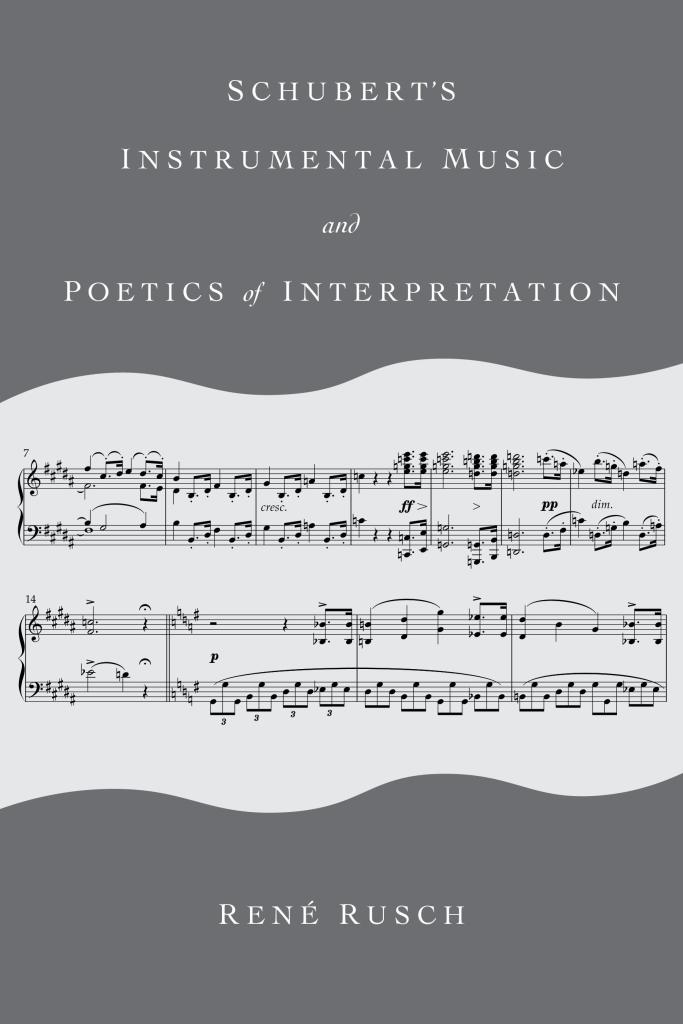
Schubert’s Instrumental Music and Poetics of Interpretation by René Rusch offers a deeply engaging and thought-provoking analysis of the multifaceted dimensions of Franz Schubert’s instrumental music through the lens of contemporary scholarship. It presents the reader with the evolving interpretations of Schubert’s work by situating them within a rich tapestry of aesthetic values, historiographical revisions, and shifting disciplinary commitments, thereby unraveling the complex web that underpins our understanding and appreciation of his music.
This book explores the poetics of interpretation, where Rusch interrogates the very foundations upon which modern assessments of Schubert’s instrumental oeuvre rest. Through a careful analysis of six representative works, Rusch provides a nuanced discourse on how different aesthetic and philosophical paradigms have shaped and reshaped the reception and analysis of Schubert’s compositions over the last two centuries. The study reconstructs the trajectory of Schubert’s music from its marginal status in the classical canon to its current recognition as a central and indispensable part of the Western musical tradition.
Rusch’s examination is situated within a broader context that considers the historical and cultural forces that have influenced the critical reception of Schubert’s work. The book opens with a reflection on how the discovery of Schubert’s previously unknown compositions after his death in 1828 significantly altered the course of his posthumous reputation. The newfound works, including symphonies, string quartets, and piano sonatas, challenged earlier assessments of Schubert as merely a composer of domestic genres, instead revealing him as a master of the larger, more ambitious forms typically associated with the Viennese Classical tradition. This discovery catalyzed a re-evaluation of his music, leading to a richer and more complex understanding of his contributions to music history.
The core of Rusch’s inquiry revolves around four key areas of Schubert studies: his approach to tonality, his treatment of sonata form, the intersection of his music with his biography, and the influence of Beethoven. Each of these areas is examined not in isolation but in a way that reveals their interconnectedness, thus blurring the boundaries between musical and extramusical considerations. Rusch argues convincingly that our interpretations of Schubert’s music cannot be disentangled from the broader narrative constructions that have been built around his life and legacy. This approach highlights the interdependence of music theory, historical context, and biographical interpretation in the ongoing project of understanding Schubert’s music.
Rusch’s treatment of Schubert’s tonality, for instance, delves into how his harmonic language has been perceived as both innovative and problematic by different generations of critics and scholars. The book demonstrates how what were once considered eccentric or arbitrary harmonic progressions can now be understood as coherent and integral to Schubert’s expressive intent, thanks to revised theoretical frameworks and hermeneutic approaches. This re-interpretation is emblematic of the broader shift in Schubert reception, where once-dismissed aspects of his music are now celebrated for their originality and depth.
Similarly, Rusch’s analysis of Schubert’s use of sonata form challenges traditional notions of formal unity and coherence. By revisiting the criticisms that have historically been leveled against Schubert’s sonata movements—namely, their perceived redundancy and excessive lyricism—Rusch offers a fresh perspective that sees these very characteristics as central to Schubert’s distinctive musical voice. The book argues that Schubert’s forms, far from being flawed, represent an alternative model of coherence that resists the teleological closure typical of his Classical predecessors. This perspective aligns with a broader aesthetic shift towards valuing the open-ended, the fragmentary, and the non-linear in art and music.
The relationship between Schubert’s music and his biography is another area where Rusch’s analysis shines. By engaging with the complex interplay between Schubert’s personal life and his compositional output, the book sheds light on how biographical narratives have shaped our understanding of his music. Rusch explores the ways in which Schubert’s image as a tortured, misunderstood genius has influenced interpretations of his works, particularly those written in his final years. This biographical lens, Rusch suggests, can both illuminate and obscure our understanding of Schubert’s music, depending on how it is employed.
The book’s exploration of Beethoven’s influence on Schubert is equally nuanced. Rusch navigates the intricate relationship between the two composers, considering both the ways in which Schubert emulated Beethoven and the ways in which he sought to distinguish himself from his illustrious predecessor. The book challenges the view of Schubert as a mere follower of Beethoven, instead presenting him as an independent thinker who engaged critically with the musical models he inherited. This reassessment of Schubert’s relationship with Beethoven is part of a broader effort to redefine Schubert’s place within the classical canon, not as a secondary figure but as a composer of equal stature and significance.
Throughout the book, Rusch draws on a wide range of philosophical, literary, and historiographical sources to support her analysis. The influence of early German Romantic philosophy, in particular, is evident in Rusch’s emphasis on the subjective nature of interpretation and the role of narrative in shaping our understanding of music. By engaging with these intellectual traditions, Rusch situates her work within a broader discourse on the nature of meaning and interpretation, making Schubert’s Instrumental Music and Poetics of Interpretation not only a study of Schubert’s music but also a discussion of the act of interpretation itself.
The book is particularly innovative in its proposal of an alternative poetics of interpretation, one that seeks to sustain the tensions and contradictions within Schubert’s music rather than resolve them into a unified whole. This approach is reflective of a broader trend in contemporary music scholarship that values multiplicity, ambiguity, and open-endedness over closure and finality. Rusch’s alternative poetics offers a new way of hearing and understanding Schubert’s music, one that embraces its complexities and resists the urge to impose a singular, overarching interpretation.
Schubert’s Instrumental Music and Poetics of Interpretation is a landmark work that significantly advances our understanding of Schubert’s music and its place within the broader landscape of music history. Through its careful analysis and its engagement with and through a wide range of intellectual traditions, the book offers a compelling re-evaluation of Schubert’s instrumental music, challenging long-held assumptions and opening up new avenues for understanding. It is a must-read for scholars, students, and anyone with a deep interest in Schubert, music theory, or the philosophy of interpretation.
 Simon Gros
Leave a comment