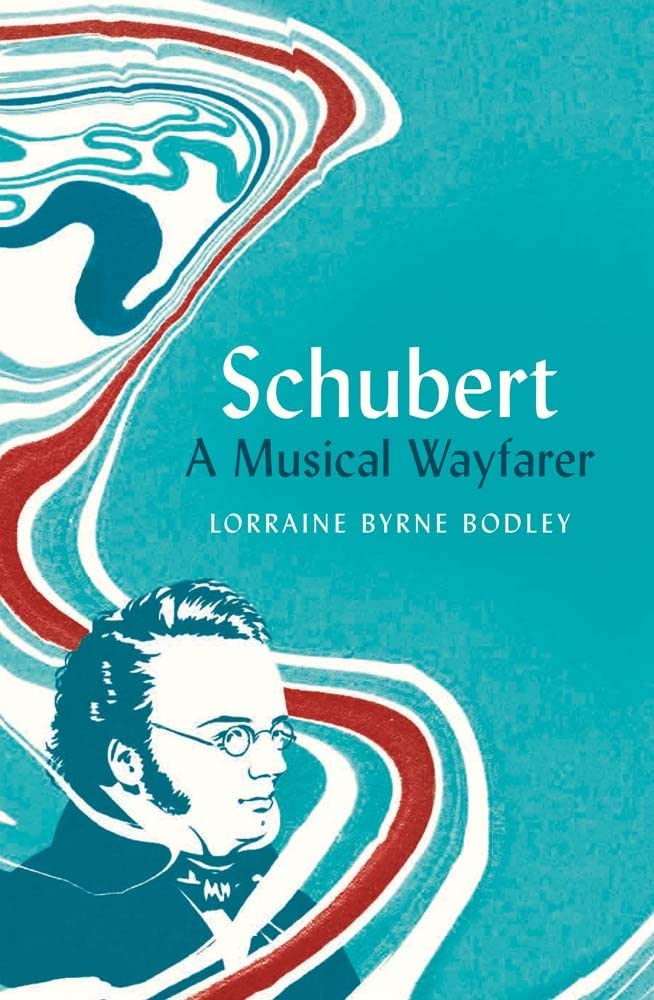
Schubert: A Musical Wayfarer by Lorraine Byrne Bodley is a monumental achievement in the realm of music biography, a work that redefines our understanding of Franz Schubert, not only as one of history’s most gifted composers but as a man whose life was as complex and poignant as the music he created. Bodley’s biography is a masterpiece of scholarly rigor, empathetic storytelling, and intricate musicological analysis, all combined together to provide a deeply immersive portrait of Schubert—a figure whose brilliance, often obscured by myth and simplification, is here revealed in its full, nuanced complexity.
The book begins by situating Schubert in the cultural and familial milieu of late 18th and early 19th century Vienna, a city vibrating with artistic energy but also deeply conservative in its social structures. Schubert, born into a family of modest means and steeped in the traditions of the Catholic Church, was shaped by these forces as much as he was by the musical innovations that characterized his era. Bodley traces Schubert’s lineage, exploring how his family’s Bohemian roots and devout faith influenced not only his early upbringing but also the thematic currents in his music. This genealogical exploration si more than mere background, it forms the bedrock of Bodley’s thesis that Schubert’s music cannot be fully understood without a deep appreciation of the personal and cultural context from which it sprang.
As Bodley goes into Schubert’s early years, she paints a vivid picture of a child prodigy whose gifts were recognized early by his family and teachers, yet whose journey was far from the smooth ascent one might expect for such a talent. Schubert’s education at the Stadtkonvikt, a prestigious boarding school for musically gifted boys, is detailed with precision, showing how the young composer’s formative experiences in this rigorous and often harsh environment laid the foundation for his later work. Bodley’s description of Schubert’s interactions with his teachers and peers is enriched by her use of archival sources, some of which are newly discovered and provide fresh insights into the composer’s early development.
Central to Bodley’s narrative is the idea of Schubert as a “wayfarer”—a theme that resonates not only in his famous song cycle, Winterreise, but also in his life’s journey, marked by restlessness, profound introspection, and a search for meaning in a world that often seemed hostile to his creative spirit. Bodley explores this motif with a psychological depth that brings Schubert’s inner world to life, examining how his music served as both an escape from and a response to the challenges he faced, from his unrequited loves to the devastating impact of his illness. This exploration is particularly poignant in Bodley’s analysis of Schubert’s late works, where the shadow of mortality looms large, and yet the music remains suffused with an undying beauty and grace.
One of the most compelling aspects of Bodley’s biography is her ability to combine the personal and the professional in Schubert’s life. She does not shy away from the darker aspects of his story—his struggles with health, his feelings of alienation, and the tensions within his circle of friends—yet she always brings the focus back to the music, showing how these experiences were transmuted into some of the most enduring compositions of the 19th century. Bodley’s analysis of works like Die schöne Müllerin and the String Quintet in C Major is both technically precise and deeply emotive, offering readers not just an understanding of these works’ structure and innovation, but also a sense of the emotional and existential weight they carry.
In her examination of Schubert’s relationships, Bodley provides a nuanced portrayal of the composer’s interactions with the artistic and intellectual circles of Vienna. She delves into his friendships with figures like Johann Michael Vogl, Franz von Schober, and the poet Johann Mayrhofer, showing how these connections both supported and complicated Schubert’s life. Bodley is particularly insightful in her discussion of Schubert’s relationship with Beethoven, a figure who loomed large over Schubert’s creative life. While the two composers are often depicted as occupying entirely separate spheres, Bodley argues for a more complex interplay of influence and admiration, challenging the simplistic narrative of Schubert as a purely derivative figure in Beethoven’s shadow.
The book also addresses the myths and legends that have grown up around Schubert since his death, particularly those that paint him either as a carefree bohemian or as a tragic, isolated genius. Bodley systematically dismantles these caricatures, using a wealth of primary sources to reconstruct a more accurate and humane portrait. She shows that while Schubert certainly struggled with societal norms and personal demons, he was also a figure of immense resilience and courage, someone who continued to create extraordinary music even as his health deteriorated and his prospects dimmed.
Bodley’s scholarship is exhaustive, yet her writing is never dry or overly technical. She has a rare gift for making complex ideas accessible to a broad audience without sacrificing depth or nuance. Her discussions of Schubert’s music are interspersed with vivid descriptions of Vienna’s cultural life, from the salons and theaters to the political upheavals that shaped the city in the early 19th century. This context is crucial for understanding Schubert’s work, which was so often in dialogue with the artistic and intellectual currents of his time.
Schubert: A Musical Wayfarer is more than biography, it is a reimagining of Schubert’s place in music history. Bodley challenges the reader to see Schubert not as a tragic figure of unfulfilled potential, but as an artist who, in his short life, achieved a body of work that continues to resonate with listeners today. Her book is a testament to the enduring power of Schubert’s music, a power that lies not just in its technical mastery, but in its profound emotional and spiritual depth. Bodley’s work will undoubtedly become a definitive source for future generations of Schubert scholars and music lovers alike, offering a richer, more complex understanding of a composer whose life and work continue to inspire.
Lorraine Byrne Bodley’s work is a triumph of musicological biography, a work that offers new insights into Schubert’s life, his music, and his place in the broader cultural and historical context of his time. It is a book that demands to be read either by those with a specific interest in Schubert or by anyone who wishes to understand the dynamics between an artist’s life and his creative output. Bodley’s Schubert is a figure of immense depth and humanity, a composer whose music continues to speak to us across the centuries, and whose life, as revealed in this extraordinary book, was as rich and complex as the works he left behind.
 Simon Gros
Leave a comment