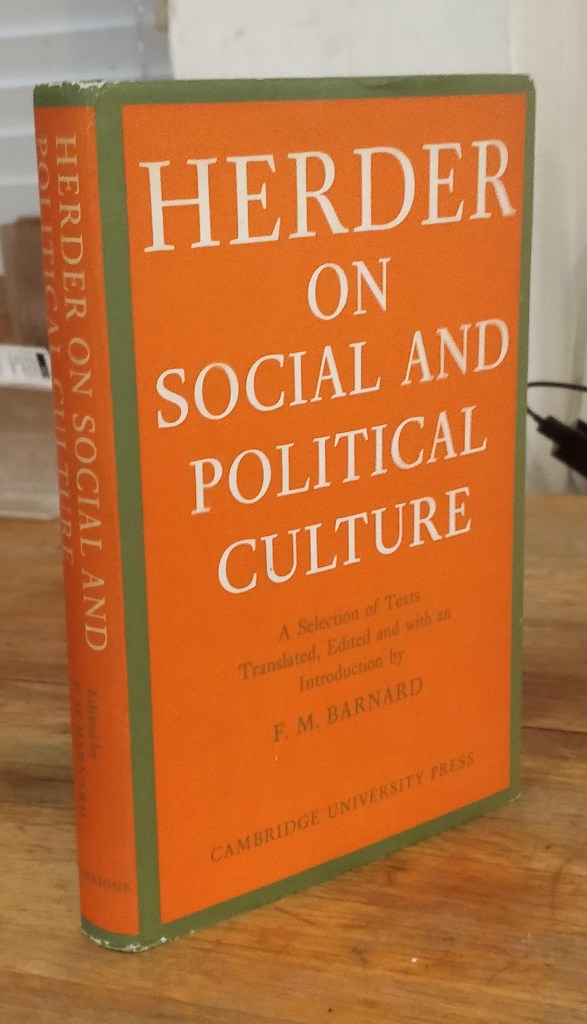
In this work, originally published in 1969, F. M. Barnard curated a compelling collection of Johann Gottfried Herder’s most significant and intellectually provocative writings, which illuminate Herder’s ideas on politics, history, and language—an amalgamation that remains remarkably relevant in today’s socio-political discourse. The volume is notable for making accessible a plethora of Herder’s writings, thereby serving as an invaluable resource for scholars and enthusiasts of philosophy, history, and cultural studies alike. Barnard’s book provides a nuanced framework for understanding Herder’s political philosophy within the broader context of Enlightenment thought, delineating how Herder diverges from contemporaneous thinkers while concurrently engaging with the epoch’s prevailing ideas.
Herder’s writings articulate a conception of political identity that significantly departs from conventional notions of statehood and sovereignty, emphasizing instead the centrality of culture, community, and language as the bedrock of human society. He asserts that true political unity emerges not from imposed authority or centralized governance but from a shared cultural identity—a concept he encapsulates with the term “Volk.” This idea, grounded in the recognition of language as the primary conduit for individual and collective identity, positions culture as an organic unifier of communities, allowing individuals to recognize themselves as integral parts of a larger social fabric. In his exploration of language, Herder innovatively posits that it is through linguistic expression that humans come to understand their place within the universe, thus intertwining personal identity with national consciousness. This interplay is illustrated in various texts included in the volume, such as Essay on the Origin of Language and Ideas for a Philosophy of the History of Mankind, where he underscores language’s vital role in shaping thought, culture, and social interactions.
Barnard’s scholarly examination reveals Herder’s innovative theory of historical interaction, which contrasts sharply with the deterministic narratives often presented by Enlightenment thinkers. Herder perceives history as a dynamic force made up by a variety of human experiences, interactions, and cultures rather than a linear progression towards an ideal state of being. This fluidity invites a rethinking of progress; for Herder, it is not a singular pathway but a multitude of pathways shaped by the cultural contexts and histories of distinct peoples. This view stands in stark contrast to Enlightenment universalism, advocating for a pluralistic understanding of humanity that honours the diversity of cultural expressions and historical trajectories.
Moreover, Herder’s writings reveal a deep skepticism towards the conventional frameworks of governance and power that characterized his contemporaneous political landscape. His disdain for bureaucratic centralization and absolute monarchies manifests in his advocacy for a decentralized, pluralistic form of governance—an idea that resonates with contemporary discussions around participatory democracy and local governance. He envisioned a “Volk-state” where governance arises organically from the community itself, eschewing hierarchical structures in favour of a model based on joint endeavour (Zusammenwirken). Barnard highlights how Herder’s conception of political organization reflects an anarcho-pluralistic ideal, wherein government is not an external imposition but a collective manifestation of communal will and cultural heritage.
In addressing the problem of political change and progress, Herder confronted the dual pressures of order and freedom. He grapples with the implications of an enlightened despotism that promises efficiency at the expense of individual liberties. Herder staunchly advocates for the latter, emphasizing the importance of fostering active, engaged citizenry capable of self-governance, even when such a system may be inherently disorderly. He poses a critical question about the essence of humanity: should society prioritize mechanical order over the cultivation of living energies and individual agency? This philosophical inquiry is deeply resonant in contemporary debates regarding governance, civil liberties, and the role of the state in the lives of individuals.
Barnard also thoughtfully situated Herder’s ideas within the discourse of traditionalism and modernity, particularly in the wake of the French Revolution. Through comparative analysis, he elucidated the distinctions between Herder’s thought and that of contemporaneous thinkers such as Edmund Burke, demonstrating how Herder’s emphasis on cultural identity and grassroots political engagement starkly contrasts with Burke’s advocacy for gradualism and respect for established hierarchies. This comparative lens not only enhances the reader’s understanding of Herder’s unique position within the political thought landscape of the time but also highlights the enduring relevance of his ideas in addressing modern political dilemmas.
J. G. Herder on Social and Political Culture is not merely an anthology of Herder’s work but a profound philosophical treatise that invites readers to engage critically with the nature of culture, identity, and governance. By compiling Herder’s most significant texts and providing insightful analysis, Barnard revitalized interest in a thinker whose contributions to social and political philosophy deserve renewed recognition in light of contemporary challenges. The collection encourages a deeper appreciation for the complexities of human societies and the ways in which culture shapes our political realities, ultimately positioning Herder as a pivotal figure in the evolution of political thought.
This volume stands as an essential text for those seeking to understand the intricate relationships between culture, language, and political identity, offering timeless insights that resonate across historical and contemporary landscapes.
 Simon Gros
Leave a comment