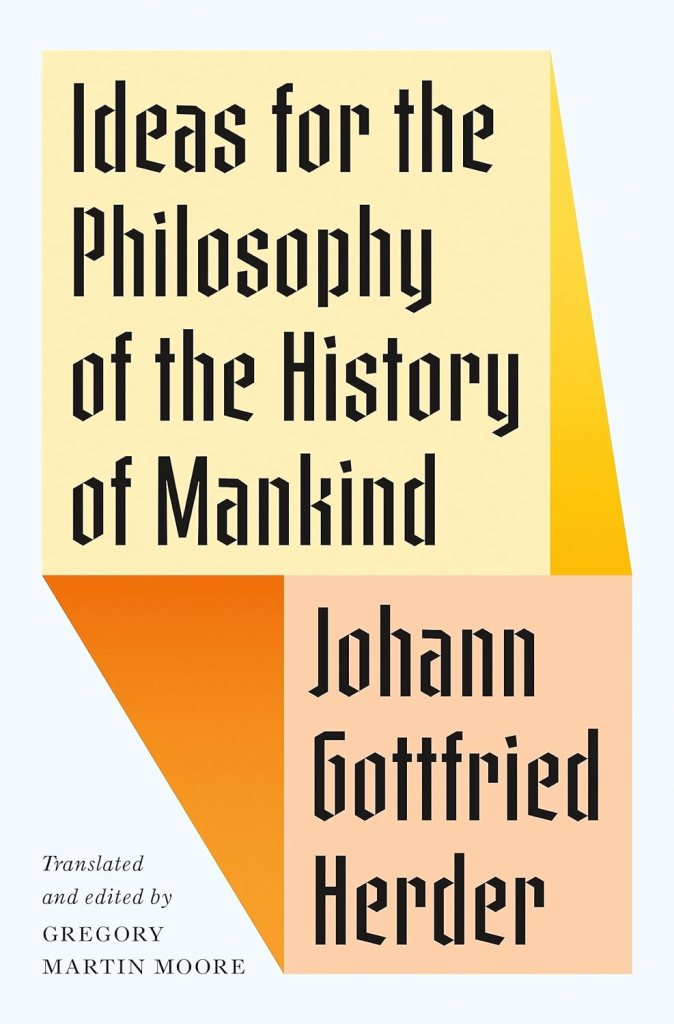
Ideas for the Philosophy of the History of Mankind by Johann Gottfried Herder is a vast and ambitious work that stands as one of the most significant contributions to Enlightenment thought. Published in four volumes between 1784 and 1791, Herder’s magnum opus sought nothing less than a comprehensive understanding of the human experience, tracing its origins, development, and purpose within the grand sweep of history and nature. The book is a testament to Herder’s polymathic intellect, encompassing a wide array of topics, from the formation of the earth and the evolution of species to the development of culture and the immortality of the soul.
Herder’s Ideas is fundamentally an exploration of the unity and purpose of history, rooted in a deep belief in the interconnectedness of all things. This work attempts to synthesize the many strands of eighteenth-century thought into a coherent whole, challenging and expanding upon the ideas of his contemporaries such as Montesquieu, Rousseau, Kant, and Buffon. Herder’s inquiry is not merely an intellectual exercise but a deeply moral endeavor, seeking to understand the place of humans in the cosmic order and the meaning of their existence.
At the heart of Herder’s philosophy is a profound commitment to understanding human nature, which he perceives as both universal and particular, shaped by the environment, culture, and historical context. He rejects the notion of a single, linear progression of history, instead proposing a more complex, organic development of human societies, each with its own unique path and destiny. This pluralistic view of history was revolutionary in its time, challenging the Eurocentric narratives that dominated Enlightenment thought and laying the groundwork for later theories of cultural relativism and historicism.
Herder’s approach to history is deeply rooted in his understanding of nature. He begins his work with a discussion of the formation of the earth and the solar system, reflecting his belief that human history cannot be separated from the broader history of nature. He sees the development of life on earth as a continuous process, governed by the same laws that govern the stars and planets. This naturalistic view of history is infused with a sense of wonder at the complexity and beauty of the natural world, which Herder sees as a manifestation of divine order.
One of the most striking aspects of Herder’s work is his treatment of race and human diversity. In an era when many of his contemporaries were beginning to develop theories of racial hierarchy, Herder instead emphasized the common humanity of all people, while also celebrating the diversity of cultures and traditions. He argued that each culture is a unique expression of the human spirit, shaped by its environment and history, and that no one culture can be considered superior to another. This egalitarian view of human diversity was a radical departure from the prevailing attitudes of his time and has had a lasting impact on the development of anthropology and cultural studies.
Herder also engages deeply with questions of metaphysics and theology, exploring the nature of the soul, the concept of immortality, and the relationship between the material and spiritual worlds. He is deeply influenced by Spinoza’s monism, which posits that everything in the universe is part of a single, divine substance. Herder’s attempt to reconcile this naturalistic view of the world with his Christian faith is one of the most fascinating aspects of his work, reflecting the broader tensions within Enlightenment thought between science and religion, reason and faith.
The Ideas is also a work of profound moral and ethical reflection. Herder is deeply concerned with the moral progress of humanity, which he sees as the ultimate purpose of history. He argues that history is not merely a record of events but a process of moral development, in which humanity gradually comes to realize its potential for goodness and justice. This vision of history as a progressive force, leading toward greater enlightenment and humanity, is deeply optimistic, yet it is tempered by a recognition of the suffering and injustice that have marked human history.
Herder’s work is notable not only for its intellectual ambition but also for its literary qualities. His prose is rich and expressive, often moving seamlessly between philosophical argument, historical narrative, and poetic meditation. This stylistic versatility reflects the breadth of Herder’s intellectual interests and his belief in the unity of all forms of knowledge. The Ideas is a work that defies easy classification, combining elements of philosophy, history, anthropology, and theology into a single, coherent vision.
The reception of Herder’s Ideas has been complex and varied. Upon its publication, it was both celebrated and criticized, with some contemporaries praising its originality and depth, while others found it overly diffuse and lacking in rigor. The French Revolution, which erupted shortly after the publication of the first volume, further complicated the reception of Herder’s work, as the political and intellectual landscape of Europe was rapidly changing. Herder himself was deeply ambivalent about the Revolution, supporting its ideals of liberty and equality but horrified by its violence and excesses. This ambivalence is reflected in the later volumes of the Ideas, which grapple with the unfolding events in France and their implications for his philosophy of history.
In the centuries since its publication, the Ideas has continued to be a source of inspiration and debate. It has influenced a wide range of thinkers, from the German Romantics to modern anthropologists, and its themes of cultural diversity, historical relativism, and the moral purpose of history remain as relevant today as they were in Herder’s time. However, the work has also been criticized for its lack of systematic rigor and its occasional lapses into obscurity and contradiction. Some scholars have argued that Herder’s attempt to reconcile his naturalistic worldview with his religious beliefs ultimately failed, resulting in a work that is rich in ideas but sometimes lacking in coherence.
Despite these criticisms, Ideas for the Philosophy of the History of Mankind remains a foundational text in the history of ideas, offering a unique and deeply humanistic vision of history and culture. It is a work that challenges readers to think deeply about the nature of humanity, the purpose of history, and the relationship between culture and nature. In a world that is increasingly interconnected yet divided by cultural and historical differences, Herder’s vision of a pluralistic and humane philosophy of history is more relevant than ever. This new translation of the Ideas, the first in over two centuries, offers English-speaking readers the opportunity to engage with Herder’s thought in all its richness and complexity, and to appreciate the enduring significance of this remarkable work.
 Simon Gros
Leave a comment