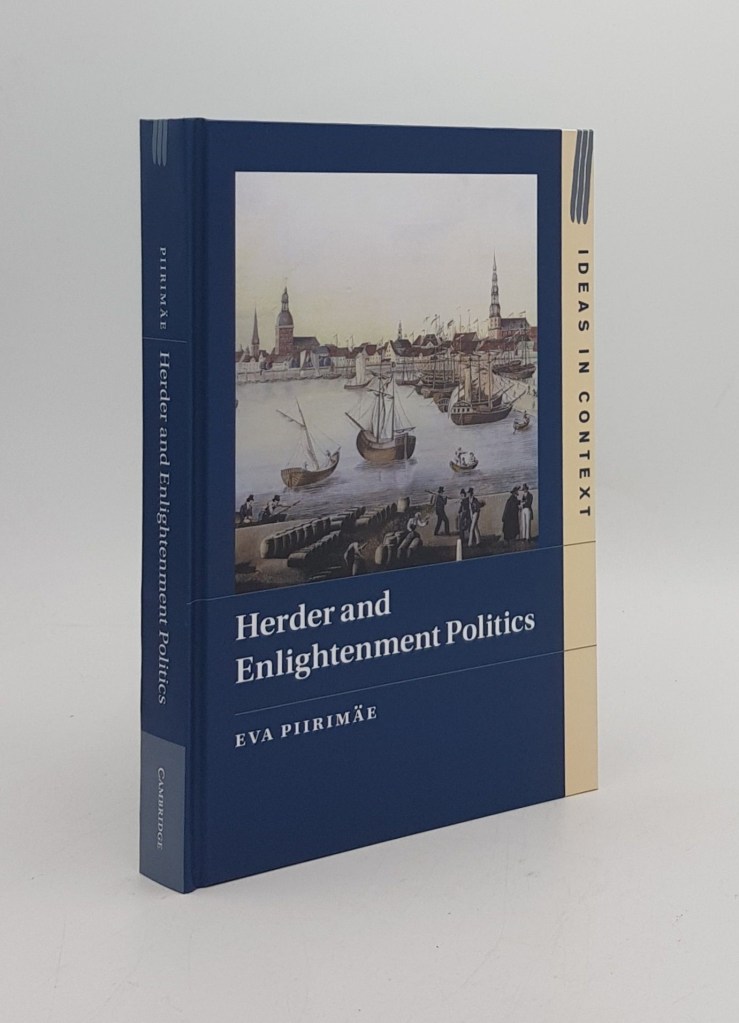
Herder and Enlightenment Politics by Eva Piirimäe presents a detailed examination of Johann Gottfried Herder’s political thought, challenging prevailing interpretations and offering a radically new understanding of his contributions to Enlightenment debates on modern patriotism, commerce, and peace.
Johann Gottfried Herder (1744–1803) stands as a pivotal figure in the genesis of philosophical anthropology and cultural history, disciplines that have shaped modern understandings of humanity and its cultural expressions. Herder’s influence extends into the study of popular culture, where his pioneering ideas on the importance of cultural context and the deep-seated connections between language, identity, and community laid the groundwork for subsequent intellectual developments. His sharp critique of colonialism and imperialism, alongside his nuanced views on national and cultural identity, positions him as a thinker of enduring relevance, particularly in contemporary discussions on multiculturalism, nationalism, and global interconnectedness.
In this important work, Piirimäe embarks on an ambitious and comprehensive re-evaluation of Herder’s political philosophy, situating his ideas within the broader intellectual currents of the Enlightenment. She reconstructs Herder’s engagement with key Enlightenment figures such as Jean-Jacques Rousseau, Montesquieu, Thomas Abbt, Adam Ferguson, Justus Möser, and Immanuel Kant. Through this reconstruction, Piirimäe reveals Herder as a thinker deeply concerned with the potential for cultural, moral, and political reform, not only in his native Germany but also across Europe, including Russia, where Herder saw significant potential for transformative change.
Herder’s vision for modern European societies was rooted in a distinctive understanding of human self-determination and natural sociability. These concepts, which Piirimäe explores in great depth, are central to Herder’s critique of both ancient and modern forms of political organization. Herder’s early works grapple with the notion of patriotism, which he saw as a double-edged sword: on the one hand, it could foster a deep sense of communal belonging and mutual responsibility; on the other, it could devolve into a dangerous form of nationalism, marked by exclusion and aggression. Piirimäe carefully traces Herder’s evolving thought on this issue, highlighting his early idealism and his later, more nuanced reflections on the limits of patriotism in a rapidly changing Europe.
Herder’s engagement with Rousseau is particularly illuminating in this context. While initially influenced by Rousseau’s critique of modernity, Herder soon diverged, developing his own theory of natural sociability that emphasized the importance of cultural and linguistic diversity as a foundation for human flourishing. Piirimäe shows how Herder’s reflections on sociability led him to a critique of Rousseau’s rejection of modern civilization and his idealization of the ancient polis. For Herder, modern liberty could not simply be a revival of ancient practices; it required a new, culturally informed understanding of human community, one that recognized the value of diversity and the need for ethical grounding in the laws and institutions of modern states.
Herder’s political thought also intersected with contemporary debates on commerce and international relations. Piirimäe delves into Herder’s views on the role of commerce in fostering interdependence among European nations, thereby promoting peace. Herder envisioned a Europe where commerce would serve as a unifying force, binding nations together through mutual interest and cultural exchange. However, he was acutely aware of the dangers of commercialism, particularly its potential to undermine local cultures and erode the moral fabric of societies. Piirimäe skilfully navigates these tensions in Herder’s thought, illustrating how his ideas on commerce were intertwined with his broader political and ethical concerns.
Herder’s critique of European statecraft, particularly his opposition to the ‘state-machines’ of modern monarchies, is another key theme that Piirimäe explores with great analytical rigor. Herder’s protracted debate with Kant, which Piirimäe reconstructs in detail, reveals the depth of his commitment to a more humane and culturally sensitive form of governance. While Kant’s vision of autonomy and the rule of law appealed to a universalist and abstract notion of justice, Herder argued for a more contextual and historically grounded approach, one that took into account the specific cultural and linguistic conditions of each people. Herder’s prediction of the eventual collapse of these ‘state-machines’ under the weight of emancipatory movements is particularly prescient, as is his call for rulers to undertake significant reforms in response to the changing dynamics of European societies.
In the context of the French Revolution, Herder’s thought took on a new urgency. He became increasingly concerned with the implications of revolutionary fervour for the self-determination of peoples and the future of international relations. Piirimäe explores Herder’s ambivalent stance towards the Revolution, noting his sympathy for the French pursuit of self-constitution while simultaneously warning against the dangers of republican imperialism. Herder’s reflections on the role of European cities in the development of modern liberty, and his vision of Europe as a commercially and culturally interconnected community of peoples, offer a compelling alternative to the more centralized and homogenizing tendencies of modern nation-states.
In the final sections, Piirimäe examines the reception of Herder’s ideas in subsequent periods, particularly in Germany and the Baltic region. She shows how Herder’s thought provided inspiration for a wide range of political movements, from liberalism to socialism to anarchism, while also cautioning against simplistic interpretations that link Herder too closely with any particular ideology. Herder’s vision of a transnational order in Europe, based on cultural and commercial ties rather than national sovereignty, is highlighted as a significant yet often overlooked aspect of his legacy.
Herder and Enlightenment Politics is not just a historical study; it also offers valuable insights into contemporary political debates. By engaging deeply with Herder’s thought, Piirimäe encourages readers to reflect on the enduring relevance of his ideas, particularly his belief in the need for laws and institutions to be grounded in ethical principles and his critique of the instrumentalization of culture by political powers. The book invites us to reconsider the connections between nationalism, cosmopolitanism, and multiculturalism, and to explore the ways in which Herder’s thought can inform our understanding of the complex interplay between culture, ethics, and politics in the modern world.
Eva Piirimäe’s book is a masterful work of intellectual history that redefines our understanding of Herder as a political thinker. It is a book that will appeal not only to scholars of the Enlightenment and political theory but also to anyone interested in the history of ideas and their relevance to contemporary political challenges. Through its careful reconstruction of Herder’s political thought, Piirimäe’s study offers a fresh perspective on the Enlightenment and its legacy, revealing Herder as a thinker whose ideas continue to resonate in our ongoing debates about liberty, community, and peace.
 Simon Gros
Leave a comment