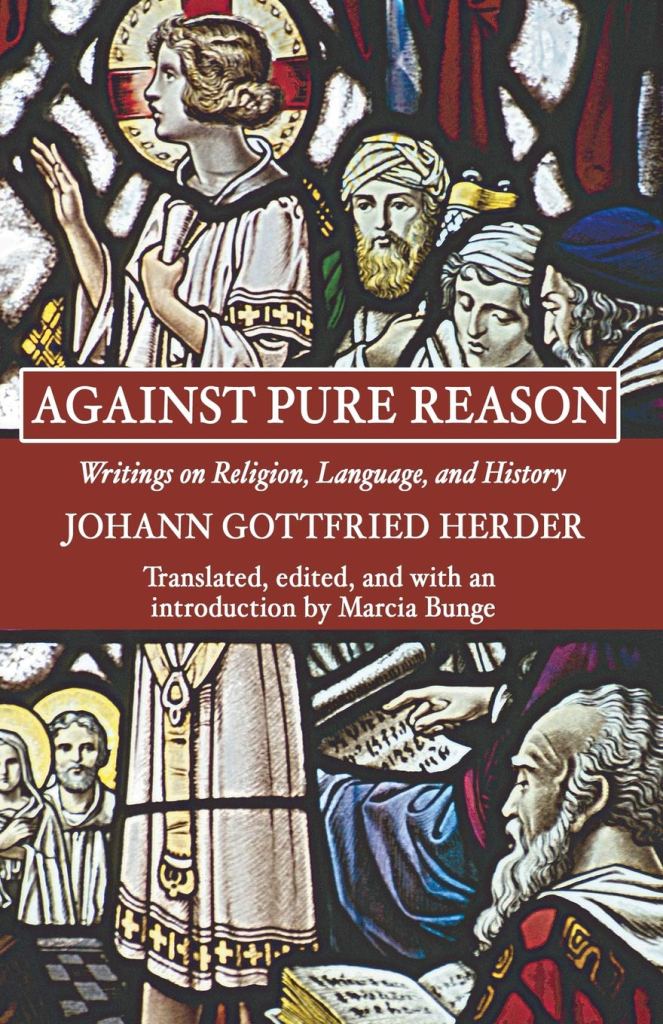
Against Pure Reason by Johann Gottfried Herder, translated and curated by Marcia Bunge, emerges as a vital rediscovery of an underappreciated thinker whose intellectual breadth and depth resonate profoundly with the concerns of contemporary thought. Herder, a towering figure in the twilight of the Enlightenment and the dawn of Romanticism, occupies a crucial yet often overlooked position in the history of ideas. His influence stretches across disciplines—biblical criticism, philosophy of language, literary theory, and the philosophy of history—yet his name is seldom mentioned alongside those of Kant, Hegel, or Nietzsche. Bunge’s translation, paired with her insightful commentary, illuminates the relevance of Herder’s work for a modern audience, presenting his ideas with a clarity and vigor that makes them accessible while retaining the nuance and complexity that characterize his thought.
Herder’s philosophy represents a spirited challenge to the Enlightenment’s exaltation of pure reason, which he perceived as a reductive and ultimately alienating force. In this collection, his critique is not an outright rejection of reason but an insistence on its limitations and its entanglement with language, history, and culture. Herder, far from being an irrationalist, sought to expand the Enlightenment’s understanding of human nature, arguing that reason is but one facet of a richer, more holistic conception of humanity. His works demonstrate a deep appreciation for the historical and cultural particularities that shape human thought and expression, advocating for a pluralistic approach to knowledge that honours the diversity of human experience.
Herder’s contributions to the philosophy of language are particularly prescient. At a time when many of his contemporaries viewed language as a mere tool for expressing pre-existing ideas, Herder recognized language as the very medium through which thought is possible. He argued that language is not a transparent vessel for conveying universal truths but a living, evolving phenomenon deeply rooted in the historical and cultural contexts from which it arises. This insight laid the groundwork for later developments in linguistic philosophy and hermeneutics, anticipating the work of figures like Heidegger and Gadamer. Herder’s insistence on the historicity of language challenges the notion of an abstract, decontextualized reason, positing instead that our understanding is always mediated by the particular languages and traditions we inherit.
In the realm of history, Herder’s thought represents a significant departure from the Enlightenment’s universalizing tendencies. He resisted the impulse to judge all cultures and historical periods by the standards of contemporary European thought, advocating instead for a deep respect for the unique character of each culture and epoch. Herder’s historical relativism, far from being a rejection of truth, is a call to recognize the multiplicity of truths that emerge from different cultural and historical contexts. His work on the philosophy of history laid the foundations for the development of historicism in the 19th century and continues to inform debates in historiography and cultural theory.
Religion, for Herder, was another domain in which the Enlightenment’s rationalist assumptions were inadequate. He approached religious texts, particularly the Bible, not as repositories of timeless doctrinal truths but as expressions of the cultural and historical circumstances from which they emerged. Herder’s historical approach to religion anticipated modern biblical criticism, encouraging readers to understand religious texts in their original context rather than through the lens of later theological developments. His view of religion as a universal aspect of human culture, yet one that takes on distinct forms in different societies, was groundbreaking. It challenged both the dogmatism of traditional theology and the reductionism of secular Enlightenment thought.
Herder’s engagement with literature is another area where his thought prefigures later developments in literary theory. He was among the first to argue for the importance of studying literature within its historical and cultural context, a perspective that would later become central to the field of comparative literature. His appreciation for the distinctive qualities of different national literatures, particularly his elevation of German folk poetry, was instrumental in the development of a national literary consciousness in Germany and influenced the Romantic movement’s valorisation of the folk as the authentic source of cultural identity.
Bunge’s translation captures the vibrancy of Herder’s prose, preserving the rhetorical force of his arguments while making them accessible to a 21st-century audience. Her extensive introduction and careful selection of texts provide readers with a comprehensive overview of Herder’s thought, highlighting the interconnectedness of his ideas across different domains. The thematic arrangement of the writings—covering human nature, language, history, myth and religion, God and nature, literature and the Bible, and Christianity and theology—reflects the integrated nature of Herder’s thinking and allows readers to trace the development of his ideas across his career.
This volume is not just a mere collection of historical texts but a plea to reengage with a thinker whose ideas are strikingly relevant to contemporary debates. Herder’s critiques of abstraction, his emphasis on the historical and cultural embeddedness of thought, and his defence of the particular against the universal resonate powerfully in an age grappling with the legacies of modernity. As the intellectual heirs of the Enlightenment, we are still wrestling with the tensions between universalism and particularism, reason and tradition, progress and preservation. Herder offers a way of thinking through these tensions that refuses to simplify or reduce, insisting instead on the richness and complexity of human life.
Against Pure Reason is thus a fitting title for this collection, as it encapsulates Herder’s challenge to the Enlightenment’s most cherished assumptions. Yet Herder’s critique is not a rejection of the Enlightenment; it is a call for its completion. He sought to deepen and broaden the Enlightenment project by recognizing the full range of human faculties and the diversity of human cultures. In an age where the fractures of modernity are increasingly apparent, Herder’s vision of a more inclusive, humane rationality offers a way forward. This book is essential reading for anyone interested in the history of ideas, the philosophy of language, or the ongoing dialogue between reason and culture. Through Bunge’s great translation and curation, Herder speaks to us across the centuries, offering insights that are as vital now as they were in his own time.
 Simon Gros
Leave a comment