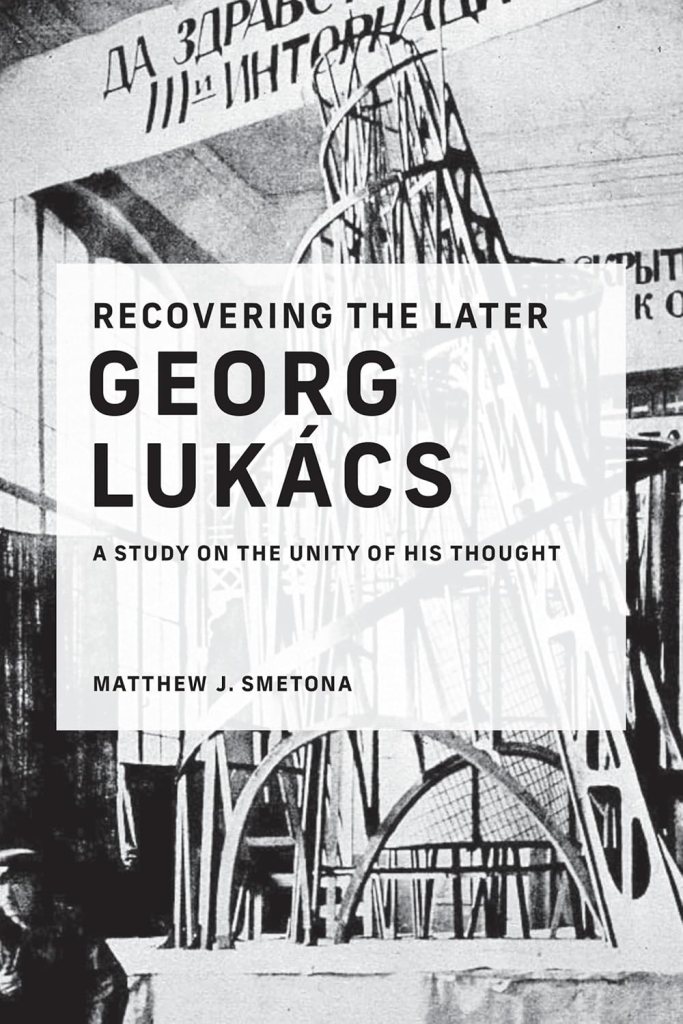
Recovering the Later Georg Lukács by Matthew J. Smetona is an expansive and rigorous exploration of the later writings of Georg Lukács, a figure whose philosophical and literary contributions have long been a subject of both reverence and contention within the canon of Western Marxism. Smetona’s work is nothing less than a scholarly excavation of the dense theoretical landscape that Lukács navigated after his early, seminal contributions, particularly History and Class Consciousness (1923). While Lukács’s early work has been widely celebrated for its incisive critique of reification and its dialectical conception of totality, his later writings have often been marginalized or dismissed, frequently seen as capitulations to the ideological pressures of Stalinism or as diluted extensions of his earlier, more radical ideas. Smetona, however, undertakes the formidable task of reevaluating this period, arguing persuasively for the intrinsic unity and continued relevance of Lukács’s later thought.
At the heart of Smetona’s argument is the assertion that the theoretical framework established in History and Class Consciousness—particularly its critique of reification through the lens of dialectical totality—remains the methodological bedrock upon which Lukács’s later works on aesthetics, politics, and ontology are constructed. Reification, understood as the process by which social relations are obscured and objectified, continues to be the central concern of Lukács’s intellectual project. However, rather than simply reiterating his earlier critiques, Lukács expands and refines his analysis, applying the concept of reification to a broader array of cultural and philosophical phenomena. Smetona traces this continuity, demonstrating that Lukács’s later work represents not a departure from, but rather a deepening of, his earlier theoretical commitments.
One of the key contributions of Smetona’s study is his nuanced reading of Lukács’s engagement with realism, both in the literary and philosophical senses. Smetona argues that for Lukács, realism becomes the primary aesthetic and methodological tool for combating reification. In literature, realism is not merely a stylistic preference but a mode of representation that has the potential to reveal the underlying social processes that capitalism tends to mystify. This literary realism is intimately connected to Lukács’s broader philosophical realism, which Smetona carefully reconstructs from Lukács’s later works. This philosophical realism, rooted in a Marxist ontology, asserts that social reality, despite being deeply enmeshed in capitalist reification, can be comprehended and transformed through a dialectical understanding of totality. Thus, Smetona reveals how Lukács’s later thought offers a coherent and potent critique of capitalist culture, one that remains profoundly relevant in contemporary debates within Marxist cultural criticism.
Smetona’s treatment of Lukács’s ontology is particularly significant, as it addresses one of the most misunderstood and underappreciated aspects of his later thought. The notion of a Marxist ontology might appear paradoxical or even contradictory, given Marx’s materialist commitments. However, Smetona carefully unpacks Lukács’s conception of ontology, showing how it is fundamentally grounded in a dialectical method that is both historical and materialist. Lukács’s ontology is not an abstract metaphysics but a concrete analysis of social being, one that insists on the processual and relational nature of reality under capitalism. Smetona argues that this ontological perspective is essential for understanding Lukács’s later work, as it provides the foundation for his continued critique of reification and his defense of realism.
Throughout his analysis, Smetona is keenly aware of the political and historical context in which Lukács wrote. He does not shy away from the complex and often controversial aspects of Lukács’s later career, including his political alignments and the accusations of ideological compromise that have been levelled against him. However, Smetona approaches these issues with a balanced and critical eye, arguing that while Lukács’s political circumstances inevitably influenced his work, they do not negate the philosophical rigor or the theoretical innovations of his later writings. In fact, Smetona suggests that these later works are all the more remarkable for the way they manage to navigate the treacherous political terrain of the mid-twentieth century while maintaining a coherent and powerful critique of capitalist society.
Recovering the Later Georg Lukács does not merely aim to vindicate Lukács’s later thought but to demonstrate its relevance to contemporary Marxist theory and praxis. By drawing connections between Lukács’s later writings and ongoing debates within Marxist aesthetics, cultural criticism, and political theory, Smetona offers new resources for the critique of capitalism. He shows how Lukács’s insights into the nature of reification, totality, and realism can be applied to contemporary cultural phenomena, from the commodification of art and literature to the alienation inherent in modern capitalist economies.
In terms of scholarship, Smetona’s work is comprehensive. He engages deeply with the primary texts, offering close readings of Lukács’s later writings that are informed by a thorough understanding of the broader intellectual currents of the time. Smetona also situates Lukács within the tradition of Western Marxism, drawing on the work of other key figures such as Adorno, Benjamin, and Bloch, while also critically assessing the contributions and limitations of their respective approaches to Marxist theory. He is attentive to the secondary literature on Lukács, engaging with both supportive and critical interpretations of Lukács’s work, and contributing to ongoing debates within the field.
Recovering the Later Georg Lukács is a landmark contribution to Lukács scholarship and to the broader field of Marxist philosophy. It challenges the conventional wisdom that has long relegated Lukács’s later work to the margins, instead offering a compelling case for its centrality to the Marxist tradition. By highlighting the methodological unity of Lukács’s thought across his later writings, Smetona not only recovers an often-overlooked dimension of Lukács’s work but also opens up new avenues for Marxist cultural criticism in the present. This book is an essential read for anyone interested in the development of Western Marxism, the critique of reification, and the role of aesthetics in the struggle against capitalist alienation.
 Simon Gros
Leave a comment