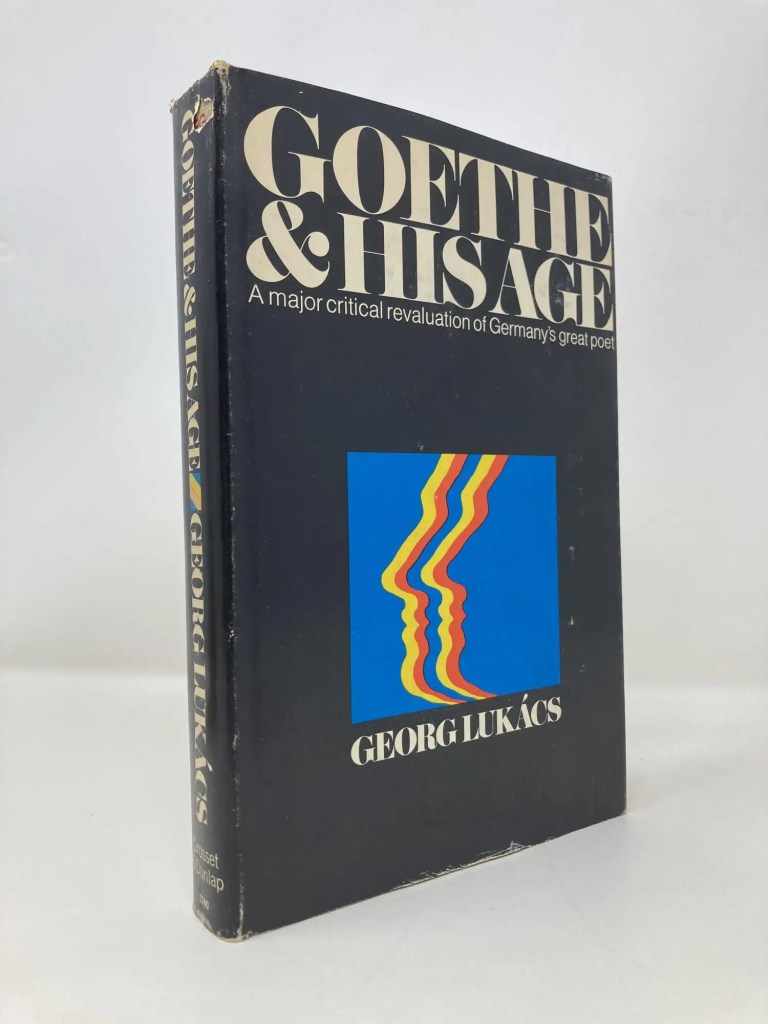
Georg Lukács’ Goethe and His Age stands as a towering achievement in the realm of literary criticism, offering an original Marxist reinterpretation of Johann Wolfgang von Goethe and his impact on the cultural and intellectual landscape of his time. Lukács, known for his dialectical approach to literature and society, crafts a text that is as much a study of Goethe’s literary output as it is an examination of the broader socio-political context in which these works were created and received. This book is a critical appraisal of Goethe’s artistic legacy and an exploration of the historical forces and contradictions that shaped his era—a period marked by the struggle between reactionary forces and the nascent bourgeoisie in Germany.
Lukács’ analysis begins by situating Goethe within the tumultuous socio-political environment of 18th-century Germany, a country plagued by feudal fragmentation and the stunted development of bourgeois culture. The author traces the impact of the German Peasants’ War of 1525, arguing that the catastrophic defeat of this rebellion against feudal oppression created a long-lasting retardation in German national and cultural development. Unlike France or England, where bourgeois revolutions had forged national unity and progressive cultural movements, Germany’s fragmented state left it vulnerable to reactionary forces. This historical context is essential for understanding Goethe’s works, which Lukács sees as embodying the contradictions of his age—a period where the aspirations for bourgeois emancipation were constantly thwarted by the reactionary politics of the petty principalities and the Junker class.
Central to Lukács’ revaluation is his Marxist reading of Goethe’s Faust, particularly in the Faust-Studien that form a significant part of the book. Here, Lukács diverges from simplistic Marxist interpretations that often reduce literary works to mere reflections of class struggle, instead offering a nuanced analysis that recognizes the complexity of Goethe’s vision. He acknowledges the dual nature of Faust, where the protagonist’s striving symbolizes both the progressive impulses of the bourgeoisie and the inevitable moral and ethical compromises that accompany such striving in a capitalist society. Lukács’ interpretation of Faust became foundational in East German (GDR) scholarship, influencing the “Vollstreckerthese,” which posited that German Enlightenment and humanist traditions could be reappropriated in the service of socialist cultural politics. Through this lens, Lukács sees Goethe not just as a product of his time but as a figure whose work anticipates and critiques the failings of bourgeois society, making his works relevant to contemporary socialist thought.
Lukács’ exploration of Goethe’s relationship with the German Enlightenment is particularly noteworthy. He challenges the traditional dichotomy established by bourgeois literary historians between the Enlightenment and the Sturm und Drang movement, of which Goethe was a central figure. Instead of viewing these movements as antithetical, Lukács argues that the German Enlightenment—despite its lack of a revolutionary social base—contained the seeds of a dialectical progression that found its expression in the contradictions of Goethe’s work. Goethe’s The Sorrows of Young Werther, often seen as a departure from Enlightenment rationalism, is reinterpreted by Lukács as a work deeply rooted in the intellectual currents of the Enlightenment, yet simultaneously critiquing its limitations through its portrayal of the alienation and despair of the modern individual. This duality in Goethe’s work reflects the broader struggle within German culture between progressive and reactionary forces, a struggle that Lukács sees as central to understanding Goethe’s significance.
The book delves into the influence of key figures of the Enlightenment on Goethe, such as Lessing and Rousseau, but Lukács is careful to highlight the unique path that Goethe forged. Unlike the French Enlightenment, which was tied to the progressive social movements leading to the Revolution, the German Enlightenment, according to Lukács, lacked a coherent social base and was marked by an inward-looking intellectualism. Goethe’s genius, as Lukács sees it, was in transcending this limitation by engaging with the broader European intellectual currents while simultaneously addressing the specific contradictions of German society. In works like Wilhelm Meister’s Apprenticeship, Goethe explores the possibilities and limitations of individual development within a society that is fundamentally unfree, making his work resonate with the struggles of modernity even as it remains firmly rooted in its historical context.
Lukács also tackles the thorny issue of Goethe’s political legacy, particularly his relationship with the reactionary forces of his time. While acknowledging Goethe’s often conservative political stance, Lukács argues that this should not obscure the progressive elements in his work. Instead, Lukács suggests that Goethe’s conservatism can be understood as a response to the failures of the bourgeoisie to fulfil its historical role as a revolutionary class in Germany. Goethe’s ambivalence towards the French Revolution, his retreat into Weimar classicism, and his later pessimism are seen by Lukács as expressions of a deep-seated recognition of the limitations of bourgeois society—a recognition that, in Lukács’ view, makes Goethe a precursor to the critical realism that would later emerge in the works of Marx and Engels.
In Goethe and His Age, Lukács not only reinterprets Goethe’s literary achievements but also offers a broader critique of German culture and its historical development. He traces the intellectual lineage from Goethe to the later reactionary ideologies of the German Empire, showing how the unresolved contradictions in Goethe’s work reflect the deeper social and political crises that would eventually lead to the rise of German imperialism and, ultimately, fascism. Lukács’ critical method is one of historical concreteness, rejecting both the categorical condemnation of German culture and the uncritical celebration of its achievements. Instead, he calls for a dialectical approach that recognizes the interplay of progressive and reactionary forces in the formation of culture.
The book is not without its polemical edge. Lukács is sharply critical of the ways in which bourgeois literary historians have distorted Goethe’s legacy, turning him into a symbol of German nationalism and reaction. He takes aim at figures like Gundolf, Korff, and Strich, who, in his view, have constructed an ideological myth around Goethe that serves the interests of the bourgeoisie rather than a true understanding of his work. Lukács’ critique extends to the very foundations of bourgeois historiography, which he argues is incapable of grasping the revolutionary potential inherent in Goethe’s work because it is fundamentally invested in maintaining the status quo.
Yet, for all its critical sharpness, Goethe and His Age is also a deeply appreciative work, one that recognizes the unparalleled artistic achievement of Goethe while insisting on the need to understand this achievement within its historical and social context. Lukács does not seek to diminish Goethe’s greatness; rather, he aims to reclaim it for a progressive tradition that sees in Goethe’s work the unresolved contradictions of bourgeois society and the possibilities for their transcendence.
Goethe and His Age is a masterful blend of literary criticism, historical analysis, and Marxist theory. It offers a compelling revaluation of one of Germany’s greatest poets, situating Goethe not just as a figure of the past, but as a thinker and artist whose work continues to speak to the crises and contradictions of the modern world. Lukács’ book is an indispensable resource for anyone seeking to understand Goethe, German culture, or the complex relationship between literature and society. Through his rigorous analysis, Lukács challenges us to rethink not only Goethe’s legacy but also the broader trajectories of European culture and history.
 Simon Gros
Leave a comment