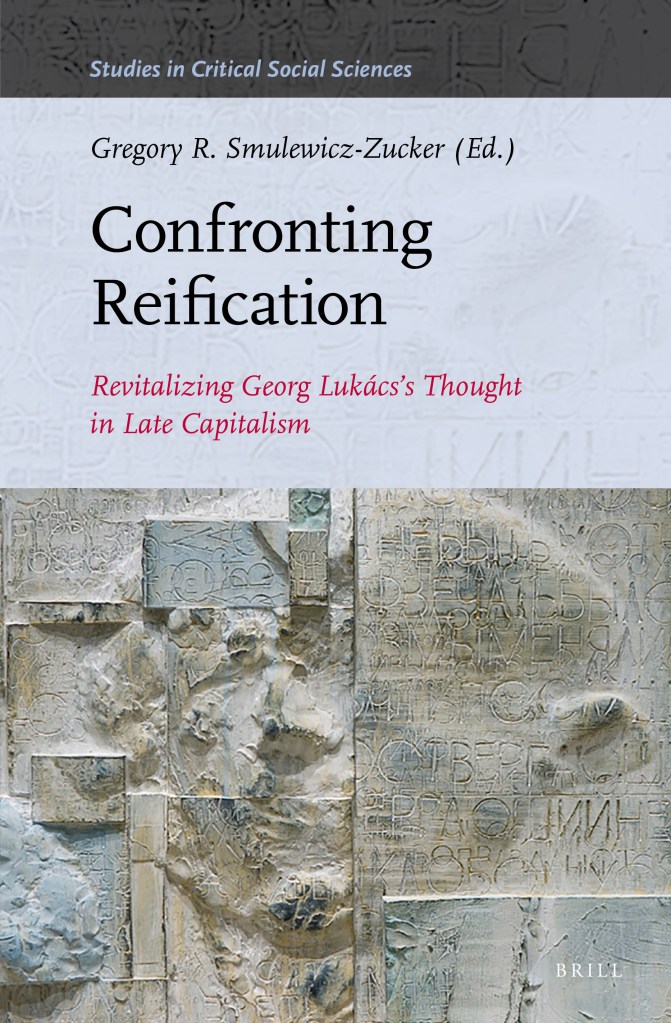
In Confronting Reification:, Gregory R. Smulewicz-Zucker and a diverse group of fourteen international scholars present a nuanced analysis of Georg Lukács’s philosophical contributions, particularly his theory of reification, which emerged as one of the most significant critiques of capitalist society in the early twentieth century. Lukács (1885-1971), a pivotal figure in Marxist thought, melded literary criticism with philosophical inquiry, providing insights that have influenced generations of thinkers, particularly within the realm of critical theory. Despite facing opposition, notably from right-wing extremists in Hungary who sought to erase his legacy, Lukács’s ideas have demonstrated a remarkable resilience and relevance in contemporary discourse, particularly in understanding the intricacies of modern capitalism.
Lukács’s concept of reification, or Verdinglichung, serves as a critical lens through which to examine the dehumanizing effects of capitalist social relations. The term reification denotes the process by which social relations and human experiences become objectified, treated as things rather than as dynamic interactions shaped by human agency. This philosophical inquiry is deeply embedded in Lukács’s History and Class Consciousness (1923), a seminal work that revitalized Marxist thought by connecting the notions of commodity fetishism and the rationalization processes within modernity. In contemporary society, marked by hyper-commodification and technological saturation, reification manifests in myriad ways, influencing how individuals perceive themselves, their relationships, and the world around them.
This volume arises in a moment when Lukács’s thought is urgently needed to confront the complexities of late capitalism, characterized by increasing social fragmentation, economic inequality, and the commodification of nearly every aspect of life. The contributors to this collection argue that understanding reification is essential for addressing the pervasive distortions of consciousness that arise in a system where human values are subordinate to market dynamics. The essays emphasize that Lukács’s insights are not merely historical artifacts but vibrant tools for critical analysis and social critique. The authors elucidate how the reification of social relations contributes to a sense of alienation, a theme resonant with contemporary experiences of disconnection and isolation in an increasingly digital and commodified world.
Lukács’s analysis of reification transcends the mere description of capitalist alienation, offering a systematic critique that connects individual subjectivity with broader social structures. The process of reification reduces complex human interactions to mere transactions, stripping away the richness of lived experience and transforming individuals into objects governed by the imperatives of the market. In this context, human qualities and abilities are commodified, rendering individuals as interchangeable components within a mechanistic economic system. The implications of this transformation are profound, as they affect not only the economic but also the existential dimensions of life. The commodification of experience leads to a crisis of meaning, where individuals struggle to find authentic connection and purpose amidst a landscape dominated by superficial exchanges and materialistic values.
As the authors delve into the contemporary significance of Lukács’s thought, they draw connections between reification and the various forms of resistance that emerge against it. They argue that recognizing the mechanisms of reification is crucial for fostering a collective consciousness capable of challenging the dominant ideologies that sustain capitalist structures. The notion of dereification, the process of reclaiming the fluidity and complexity of social relations, emerges as a central theme. By understanding the contingent nature of social institutions, individuals can begin to break down the barriers imposed by reified consciousness and engage in transformative practices that resist the commodification of life.
The essays reflect on the historical trajectory of Lukács’s influence, particularly on the Frankfurt School and subsequent generations of thinkers. The resurgence of interest in Lukács in the late twentieth century, particularly in the wake of the 1968 protests, signalled a renewed engagement with the critical possibilities of Marxism in the face of an increasingly bureaucratic and technocratic society. The contributors to this volume articulate a desire to recapture the humanistic ethos underlying Lukács’s work, emphasizing its capacity to offer a critical framework for addressing the crises of our time.
The philosophical legacy of Lukács is examined alongside contemporary challenges, including the rise of authoritarianism, the erosion of democratic values, and the persistence of class struggles in an age of globalization. The volume situates Lukács’s thought within these pressing socio-political contexts, arguing for its relevance in critiquing the neoliberal order and exploring the possibilities for collective action and solidarity. By confronting reification, the authors advocate for a critical engagement with the structures that perpetuate inequality and alienation, emphasizing the importance of reclaiming the human dimensions of existence in a world increasingly dominated by commodified relationships.
Confronting Reification serves as an academic tribute to Georg Lukács for contemporary scholars, activists, and thinkers. It invites readers to engage with the complexities of modernity through the lens of Lukács’s philosophy, offering new perspectives on how to confront the challenges posed by reification and its manifestations in everyday life. The essays collectively argue that the revitalization of Lukács’s thought is not only a scholarly endeavour but a necessary response to the urgent need for a critical framework capable of addressing the transformations of society in late capitalism. In an age marked by social fragmentation and disconnection, the call to confront reification becomes a rallying cry for those seeking to reclaim the human essence of social relations and forge a path toward a more just and equitable world.
 Simon Gros
Leave a comment