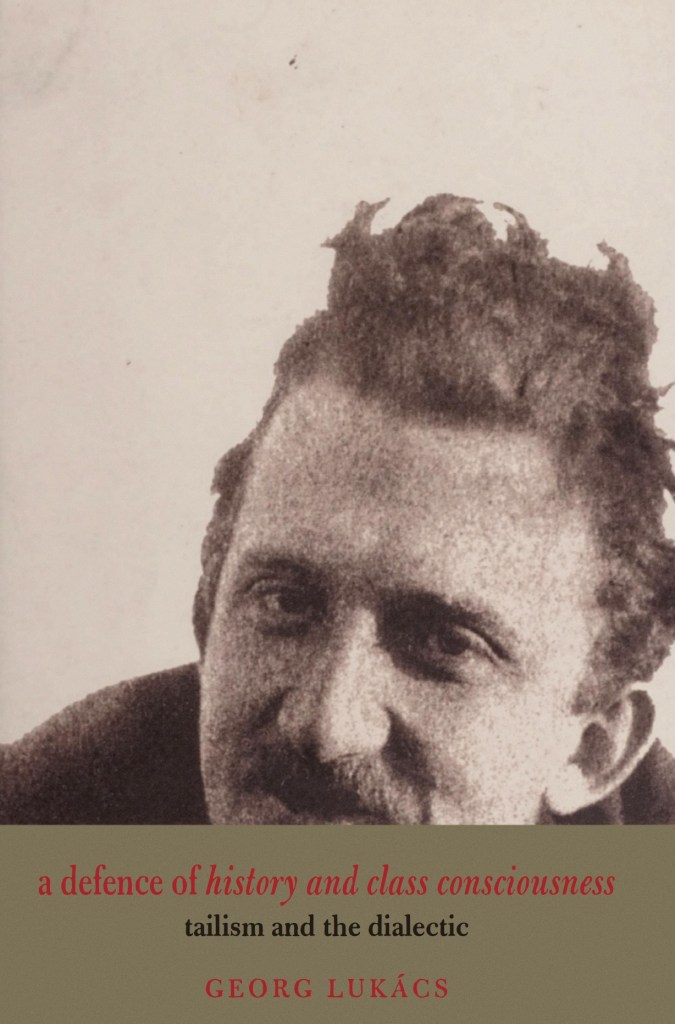
A Defence of History and Class Consciousness: Tailism and the Dialectic by Georg Lukács is an extraordinary text that serves as a profound continuation and defense of his seminal work, History and Class Consciousness (1923). This lost manuscript, rediscovered after decades of obscurity, offers readers a rare and invaluable insight into Lukács’ intellectual tenacity and commitment to Marxist theory during a period of intense political and ideological strife. Written in the mid-1920s, amidst the rising tide of Stalinism and the ideological purges that accompanied it, this work not only reaffirms Lukács’ original theses but also challenges the dominant interpretations that sought to dilute or discredit his contributions to Marxist philosophy.
Lukács, often hailed as the “Philosopher of the October Revolution,” had initially established his reputation with History and Class Consciousness, a text that revolutionized Western Marxist thought by reasserting the centrality of Hegelian dialectics within Marxism. However, the liberating potential of the October Revolution, which had initially inspired Lukács and his contemporaries, was rapidly being undermined by the bureaucratic consolidation of power under Stalin. This consolidation brought with it an ideological rigidity that targeted any deviation from the emerging orthodoxy. Lukács found himself at the centre of this ideological battleground, facing fierce criticism from party loyalists like Abram Deborin and Laszlo Rudas, who accused him of diverging from Marxist-Leninist principles.
In Tailism and the Dialectic, Lukács mounts a passionate and rigorous defence of his earlier work, confronting his critics head-on. This text reveals a Lukács who is deeply engaged in the struggle to preserve the revolutionary essence of Marxist theory against what he perceives as a growing tailist tendency within the Communist movement—a tendency to follow rather than to lead, to mechanically apply Marxist theory rather than to dialectically develop it. Lukács argues that his critics, entrenched in a dogmatic and positivist interpretation of Marxism, have fundamentally misunderstood the dialectical method and its implications for revolutionary praxis.
At the heart of Lukács’ defence is his insistence on the dialectical unity of theory and practice, subject and object, and the role of consciousness in mediating this relationship. He vehemently opposes the dualistic approach taken by Deborin and Rudas, who, in his view, reduce Marxism to a deterministic science of history, thereby stripping it of its revolutionary potential. Lukács contends that such an approach is inherently flawed because it fails to grasp the dynamic, historical, and class-based nature of social reality. By treating the laws of history as objective, immutable forces, independent of human agency, Deborin and Rudas effectively nullify the possibility of revolutionary change, relegating the proletariat to the passive role of spectators rather than active agents of history.
Lukács’ concept of “imputed class consciousness” plays a pivotal role in this critique. He argues that genuine class consciousness is not simply the sum of the immediate, empirical experiences of the working class, but rather, it is the consciousness that is imputed to the class by virtue of its historical role and objective interests within the totality of capitalist society. This consciousness, he maintains, can only be achieved through the mediation of the revolutionary party, which serves as the vehicle for transcending the immediacy of everyday experience and linking the subjective aspirations of the proletariat with the objective conditions of the class struggle.
This emphasis on mediation is central to Lukács’ understanding of the dialectic. He asserts that the dialectical method, far from being a mere philosophical abstraction, is the very lifeblood of revolutionary praxis. It is through the dialectical interplay of theory and practice, subject and object, that the proletariat can achieve a revolutionary consciousness capable of transforming society. Lukács accuses his critics of failing to grasp this fundamental point, arguing that their adherence to a mechanical materialism blinds them to the revolutionary potential of dialectical thought.
Moreover, Lukács revisits his critique of Engels’ dialectics of nature, a point of contention that had been seized upon by his critics as evidence of his supposed idealism. In Tailism and the Dialectic, Lukács refines his argument, acknowledging the importance of natural-scientific methods within their proper domain but insisting that the dialectic as a method of social analysis cannot be reduced to the same principles that govern the natural sciences. He warns against the dangers of conflating the two, as such a conflation leads to a deterministic worldview that negates the role of human agency in history.
The text also serves as a broader philosophical critique of Menshevism and other forms of Marxism that, in Lukács’ view, fail to fully embrace the revolutionary implications of dialectical materialism. He argues that these tendencies, by clinging to outdated or insufficiently radical interpretations of Marxism, are unable to provide the theoretical and practical leadership necessary for the proletariat to achieve its historical mission. Lukács positions himself in direct opposition to these currents, asserting that only a truly dialectical approach can illuminate the path to proletarian revolution.
In the broader context of Lukács’ oeuvre, Tailism and the Dialectic is a crucial text that bridges the gap between History and Class Consciousness and his later works. It demonstrates that Lukács did not, as some have claimed, abandon the revolutionary insights of his earlier writings but rather continued to develop and defend them in the face of mounting political pressure. The text also sheds new light on Lukács’ intellectual trajectory during a critical period in the history of Marxist thought, revealing the depth of his commitment to the revolutionary potential of dialectical materialism.
The rediscovery and publication of Tailism and the Dialectic has been a momentous event in the history of Marxist theory. This text not only enriches our understanding of Lukács’ philosophy but also challenges us to reconsider the history of Western Marxism and the complex interplay of theory and practice within the Communist movement. The fact that Lukács himself believed the manuscript to be lost only adds to its mystique, underscoring the resilience of revolutionary ideas even in the face of seemingly insurmountable obstacles.
With the English translation by Esther Leslie, accompanied by an introduction by John Rees and a postface by Slavoj Žižek, this edition of Tailism and the Dialectic is poised to have a profound impact on contemporary debates within Marxist theory and philosophy. It invites readers to engage with Lukács’ thought in a new and deeper way, challenging us to rethink our assumptions about the relationship between theory and practice, the role of the revolutionary party, and the nature of dialectical materialism. In doing so, it reaffirms Lukács’ place as one of the most important and influential Marxist thinkers of the twentieth century, whose ideas continue to resonate in our ongoing struggles for social justice and revolutionary change.
 Simon Gros
Leave a comment