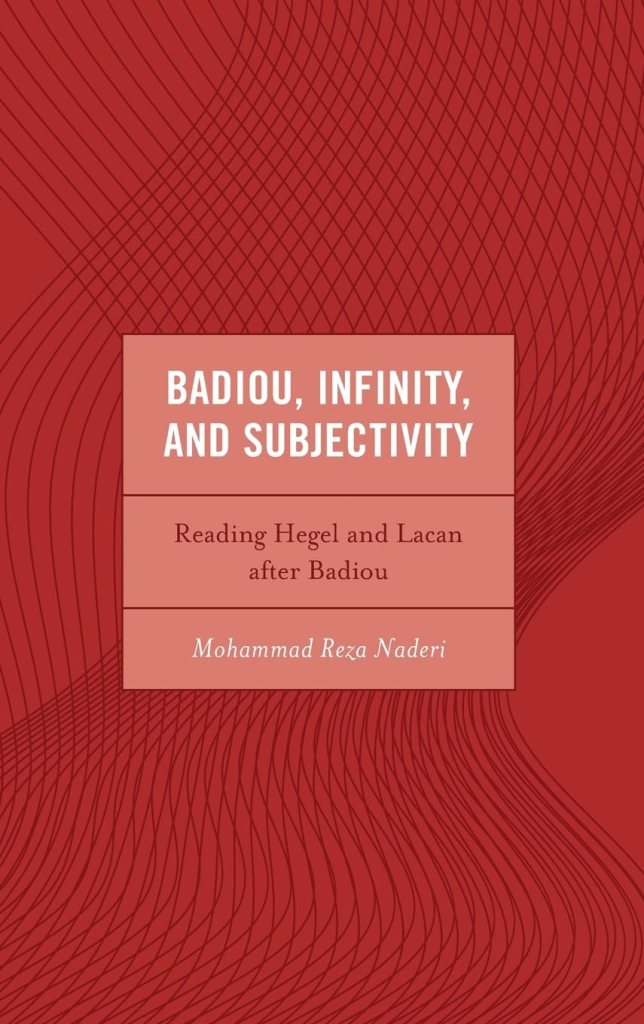
In Badiou, Infinity, and Subjectivity, Mohammad Reza Naderi analyses Alain Badiou’s philosophical development and traces the trajectory of Badiou’s thought by foregrounding the centrality of axiomatic thought and the concept of mathematical infinity as the bedrock of Badiou’s philosophical architecture. The book’s central thesis posits that axiomatic thought, particularly in its engagement with infinity, is not merely one of the many tools of philosophical inquiry but the only form of thinking adequate to the infinite nature of being itself. In pursuing this thesis, Naderi uncovers two additional and significant propositions: the coherence of Badiou’s intellectual evolution, which he argues is far more unified than previously acknowledged, and the formulation of a theory he terms “discipline,” which offers a novel interpretation of Badiou’s procedures of truth.
Naderi’s work begins by situating Badiou’s engagement with the concept of infinity within a broader historical and philosophical context. He notes that while the notion of the infinite has been a persistent philosophical concern since antiquity, its role underwent a significant transformation in the modern era. The book identifies the 20th century as a pivotal moment in which the infinite, once a celebrated and almost mystical concept, became relegated to the peripheries of serious philosophical discourse. The century’s dominant intellectual currents, particularly those influenced by existentialism, phenomenology, and post-structuralism, largely rejected the infinite as a relic of metaphysical thinking, focusing instead on finitude, alterity, and the limits of human experience. Naderi argues that Badiou’s philosophy stands out precisely because it defiantly resists this trend, reasserting the centrality of the infinite as a category of thought.
This philosophical rehabilitation of the infinite is not an abstract or merely speculative project for Badiou but one deeply rooted in his engagement with various fields, including mathematics, politics, psychoanalysis, and art. Naderi highlights how Badiou’s work from the mid-1960s, particularly his involvement with the Cahiers pour l’Analyse and his early engagements with Lacanian psychoanalysis and structuralism, laid the groundwork for his later development of a robust ontological system in which mathematics, and specifically set theory, becomes the language through which the infinite is rigorously conceptualized. Naderi’s exegesis of Badiou’s works demonstrates that Badiou’s engagement with infinity is not a static or isolated concern but one that evolves in dialogue with his shifting philosophical preoccupations.
In tracing this evolution, Naderi divides his analysis into three main phases, each corresponding to a significant period in Badiou’s intellectual development. The first phase, which he identifies as Badiou’s logicist and structuralist period, is exemplified by his early work “Mark and Lack.” Here, Badiou begins to explore the implications of mathematical logic for thinking about the structure of the subject and the dialectics of presence and absence, heavily influenced by his readings of Lacan and Frege. Naderi’s detailed analysis of this period reveals how Badiou’s early encounter with structuralism led him to formulate key ideas about the relationship between the subject and the symbolic order, ideas that would later be crucial for his more mature philosophy.
The second phase, which Naderi terms Badiou’s political and revolutionary period, is centered around his Theory of the Subject. This period marks a shift from the formalism of his earlier work to a more militant and explicitly political engagement with Marxism and Maoism. Naderi argues that despite the apparent shift in focus, the questions that preoccupied Badiou during this time—questions about the nature of political subjectivity, the conditions for revolutionary change, and the emergence of novelty—are deeply connected to his ongoing concern with infinity. In Theory of the Subject, Badiou begins to develop his idea of the subject as a site of rupture within the structure, a figure capable of instigating radical change by breaking with the given order. Naderi shows that this conception of the subject is already informed by a nascent understanding of the infinite as a principle of radical openness and potentiality.
The third and final phase of Badiou’s intellectual journey, as discussed by Naderi, is marked by the publication of Being and Event, which Naderi identifies as the culmination of Badiou’s philosophical project. In this magnum opus, Badiou fully articulates his ontology of the multiple, grounded in set theory, and presents his famous thesis that “mathematics is ontology.” Naderi provides a detailed and nuanced reading of Being and Event, showing how Badiou’s mature philosophy integrates his earlier concerns with structure, subjectivity, and political change into a comprehensive system in which the infinite plays a central role. Naderi argues that for Badiou, the infinite is not merely a concept to be thought but the very condition of possibility for thinking itself. It is through the infinite that Badiou is able to conceive of a being that is irreducible to any totalizing logic, and it is through the axiom of infinity that he is able to account for the emergence of the new, the unforeseen, and the radically other.
Naderi’s concept of “discipline” is introduced as a crucial interpretative tool for understanding Badiou’s philosophy. He defines discipline as a mode of thought that is at once rigorous and inventive, capable of engaging with the infinite without succumbing to the temptations of metaphysical closure or empirical reductionism. This discipline is exemplified in what Badiou calls “procedures of truth”—the processes by which truths emerge in the domains of science, politics, art, and love. Naderi’s analysis of discipline is one of the most original contributions of the book, offering a new way of thinking about the coherence of Badiou’s thought across different periods and thematic concerns. He argues that discipline is what allows Badiou to maintain a consistent commitment to the infinite while also adapting his philosophical framework to address new challenges and contexts.
Throughout the book, Naderi engages in a close and careful reading of Badiou’s texts, supported by extensive references to both primary and secondary sources. His scholarship demonstrates a deep familiarity with the entire corpus of Badiou’s work as well as with the broader philosophical traditions in which Badiou is situated. Naderi’s engagement with Hegel and Lacan, two figures who have been crucial for Badiou’s thinking, is particularly noteworthy. He shows how Badiou’s dialogue with these thinkers has shaped his understanding of the infinite, subjectivity, and the nature of thought itself. Naderi’s analysis of Badiou’s engagement with Hegel, for instance, highlights the ways in which Badiou both appropriates and departs from Hegelian dialectics, particularly in his rejection of the synthesis and his insistence on the irreducibility of the multiple. Similarly, Naderi’s reading of Badiou’s relationship to Lacan emphasizes the centrality of the symbolic order and the logic of the signifier in Badiou’s early work, while also showing how Badiou’s later philosophy moves beyond Lacan’s framework to develop a more radical conception of the subject.
Badiou, Infinity, and Subjectivity is a work of considerable ambition and scope, offering a comprehensive and detailed account of Badiou’s philosophical project from its inception to its most mature formulations. Naderi’s book is not only a significant contribution to Badiou scholarship but also a valuable resource for anyone interested in contemporary philosophy, particularly in the intersections of mathematics, politics, psychoanalysis, and ontology. By placing the concept of infinity at the center of his analysis, Naderi provides a new lens through which to understand Badiou’s thought, one that highlights the radical and transformative potential of Badiou’s commitment to the infinite. This book will be essential reading for philosophers, political theorists, and anyone interested in the future of thought in a world that often seems to have forsaken the infinite for the finite, the calculable, and the merely possible.
 Simon Gros
Leave a comment