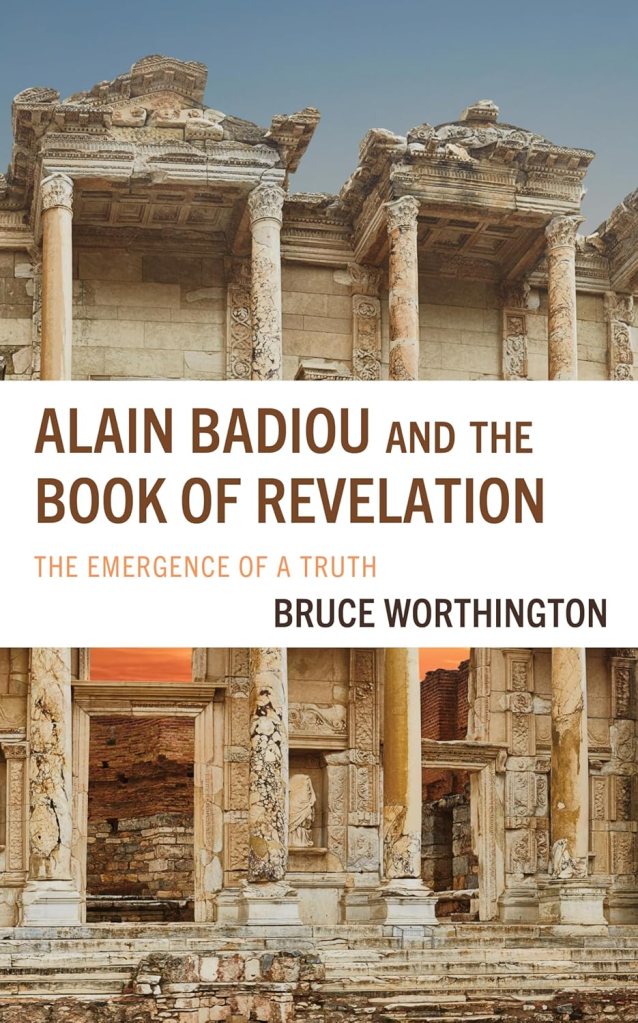
Alain Badiou and the Book of Revelation: The Emergence of a Truth by Bruce Worthington represents a striking intersection of philosophy and biblical studies, serving as an intellectual crucible in which the radical concepts of Alain Badiou are applied to the enigmatic text of the Book of Revelation. This work explores the notion of the event—an occurrence that disrupts the status quo, introducing a new truth that defies the prevailing order. Worthington’s analysis illuminates the historical and theological dimensions of early Christianity and repositions Badiou’s philosophical framework as a lens through which the emergence of Christianity can be rigorously understood, challenging the modern scholarly preoccupations with finitude and historicism that have long dominated biblical studies.
Worthington’s text is deeply rooted in Badiou’s metaphysics, particularly the notion that truths are rare and revolutionary occurrences that break with the continuity of being. These truths, as Badiou asserts, are neither mere facts nor reducible to historical circumstances; instead, they emerge from events that establish new ontological realities. Worthington outlines this process, demonstrating how the concept of the event in Badiou’s philosophy offers a compelling alternative to the traditional Hegelian dialectics and Nietzschean genealogies that have often framed discussions of Christian origins. The book contends that these earlier frameworks, while offering valuable insights into the mechanics of history and power, ultimately diminish the radical potential inherent in the notion of the event, reducing it either to the teleological unfolding of a preordained rational order or to the arbitrary results of discursive power struggles.
At the basis of Worthington’s argument is the assertion that the event of Jesus Christ’s death and resurrection, as proclaimed by the early Christians, should be understood as a paradigmatic Badiouian event. This event, which ruptures the established Judaic religious order and Roman political power, brings forth a new truth that cannot be fully encapsulated by the existing structures of thought or society. Worthington applies Badiou’s framework to argue that the early Christian community, particularly as reflected in the Book of Revelation, did not merely emerge as a socio-political entity within the continuum of Jewish and Greco-Roman traditions, but rather as a militant subjectivity called into being by the truth of this event. This truth, Worthington suggests, is not merely a theological proposition but an ontological transformation that redefines the very conditions of what it means to be a political and religious subject.
The Book of Revelation, with its vivid imagery and apocalyptic vision, serves as a rich text through which Worthington explores the consequences of the event. Revelation is interpreted not as a coded historical document or a symbolic narrative detached from material realities, but as a text that articulates the radical consequences of the Christ-event—a new world order grounded in the victory of the Lamb. Here, Worthington draws out the political implications of Badiou’s thought, showing how the apocalyptic vision of Revelation reflects the emergence of a new political body, one that is oriented around the truth of the event and its radical demands for justice, equality, and the obliteration of the existing order. This new body politic, which Badiou might describe as the militant subject, is tasked with the declaration and embodiment of this truth in a world that is otherwise defined by finitude, oppression, and the nihilistic structures of power.
Worthington’s application of Badiou’s theory of the event to Christian origins challenges the dominant academic approaches that have either subsumed the novelty of early Christianity within broader historical processes or deconstructed it to the point of erasure. He critiques the tendency of contemporary biblical scholarship to “cover over” the event, reducing the radical rupture of the Christ-event to mere cultural evolution or textual interpretation. This covering-over, as Worthington argues, is symptomatic of a broader ideological commitment to finitude, a refusal to acknowledge the possibility of genuine novelty or the emergence of truths that disrupt and redefine the historical situation. By contrast, Worthington’s Badiouian reading of Revelation reasserts the significance of the event as a site of radical transformation, where the infinite breaks into the finite, and where the emergence of a new truth challenges the totalizing narratives of both religious orthodoxy and secular historiography.
In the second half of the book, Worthington delves into a close reading of the Book of Revelation through the lens of Badiou’s thought, illuminating how the text’s apocalyptic vision can be understood as a response to the Christ-event. This analysis not only brings to light the political dimensions of Revelation but also suggests that the text itself functions as a militant declaration of the new truth that has emerged from the event. Revelation’s portrayal of the New Jerusalem, the final battle between good and evil, and the establishment of God’s kingdom on earth are all interpreted as reflections of the new political subjectivity that emerges in response to the truth of the Christ-event—a subjectivity that is defined not by the finitude of the present order but by its fidelity to the infinite demands of the truth.
Worthington’s work stands out not only for its rigorous application of Badiou’s philosophical concepts to biblical studies but also for its challenge to the prevailing epistemological assumptions within the field. By arguing for the re-emergence of truth as a central category of analysis, Worthington calls for a re-evaluation of the methods and frameworks that have traditionally governed the study of Christian origins. He suggests that only by recognizing the evental nature of Christian origins—an origin that is itself defined by the emergence of a new truth—can scholars fully appreciate the radical novelty of early Christianity and its implications for contemporary thought.
Alain Badiou and the Book of Revelation is not merely a scholarly text; it is a provocative invitation to rethink the relationship between philosophy, theology, and history. Worthington’s work exemplifies how Badiou’s philosophy can be mobilized to uncover new dimensions of historical inquiry, offering fresh insights into the nature of Christian origins and the enduring significance of the Book of Revelation. It is a book that will undoubtedly provoke debate and inspire further research, as it challenges scholars to reconsider the very foundations of their disciplines in light of the radical potential of the event and the truths it reveals.
 Simon Gros
Leave a comment