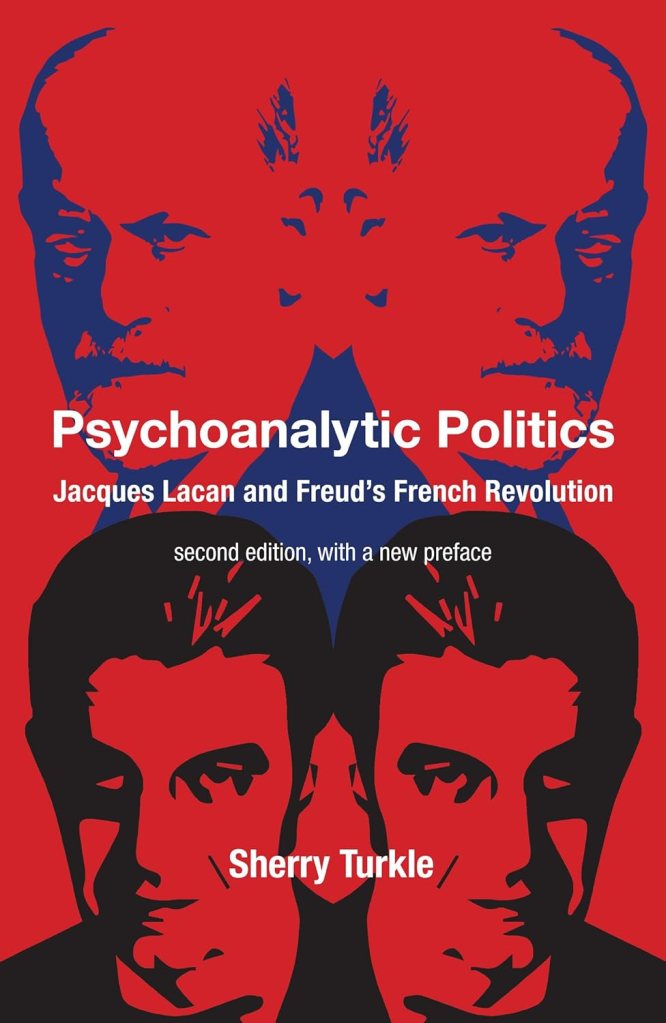
Psychoanalytic Politics by Sherry Turkle stands as a seminal investigation into the intersection of psychoanalysis, culture, and politics in post-1968 France. This expanded edition not only revisits the original themes with renewed vigor but also amplifies the resonance of Lacanian psychoanalysis in today’s increasingly digital and interconnected world. The book explores how a nation that was once resistant to Freud found itself engulfed in a psychoanalytic fervor, particularly through the lens of Jacques Lacan’s reinterpretations of Freudian theory. Turkle discusses this cultural phenomenon, presenting Lacan as a symbol of the broader intellectual and political upheavals of the time.
Turkle’s work offers an in-depth sociological analysis of how Lacanian psychoanalysis managed to infiltrate various aspects of French society, from academia to the everyday lives of ordinary citizens. The book challenges readers to understand psychoanalysis not just as a clinical practice or intellectual pursuit but as a cultural force that shapes and is shaped by the political and social currents of its time. Turkle’s analysis shows that the rapid adoption of psychoanalytic ideas in France was not merely a result of their intellectual merit but also of the unique historical and cultural conditions following the May 1968 uprisings. Lacan’s psychoanalysis became intertwined with the broader societal shift towards questioning authority, traditional values, and the very nature of subjectivity.
Turkle provides a vivid portrayal of how Lacan’s ideas resonated with the French intelligentsia, particularly those influenced by structuralism and post-structuralism. Lacan’s emphasis on language, the unconscious, and the fragmented self appealed to a generation of thinkers who were already skeptical of unified, coherent narratives about the human condition. The book details how Lacan’s teachings, with their dense and often opaque rhetoric, became a sort of intellectual rite of passage for French scholars, combining the complexities of psychoanalysis with the radical political discourse that characterized the era.
Psychoanalytic Politics is not merely about intellectual history, it shows how Lacan’s ideas permeated French culture at large. Turkle investigates the diffusion of psychoanalytic thought into everyday life, examining how Lacanian concepts were absorbed by education systems, media, and even popular culture. This process, Turkle argues, created a psychoanalytic culture that extended far beyond the boundaries of the professional psychoanalytic community. In France, psychoanalysis became more than a method of therapy; it became a way of understanding the self, society, and of relationships that bind them together.
The book presents the paradoxical nature of Lacan’s influence. While he positioned himself as a revolutionary thinker who sought to subvert established norms, he also cultivated a highly hierarchical and arguably authoritarian following. Turkle does not shy away from discussing the internal contradictions of Lacanian psychoanalysis, where the tension between its radical content and the authoritarian structure of its dissemination often led to schisms and conflicts within the movement. This examination is a reflection on the broader dynamics of intellectual and political movements, questioning how revolutionary ideas can sometimes become institutionalized and, in the process, lose some of their subversive power.
Turkle’s new preface and the additional chapter in this edition highlight the ongoing relevance of Lacanian thought in the contemporary world, particularly in the context of digital technology and artificial intelligence. Lacan’s skepticism towards reductionist approaches to the human mind—whether through biology, behaviorism, or now, algorithmic computation—offers a critical perspective on the increasing encroachment of technology into the realms of human identity and relationships. Turkle suggests that Lacan’s insistence on the irreducibility of the human experience to mere data points remains a powerful counter-narrative to the current trends in AI and digital culture.
Psychoanalytic Politics thus serves as both a historical document and a work of critical theory that invites readers to reflect on the enduring power of psychoanalytic ideas in shaping not just personal identities but also collective political and cultural movements. Turkle’s exploration of the rise of a psychoanalytic culture in France is not merely about the past; it is a lens through which to view contemporary challenges in understanding the human condition in an increasingly technologized world. The book is a testament to the enduring relevance of psychoanalysis, not just as a therapeutic practice but as a critical tool for examining the intersections of mind, culture, and politics. Turkle’s work is a reminder of the complexities of intellectual life and the ways in which ideas can both shape and be shaped by the tumultuous currents of history.
Psychoanalytic Politics is an intellectual tour de force that encapsulates the vibrant and often contentious relationship between psychoanalytic theory and the broader social and political environment of post-1968 France. Turkle’s scholarship and insights make this work an indispensable resource for anyone interested in the history of psychoanalysis, the sociology of culture, or the dynamics of political thought. As she traces the arc of Lacanian psychoanalysis from its revolutionary aspirations to its complex legacy, Turkle offers readers a rich and nuanced understanding of how ideas evolve, how they take root in different cultural contexts, and how they continue to influence our understanding of what it means to be human.
 Simon Gros
Leave a comment