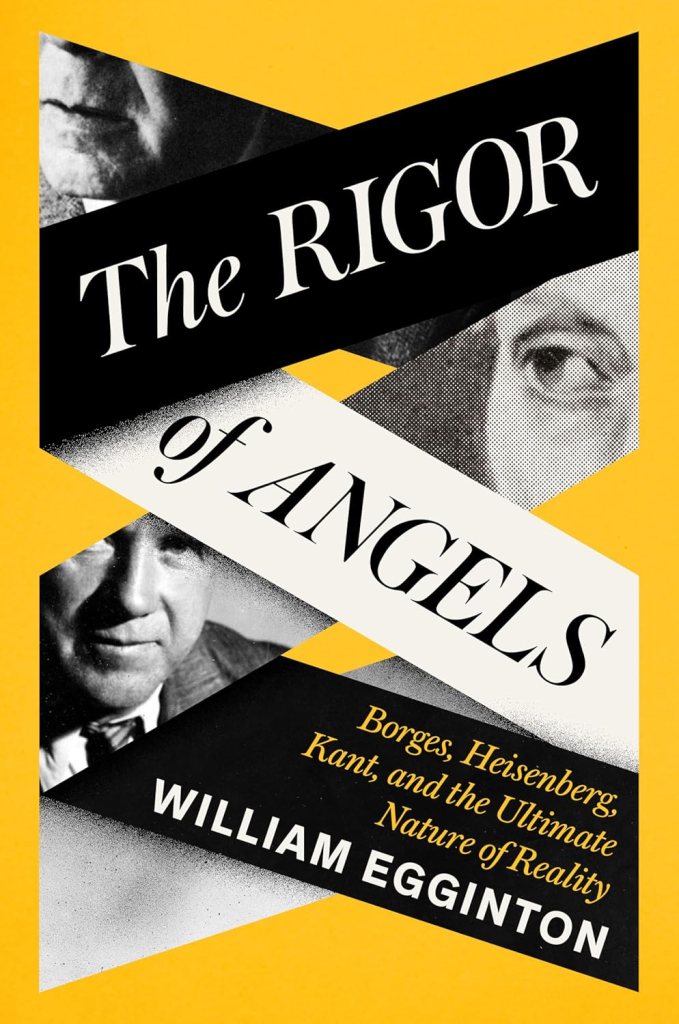
The Rigor of Angels by William Egginton is an ambitious and exhilarating intellectual journey that transcends the boundaries of literature, science, and philosophy, deftly interweaving the lives and thoughts of three towering figures—Jorge Luis Borges, Werner Heisenberg, and Immanuel Kant—to explore the elusive and multifaceted nature of reality. Egginton’s work is both a profound meditation on the limits of human knowledge and an intricate narrative that reveals how these three minds, each from vastly different backgrounds, arrived at strikingly similar conclusions about the nature of existence and the human condition.
The book is a masterful synthesis of ideas, where Borges, the Argentine poet and fiction writer, Heisenberg, the German physicist and pioneer of quantum mechanics, and Kant, the Prussian philosopher who reshaped modern thought, converge in their shared quest to understand the nature of reality. Each of these thinkers, in their own unique way, grappled with the idea that reality is not a fixed, independent entity but rather a construct shaped by our perceptions, limitations, and intellectual frameworks.
Borges, through his labyrinthine stories and metaphysical musings, approached reality as a complex web of symbols, narratives, and infinite possibilities. His work often delves into the paradoxes of time, memory, and identity, suggesting that the world we experience is a reflection of our inner selves—a mirror of our fears, desires, and ultimately, our mortality. In Borges’ universe, reality is a fluid and elusive concept, one that cannot be fully grasped or understood, but only hinted at through the power of imagination and language.
Heisenberg, on the other hand, approached reality from the realm of physics, where the certainty of classical mechanics gave way to the strange and unpredictable behaviour of particles at the quantum level. His formulation of the uncertainty principle, which posits that certain pairs of physical properties, like position and momentum, cannot be simultaneously known to arbitrary precision, shattered the notion of a deterministic universe. For Heisenberg, reality was not a fixed set of laws but a probabilistic field where observation and measurement played an integral role in shaping the very phenomena being observed. This revelation had profound implications not only for physics but for our understanding of free will, causality, and the nature of existence itself.
Kant’s philosophical system, particularly his work in the Critique of Pure Reason, established the idea that our experience of reality is mediated by the structures of the human mind. Kant argued that space and time are not inherent properties of the external world but forms of intuition through which we perceive and make sense of our experiences. Reality, according to Kant, is thus something that is partially constructed by the mind, which imposes order and coherence on the raw data of sensory input. This idea that reality is shaped by the limits and capacities of human cognition resonated deeply with both Borges and Heisenberg, whose work similarly acknowledged the inherent limitations of human knowledge and perception.
Egginton’s exploration of these three intellectual giants is a comparative study and a profound investigation into the nature of knowledge, the limits of human understanding, and the existential dilemmas that arise from our attempts to comprehend the world. He skilfully navigates the connections between Borges’ literary explorations, Heisenberg’s scientific discoveries, and Kant’s philosophical inquiries, revealing how each thinker, in his own way, uncovered the fundamental truth that reality is both more mysterious and more malleable than we can ever fully comprehend.
Through this intricate variety of ideas, The Rigor of Angels challenges the reader to reconsider the very foundations of reality. It posits that the world we inhabit is not an objective, external truth waiting to be discovered but a dynamic interplay between our minds and the universe. This interplay is fraught with paradoxes, uncertainties, and contradictions, yet it is precisely these elements that make life rich, complex, and ultimately, meaningful.
Egginton’s writing is as elegant as it is erudite, making complex ideas accessible without sacrificing their depth or nuance. He draws on a wide range of examples, from the peculiar case of Solomon Shereshevsky, whose perfect memory rendered him incapable of abstraction, to Einstein’s reluctant acceptance of the implications of quantum mechanics, to illustrate the impact that these thinkers’ ideas have had on our understanding of reality. By grounding his analysis in the lives and experiences of Borges, Heisenberg, and Kant, Egginton makes their abstract theories resonate on a deeply human level, reminding us that the quest to understand reality is as much a personal journey as it is an intellectual one.
The Rigor of Angels is a book that challenges its readers to embrace the uncertainties and limitations of knowledge, to let go of the comforting illusion of a fixed and knowable reality, and to find meaning in the very act of exploration. It is a celebration of the human spirit’s relentless pursuit of truth, even in the face of insurmountable obstacles, and a poignant reminder that it is our limitations, as much as our abilities, that define who we are.
In bringing together Borges, Heisenberg, and Kant, Egginton offers a compelling vision of the ultimate nature of reality—one that is not defined by what we can know but by what we can imagine, question, and explore. It is a vision that acknowledges the beauty and complexity of the world, even as it accepts that some mysteries may remain forever beyond our grasp. In this way, The Rigor of Angels is not just a book about three great thinkers; it is a meditation on the human condition itself, on our place in the cosmos, and on the inexhaustible wonder of the universe.
 Simon Gros
Leave a comment