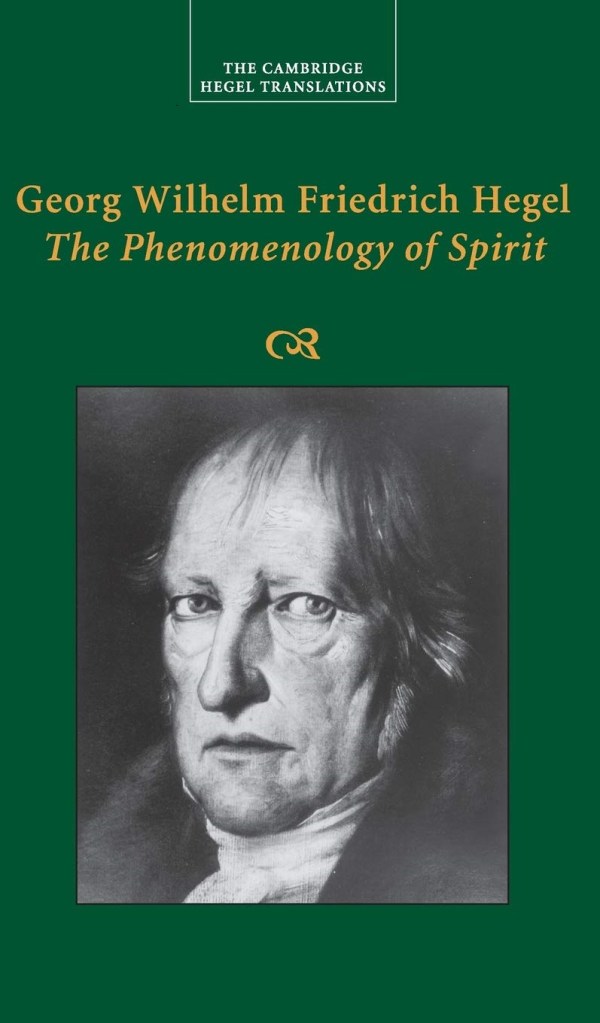
Georg Wilhelm Friedrich Hegel’s The Phenomenology of Spirit, first published in 1807, stands as a monumental achievement in the realm of modern philosophy, encapsulating a pivotal shift in understanding consciousness, self-awareness, and the evolution of human experience. In this seminal work, Hegel presents a profound exploration of the development of self-consciousness and its relation to the world, offering a novel framework that has significantly shaped subsequent philosophical thought. Terry Pinkard’s translation of this dense and historically transformative text makes Hegel’s complex ideas more accessible while maintaining the philosophical rigor of the original.
The Phenomenology of Spirit traces the dialectical journey of consciousness from its most immediate and unreflective state, termed “sense-certainty,” to the highest form of self-awareness, or “absolute knowledge.” This journey is a progression through stages and a dynamic process wherein each stage transcends and includes its predecessors, reflecting a movement toward ever deeper forms of understanding and self-realization. Hegel’s dialectical method unfolds as consciousness grapples with its own limitations and contradictions, thereby evolving into a more comprehensive and self-aware state.
Hegel’s philosophical narrative begins with the simplest form of consciousness, “sense-certainty.” In this stage, consciousness is immediately oriented toward the sensory world but remains at a rudimentary level of awareness, without a deeper understanding of the objects of perception. As consciousness progresses, it encounters various forms of “sense-certainty” which reveal the limitations and contradictions inherent in this initial mode of knowing. This dissatisfaction propels consciousness into higher stages of development.
The next significant phase in this dialectical progression is “perception,” where consciousness begins to recognize objects as having specific qualities and enduring existence. However, perception itself encounters limitations as it struggles to reconcile the unity of objects with their multifaceted nature. This conflict leads consciousness to seek a more profound understanding through “force and the understanding,” where it grapples with the underlying forces that constitute the nature of objects and their interrelations.
As consciousness evolves further, it reaches the stage of “self-consciousness,” where it becomes aware of itself as a distinct entity. This development is marked by the famous dialectic of the “master-slave” or “lord-bondsman” relationship, which illustrates the dynamic of recognition and self-certainty within human relations. The master, who seeks recognition from the slave, ultimately finds himself dependent on the slave’s labor and recognition, revealing the interdependence inherent in human agency.
The narrative continues through various stages of self-consciousness, including “reason” and “ethical life,” where consciousness integrates individual freedom with social and ethical structures. In these stages, Hegel explores the complex interplay between personal desires, ethical duties, and the realization of freedom within societal institutions. The development of “ethical life” reflects the synthesis of individual and communal aspects of consciousness, culminating in a recognition of the self as part of a rational and ethical whole.
One of the crucial contributions of Hegel’s Phenomenology is its analysis of “absolute knowing,” where consciousness achieves a comprehensive understanding of itself and the world. In this stage, the dialectical process culminates in the realization that self-consciousness and objectivity are intertwined and mutually constitutive. This stage signifies the resolution of previous contradictions and the attainment of a universal perspective on knowledge and existence.
Terry Pinkard’s translation of The Phenomenology of Spirit is distinguished by its fidelity to Hegel’s original text and its effort to make the dense philosophical arguments more accessible to modern readers. Pinkard’s translation addresses the challenges inherent in conveying Hegel’s complex ideas, such as his use of specialized terminology and his dialectical method. By carefully preserving the nuances of Hegel’s language and providing helpful glossaries and an introduction, Pinkard’s edition allows readers to engage with the text’s philosophical depth without being overwhelmed by its difficulties.
The impact of The Phenomenology of Spirit extends beyond philosophy into fields such as psychology, sociology, and political theory. Hegel’s exploration of self-consciousness and its development has influenced later thinkers, including existentialists, Marxists, and pragmatists, each of whom has engaged with Hegel’s ideas in different ways. The work’s examination of human agency, historical development, and social relations has had a lasting impact on the intellectual landscape, shaping contemporary debates on subjectivity, freedom, and the nature of reality.
The Phenomenology of Spirit is a foundational text that offers a rich and challenging account of the evolution of human consciousness and its relation to the world. Terry Pinkard’s translation serves as an invaluable resource for scholars and students, providing an accurate and accessible version of Hegel’s complex philosophical system. Through its detailed examination of consciousness, self-awareness, and the dialectical process, Hegel’s work continues to inspire and provoke thought, affirming its central place in the history of modern philosophy.
 Simon Gros
Leave a comment