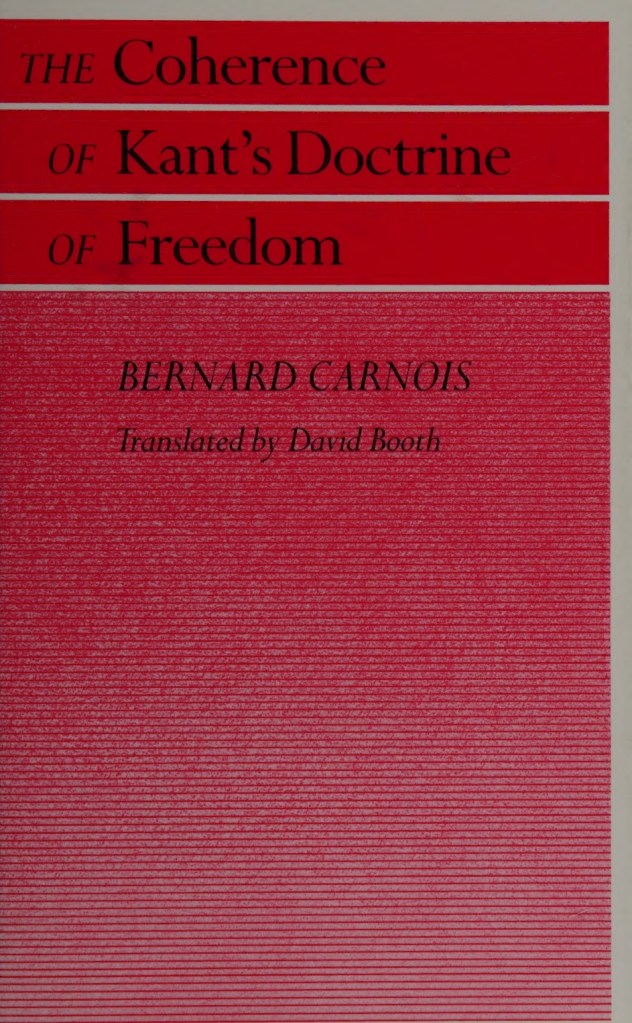
The Coherence of Kant’s Doctrine of Freedom by Bernard Carnois, as translated by David Booth, is an examination of one of the most pervasive concepts in Immanuel Kant’s philosophy: the idea of freedom. The term ‘freedom’ permeates Kant’s philosophical corpus, appearing in contexts as varied as cosmology, morality, and theology. It is a concept that both anchors and challenges the coherence of Kant’s system, demanding an interpretation that can reconcile its disparate uses and implications. Carnois’s work is an ambitious attempt to synthesize these diverse meanings into a coherent and systematic framework, addressing not only the internal consistency of Kant’s thought but also its overarching unity.
In the book Carnois undertakes the formidable task of organizing Kant’s varied usages of freedom into a logical and systematic structure, which he refers to as a “grammar.” This conceptual grammar serves as a tool to isolate and define the individual meanings of freedom in Kant’s work, enabling Carnois to explore their implications and delineate their boundaries. At the core of this investigation is the question of whether Kant’s multifaceted concept of freedom can be rendered coherent without compromising the unity of his philosophical system. Carnois’s method is rigorous and analytic, yet it is also attuned to the dynamic and evolving nature of Kant’s thought. This dual approach allows Carnois to trace the development of Kant’s concept of freedom across different works and periods, while also evaluating the coherence of the doctrine as a whole.
Carnois begins his exploration by addressing the concept of transcendental freedom, which emerges within the context of Kant’s theoretical philosophy. Transcendental freedom is a problematic concept, appearing as part of the cosmological inquiries in the Critique of Pure Reason. It arises in the Third Antinomy, where Kant confronts the apparent conflict between the deterministic laws of nature and the possibility of free causality. This tension between determinism and freedom is not merely an external contradiction imposed on reason but rather originates from within the very structure of rational inquiry itself. The antinomy poses a fundamental challenge: how can the causal order of the natural world be reconciled with the idea of a spontaneous, unconditioned cause that initiates a series of events?
Carnois argues that Kant’s notion of the intelligible character plays a crucial role in resolving this tension. The intelligible character refers to the aspect of the self that is not determined by empirical conditions but is instead governed by rational principles. It is through this concept that Kant attempts to bridge the gap between transcendental freedom, as a speculative idea, and practical freedom, which is evidenced by our moral experience. Practical freedom, for Kant, is not merely a theoretical possibility but a fact of reason—an undeniable reality that underlies our moral judgments and actions. Carnois analyzes how Kant synthesizes these two forms of freedom, showing that while transcendental freedom remains a challenging and somewhat ambiguous notion, it finds its proper expression and validation in the domain of practical reason.
The next stage of Carnois’s analysis focuses on the concept of autonomy, which is central to Kant’s moral philosophy. Autonomy, for Kant, is the idea that the will is not subject to any external law but instead gives the law to itself. This self-legislation is what constitutes moral freedom, and it is the foundation of Kant’s deontological ethics. Carnois explores how Kant’s doctrine of autonomy develops from the idea of practical freedom and how it is articulated within the framework of the moral law. He shows that autonomy is not simply a formal principle but is deeply interconnected with the concept of duty and the categorical imperative. The moral law, in its universality and necessity, is both the expression and the guarantee of our freedom. Carnois’s analysis illuminates the connection between freedom and morality in Kant’s thought, demonstrating that for Kant, to be free is to act in accordance with the moral law that one has autonomously chosen.
However, Carnois does not shy away from the complexities and challenges that arise within Kant’s doctrine of freedom. One of the most intriguing aspects of his analysis is his exploration of the role of negativity in Kant’s idea of freedom. Freedom, for Kant, is not only the capacity to initiate a series of events or to act according to the moral law; it is also deeply marked by the limitations and imperfections of human finitude. Carnois investigates how Kant’s concept of freedom entails a dialectical process in which freedom posits itself but then inevitably denies itself, only to preserve the possibility of its regeneration. This dynamic of self-affirmation and self-negation introduces a kind of “history” of freedom, where human freedom is always at risk of being compromised but is also constantly striving towards its own fulfilment.
Carnois’s work is distinguished not only by its depth of analysis but also by its engagement with the broader Kantian scholarship, particularly within the French philosophical tradition. The book introduces English-speaking readers to a wealth of French Kantian scholarship that has previously been inaccessible, enriching the global understanding of Kant’s philosophy. Carnois’s interpretation of Kant is a trenchant analysis of the relationship between ethical commitments and metaphysical assumptions. In examining how Kant’s ideas on freedom intersect with his broader metaphysical and theological commitments, Carnois offers insights that are relevant to moral, religious, and political philosophy.
The Coherence of Kant’s Doctrine of Freedom by Bernard Carnois is a helpful contribution to Kant scholarship. It offers a comprehensive interpretation of one of the most complex and pivotal concepts in Kant’s philosophy. Carnois’s work demonstrates that Kant’s concept of freedom, despite its apparent diversity and complexity, can be rendered coherent within the framework of his critical philosophy. By systematically organizing and analysing the different senses of freedom in Kant’s work, Carnois provides a unified account that respects both the depth and the dynamism of Kant’s thought. This book is essential reading for anyone interested in Kant, freedom, or the relationship between ethics and metaphysics.
 Simon Gros
Leave a comment