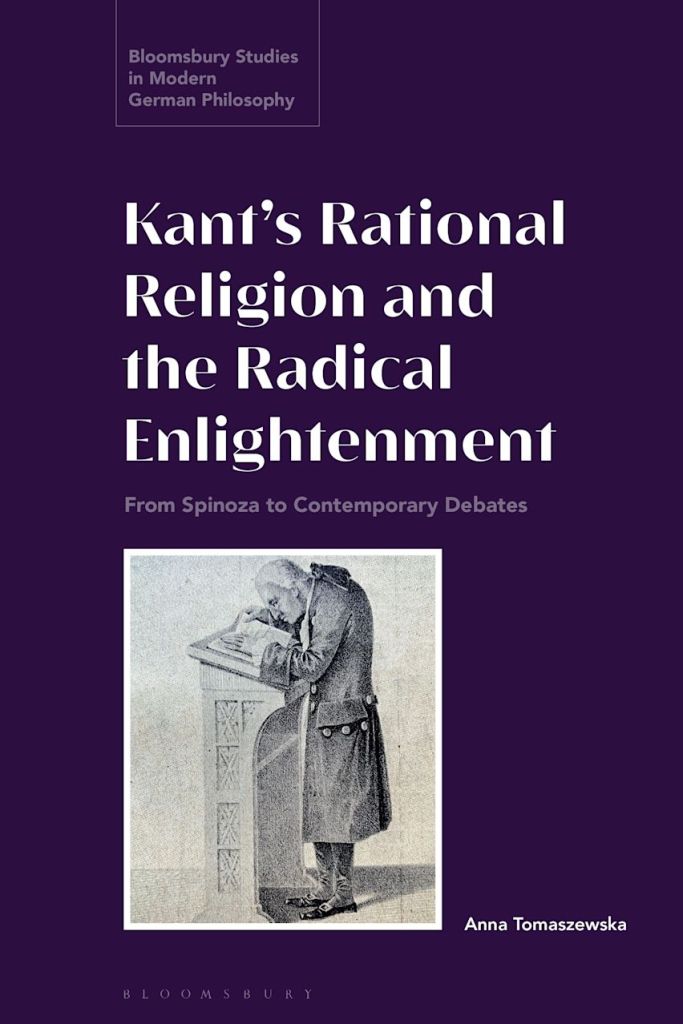
Anna Tomaszewska’s Kant’s Rational Religion and the Radical Enlightenment offers a transformative examination of Immanuel Kant’s engagement with religion, situating his theological and philosophical perspectives within the broader context of Enlightenment thought. The book challenges the prevailing view of Kant as a moderate Enlightenment thinker who sought merely to reconcile faith with reason. Instead, Tomaszewska argues that Kant’s approach to religion aligns more closely with the radical Enlightenment, particularly the ideas originating from Baruch Spinoza and his followers, who critiqued traditional divine revelation.
Tomaszewska’s analysis hinges on a sophisticated reconceptualization of Kant’s religious philosophy, which she explores through three primary dimensions: epistemological, ethical, and political. Her argument is that Kant’s defence of religion, far from being a conservative attempt to harmonize faith with rationality, actually involves a radical rationalization of religion’s core tenets. This rationalization seeks to establish morality as the essence of religious faith, positioning Kant not as a reconciler but as a thinker engaged in a more profound critique and reconfiguration of religious concepts.
In her detailed examination, Tomaszewska demonstrates how Kant’s theological stance shares significant affinities with early modern rationalists and German Spinozists. She suggests that Kant’s religious thought, while ostensibly accommodating faith within the framework of Enlightenment reason, also reflects a deeper engagement with Spinoza’s critique of divine revelation. This connection implies that Kant’s philosophical project includes a secularizing tendency, rooted in an attempt to rationalize rather than uproot Christianity, thereby influencing contemporary political philosophy.
The book addresses how Kant’s rational religion differs from and relates to Spinoza’s radical Enlightenment views. Tomaszewska shows that, despite Kant’s efforts to reconcile religion with reason, his theology can be seen as an extension of the radical Enlightenment’s critique of supernatural claims and religious dogma. Kant’s rationalism, according to Tomaszewska, emerges not as a simple moderate position but as a complex balance between preserving certain religious forms and subjecting them to rational scrutiny.
A key aspect of Tomaszewska’s analysis is her focus on Kant’s treatment of freedom of thought versus freedom of belief. She argues that Kant prioritizes critical engagement and rational assessment of religious beliefs over an uncritical acceptance of these beliefs. This perspective, she contends, reflects a secularizing impulse within Kant’s thought, aligning him with radical Enlightenment thinkers who sought to reform or even reject traditional religious institutions and doctrines.
Tomaszewska’s book engages deeply with Kant’s pre-critical writings, particularly his early proofs of God’s existence, and positions them against the backdrop of Spinoza’s influence. She critically assesses the notion that Kant’s early work reflects a Spinozist metaphysical framework and contends that Kant’s critical philosophy represents a departure from theistic metaphysics, emphasizing moral autonomy over divine causation.
The book also explores Kant’s critique of Spinoza, particularly the portrayal of the “virtuous atheist” and the concept of Schwärmerei (enthusiasm) in Kant’s texts. Tomaszewska highlights Kant’s complex relationship with atheism and his attempt to differentiate his rational religion from Spinoza’s more radical critiques. Kant’s notion of “moral faith” is examined as a form of belief that maintains ethical values independent of theological doctrines.
In juxtaposing Kant’s and Spinoza’s views on theory and practice, Tomaszewska reveals their shared commitment to the primacy of practical reason. She contrasts Spinoza’s emphasis on the unity of action and cognition with Kant’s own focus on practical rationality as a means of moral and political guidance. This comparison reveals how both philosophers integrate ethical considerations into their understanding of rationality and religion.
Tomaszewska’s discussion extends to Kant’s “rational church” concept, which redefines religious institutions as ethical communities rather than traditional ecclesiastical authorities. Kant’s vision of a church aligned with rational morality represents a significant departure from conventional religious institutions, reflecting his commitment to Enlightenment values while still engaging with the religious sphere.
The book’s final chapters delve into Kant’s Opus postumum and the apparent contradictions in his late theological work. Tomaszewska argues that Kant’s identification of God with practical reason does not diminish the role of the divine in his ethical framework. Instead, it underscores the idea of God as a moral legislator, essential for the concept of autonomy and the ethical community.
Tomaszewska’s Kant’s Rational Religion and the Radical Enlightenment provides a profound and original analysis of Kant’s engagement with religion. By positioning Kant within the radical Enlightenment tradition and examining his relationship with Spinoza’s thought, Tomaszewska offers new insights into the secularizing trends of Enlightenment philosophy and its impact on contemporary political and religious debates.
 Simon Gros
Leave a comment