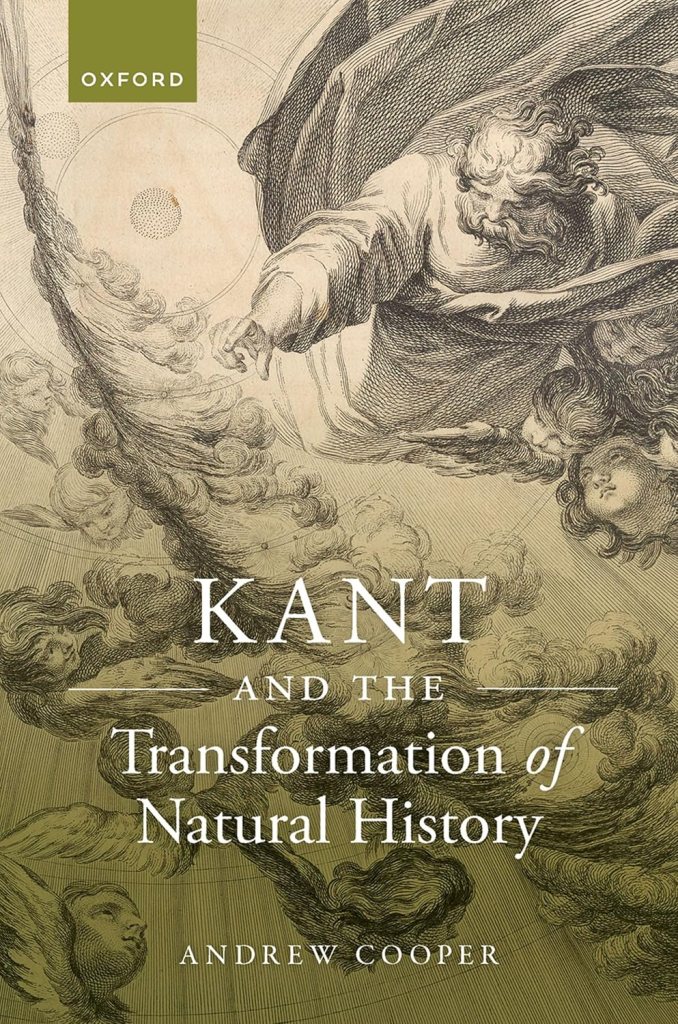
In Kant and the Transformation of Natural History, Andrew Cooper offers an analysis that places Kant’s contributions within a broader context of the Enlightenment’s intellectual upheavals. This scholarly work presents the first systematic examination of Kant’s conceptualization of natural history, arguing that Kant’s influence on the field was both profound and transformative, yet also deeply complex and fraught with contradictions.
Cooper’s study argues that Kant’s contributions to natural history are often overshadowed by his more celebrated works on metaphysics and epistemology. However, Cooper insists that Kant’s philosophical innovations in natural history were crucial in shaping the trajectory of modern scientific inquiry. The book contends that Kant played a decisive role in moving natural history from a purely descriptive endeavour into a more rigorous and systematic discipline, influenced by his integration of Newtonian mechanics and quasi-Leibnizian metaphysics.
Central to Cooper’s argument is the assertion that Kant’s conception of natural history was inherently “universal,” aiming to offer a comprehensive and dynamic understanding of nature. This approach diverged significantly from the static and taxonomic perspectives that predominated in the pre-Enlightenment period. Kant’s work, according to Cooper, represented a significant shift towards understanding natural phenomena as products of historical and temporal processes. By incorporating the dimension of time into the analysis of natural history, Kant helped establish a framework that could address not just static classifications but also the development and transformation of natural objects over time.
Cooper challenges the prevailing interpretation that Kant’s theory of science denies the possibility of a developmental conception of nature. Instead, he argues that Kant’s approach provided a method by which natural historians could genuinely engage in historical disputes and potentially achieve consensus. This method was not merely an academic exercise but a practical tool for scrutinizing and refining historical claims about the natural world. Cooper’s book thus highlights Kant’s contribution to the evolution of natural history as a discipline capable of addressing the complexities and dynamism of nature in a more robust manner than had been previously possible.
An important aspect of Cooper’s analysis is his critical examination of Kant’s views on race, which he argues are deeply problematic and reflect a broader tension within Kant’s philosophical project. While Kant’s natural history aimed to provide a universal framework for understanding natural phenomena, his work also embedded certain racial assumptions that are now recognized as racist. Cooper scrutinizes how Kant’s concept of race was influenced by and in turn influenced the broader intellectual and scientific currents of his time. This examination reveals a disconcerting aspect of Kant’s work: despite his philosophical advancements, he also perpetuated racial prejudices, which Cooper addresses with a critical perspective that seeks to untangle Kant’s scientific contributions from his more troubling ideological positions.
In the book Cooper engages deeply with Kant’s extensive writings and lectures, demonstrating how Kant’s theories on natural history were informed by and responded to the evolving scientific and philosophical landscapes of the eighteenth century. Cooper’s study situates Kant within a broader narrative of scientific transformation, illustrating how his work contributed to, and was influenced by, the broader shifts from mechanical to more dynamic conceptions of nature.
The book also addresses how Kant’s critical philosophy, particularly his notions of the regulative use of reason, intersects with his views on natural history. Cooper argues that Kant’s critical turn did not merely retreat from his earlier, more expansive natural history but rather reconfigured it in light of his evolving epistemological and metaphysical concerns. By grounding historical reasoning in universal laws and rejecting metaphysical speculation, Kant sought to provide a more rigorous and systematic approach to natural history, even as he grappled with the limitations and challenges inherent in studying living and evolving natural phenomena.
Cooper’s detailed analysis extends to Kant’s engagement with various scientific debates of his time, such as those concerning the extension of Newtonian mechanics to biological and geological phenomena. By exploring Kant’s responses to these debates, Cooper sheds light on how Kant’s philosophy was not only a reaction to but also a participant in the transformative scientific developments of the Enlightenment. This engagement underscores Kant’s role in shaping the methodological and epistemological foundations of natural history, even as his work was intertwined with the prejudices and limitations of his era.
Andrew Cooper’s work is a significant scholarly contribution that offers a critical perspective on Kant’s role in the development of natural history. By elucidating Kant’s contributions and limitations, Cooper provides valuable insights into the evolution of scientific thought and the complex interplay between philosophical inquiry and empirical investigation. The book stands as a critical resource for both Kant scholars and historians of science, offering a profound reflection on the intersections between philosophy, natural history, and the broader intellectual currents of the Enlightenment.
 Simon Gros
Leave a comment